then Add to Home Screen.
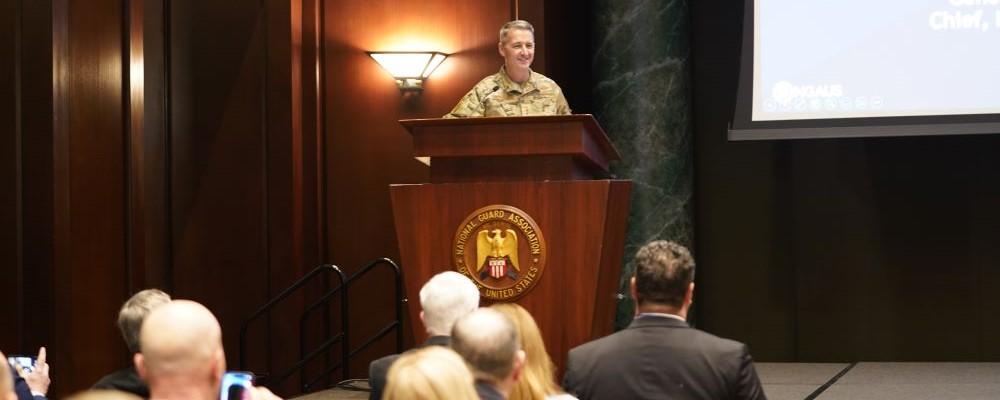
The National Guard’s member on the Joint Chiefs of Staff told nearly 200 defense industry representatives that they are critical to keeping the U.S. military more capable than its potential adversaries.
Gen. Steven Nordhaus, the chief of the National Guard Bureau, told attendees at the 28th annual NGAUS Industry Day that it’s the defense industry that provides the equipment that enables the U.S. military to successfully conduct recent operations like Absolute Resolve in Venezuela and Midnight Hammer in Iran.
“To quote [Gen. Dan Caine] the chairman [of Joint Chiefs] … nobody else could do what our nation did,” Nordhaus said. “But we can't rest on that. We have to be able to move out in pace and speed so that we’re constantly staying ahead and getting the latest and greatest weapon systems into our warfighters.”
The event was held at the National Guard Memorial, the association’s headquarters in Washington, D.C.
Nordhaus told attendees that they are a part of what Secretary of War Pete Hegseth now calls “The Arsenal of Freedom,” a nationwide initiative aimed at revitalizing America’s defense industrial base.
The effort emphasizes “peace through strength,” urging rapid, “go hard and go fast” domestic manufacturing.
Nordhaus advised his audience to see the Guard as able partners in the effort.
“Our leaders are innovative through our people who combine a warfighting mindset and extensive warfighting and homeland experience,” he said. “This provides a military with a direct infusion of private sector expertise and an entrepreneur mindset; we offer unique opportunities to the innovation ecosystem.”
He cited as an example the Air National Guard Air Force Reserve Command Test Center in Tucson, Arizona. Since 1981, it has found ways to use commercial-off-the shelf equipment to inexpensively keep older aircraft in the fight.
An attendee asked if the new National Defense Strategy’s emphasis on the Western Hemisphere would affect priorities “in the acquisition of weapon systems.”
“If we’re ready for combat, we're ready for anything,” he answered, “and when we think about being ready, we always have to get ready for the most complex and hardest environments that we’re going to face. … We can’t let that [capability] gap close at all. We have to find ways to open that gap.
— By John Goheen