then Add to Home Screen.
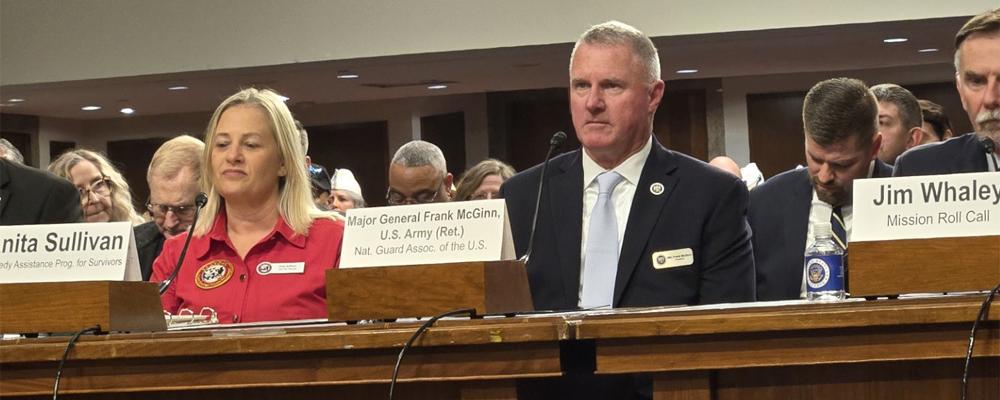
The association president told lawmakers last week about the inequities National Guard Soldiers and Airmen too often face due to an obsolete duty-status system.
Retired Maj. Gen. Francis M. McGinn said more than 40,000 Guardsmen were mobilized and on duty as he testified March 4 before a joint hearing of the House and Senate Veterans’ Affairs committees.
“In many of these missions,” he said, “National Guardsmen serve shoulder to shoulder with active-component forces, performing the same duties, under the same conditions and facing the same risks. Yet too often, they do so under duty statuses that provide significantly less pay and benefit protection.”
McGinn attributed the disparity to “a complex and outdated patchwork of more than 30 distinct duty statuses, many of which were created for a different era. In practice, this system allows orders to be structured in ways that deny Guardsmen access to housing allowances, medical coverage and education benefits.”
The damage to quality of life eventually erodes retention and, ultimately, readiness, he explained.
“Readiness is not just equipment and training; it is people willing and able to answer the call,” McGinn said.
None of this is news, he added. The fiscal 2016 National Defense Authorization Act directed the Pentagon to submit a Duty Status Reform legislative proposal.
“Since then, multiple iterations have been developed but have not advanced, largely due to interagency concerns about benefit alignment,” McGinn said. “While studies and discussions have continued, the operational reality has only intensified.”
Today, the Duty Status Reform Act (H.R. 6976) is before Congress. It reduces the more than 30 duty statuses to four.
McGinn asked the veterans’ committees to fully support the House legislation and support the introduction of a companion bill in the Senate.
“Duty Status Reform is not about expanding benefits indiscriminately,” he added. “It is about aligning duty status authorities with how the National Guard is used today.”
Eight military and veterans service organizations — including NGAUS — testified at the hearing, which was an opportunity to outline objectives for congressional deliberations on fiscal 2027 legislation.
The way credit is determined toward eligibility for the Post-9/11 GI Bill is another, McGinn said.
“Again, Guard and Reserve members routinely serve alongside active-component forces, often under identical conditions and performing the same duties,” he said. “Yet many periods of service still do not qualify for Post-9/11 GI Bill credit, particularly when members serve under certain Title 32 authorities or short-duration orders that fall outside qualifying thresholds.”
“This creates a disparity that is increasingly difficult to justify,” he added.
The Guard and Reserve GI Bill Parity Act (H.R. 1423 and S. 649) would count every day a Guardsman or Reservist spends in a federal status towards eligibility.
Rep. Mark Takano of California, the ranking Democrat on the HVAC and a co-sponsor of the bill in the House, asked McGinn how important it is for Congress to pass the legislation.
“It's imperative,” the NGAUS president replied.
“If you're flying a UH-60 Black Hawk helicopter during your weekend drill or your two weeks of annual training, how is that different service than someone on active duty flying one?” he asked back. “It’s the same service. It's the same risk. A day in uniform, regardless of your status, should be a day that counts towards the Post-9/11 GI Bill.”
McGinn also stressed the importance of congressional oversight in the development of a reserve component–specific track within the Transition Assistance Program.
He explained that unlike active-component members who transition completely and only once from uniformed service to civilian life, most Guardsmen and Reservists do not separate from military service at the same time they transition from active-duty orders. They may also do it several times over the course of a career.
Therefore, Guardsmen and Reservists have very different transition needs than their active-component counterparts.
Congress recognized this gap, he said, in the fiscal 2025 NDAA and directed the Pentagon to develop a reserve component–specific track within TAP.
But “without deliberate oversight, there is a risk that a reserve component track becomes a repackaged version of the active model rather than a truly tailored program,” he added.
McGinn’s written testimony from the hearing is available here.
— By John Goheen