then Add to Home Screen.
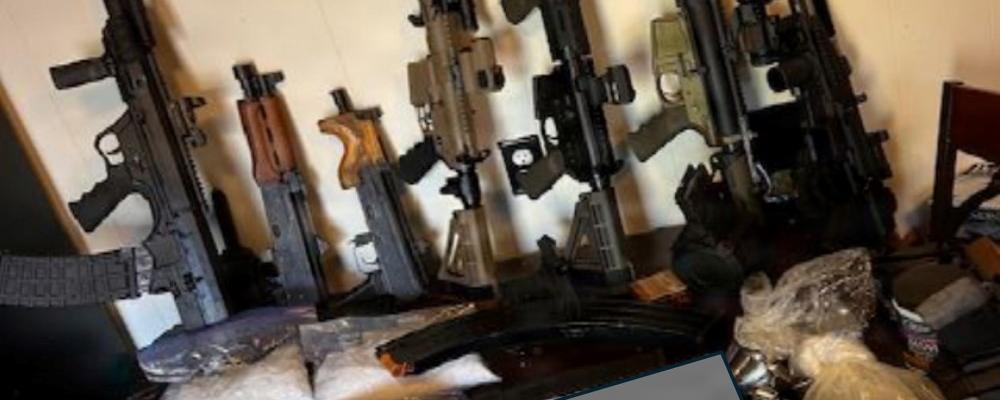
Members of the Georgia National Guard Counterdrug Task Force assisted state and local law enforcement agencies in an investigation that resulted in the seizure of more than 13 kilograms (nearly 29 pounds) of fentanyl, cocaine and other drugs, along with 10 firearms, cash and other property (pictured above).
“Roughly 220 Americans are dying a day from fentanyl,” said Lt. Col. Matt Howard, the head of the task force. “The leading cause of death right now between 18- and 45-year-olds is synthetic drug overdose — not disease, not car accidents, not gun violence — and that is something that I think is beatable.”
State and local law enforcement led the investigation, which concluded March 26, with the task force in a support role.
“We’re not cops,” Howard said. “We don’t have a badge and we don’t make arrests.”
Instead, said Howard, the task force provides support on the back end with analysis, mission planning, reconnaissance and demand-reduction efforts.
For the March case, task force members conducted more than 60 hours of vehicle reconnaissance while also advising partner agencies on observation strategies and communication plans, said Howard.
He added that much of that effort was headed up by one individual on the task force — Master Sgt. Troy Gonzalez.
“Later on that day, based on information from that case, he supported an operation that got an additional five kilos of meth related to that initial case,” Howard said. “You’re really talking about a person that’s making an actual difference.”
The task force is part of the larger National Guard Counterdrug Program, which includes similar task forces in every state that bolster law enforcement efforts to disrupt and dismantle drug trafficking and transnational criminal networks.
Guard counterdrug efforts are organized differently in each state based on individual state needs and requirements. Those in the program all serve on Title 32 state orders under the governor’s authority.
Overall, Howard said, the program assists by providing support that otherwise may not be available.
“I’ve worked with law enforcement agencies that have like 12 people counting the secretary,” he said. “They don’t have helicopters. They don’t have an analysis person.”
That’s where the Guard comes in.
“We only work on narcotics cases, but we provide assistance to those individual agencies that really pays in dividends,” Howard said. “We have experience that is militarily unique that can really help these local agencies kind of flourish.”
One way is by connecting agencies, Howard said.
“I think we are sometimes the bridge between elements or agencies where we can get folks to kind of work together,” he said. “I think we’re really the trusted brokers.”
A lot of that comes from the mix of military and civilian-acquired skills Guardsmen bring with them, Howard said, using Gonzalez, who headed the task force support during the March investigation, as an example.
“You got a guy who’s walking in, that’s this enabler from Counterdrug, who served as a law enforcement officer in the past, served as fireman in the past, was in the Army, and is now in the Air Force,” he said. “A lot of the GBI [Georgia Bureau of Investigation] guys that he was working with, he actually trained when he was a cop.”
That helps make connections and allows him to “kind of serve as an outside mentor” with the goal of a larger impact on the illicit drug trade.
Howard said the March investigation is representative of typical support.
“It's an impressive case, but it's kind of par for the course,” he said, adding that last year counterdrug task force efforts in Georgia supported the seizure of 89 million lethal doses of fentanyl. About 3 milligrams is considered lethal.
—By Sgt. 1st Class Jon Soucy,
National Guard Bureau