then Add to Home Screen.
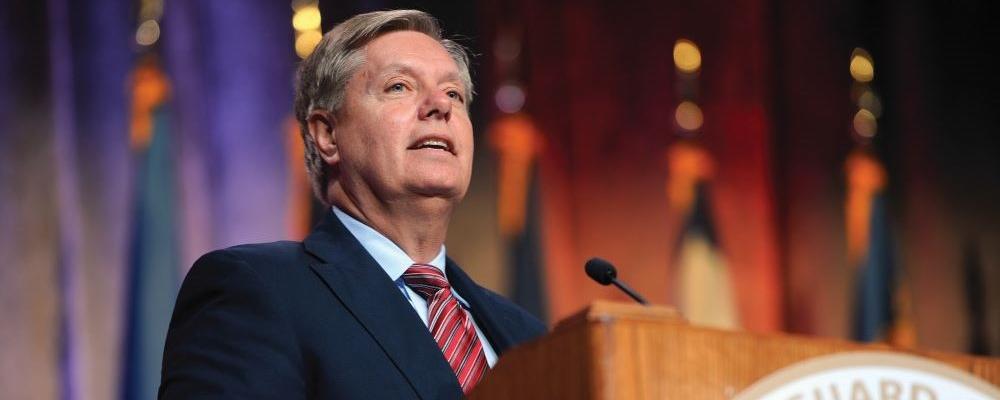
Sen. Lindsey Graham, R-S.C., a former South Carolina Air National officer and the co-chair of the Senate National Guard Caucus since 2010, died Saturday. He was 71.
He died unexpectedly from an aortic dissection, a tear in the main artery, according to a preliminary report from the Washington, D.C. medical examiner.
The four-term senator had returned only hours earlier from a trip to Ukraine, where he sought to negotiate new sanctions against buyers of Russian oil.
Graham is probably best known as the co-sponsor of 2011 Senate legislation that was instrumental in securing a seat for the chief of the National Guard Bureau on the Joint Chiefs of Staff.
“Senator Graham was one of us,” said retired Army Maj. Gen. Francis M. McGinn, the NGAUS president. “The seat at the table tops a long list of significant contributions to our force. The National Guard has lost a great champion.”
Retired Army Maj. Gen. Gus Hargett, the association president from 2010 to 2017, said Graham did more than just introduce the Guard Empowerment bill in 2011.
“The Guard wouldn’t be on the Joint Chiefs without Lindsey Graham,” Hargett said. “His energy and personality were the difference.”
Hargett and other Guard leaders say a Senate Armed Services Committee hearing in November 2011 cemented the victory in the Senate.
Senate opponents had devised the hearing to blunt the effort. Every standing member of the Joint Chiefs of Staff testified against the legislation. Some were adamantly opposed. Only Gen. Craig R. McKinley, the NGB chief and a regular “invitee” to JCS meetings, spoke in favor.
A gifted litigator, Graham held the hearing spellbound for seven minutes, repeatedly coercing opponents on the panel to make his case.
He got Army Gen. Martin Dempsey, the JCS chairman, to admit the nation is under constant threat of natural disasters, the Guard was the military’s first responders at home and the JCS had no contact with the adjutants general.
Dempsey also admitted he could tell the NGB chief “to get out of the room.”
“At the end of the day,” Graham said looking at McKinley, “you need to be in the room with some weight behind you, not just an invitation.”
McKinley later said Graham gave the SASC a “civics lesson.”
Within hours, two senators who had been on the fence announced their support, and the bill breezed to inclusion in the fiscal 2012 National Defense Authorization Act.
“I think that the decision to make the Guard part of the Joint Chiefs was a good decision — it stood the test of time,” he told NATIONAL GUARD in May 2024. Institutionally, everybody was against it until they weren’t. That was sort of a lot of fun.”
Before his nearly 24 years in the Senate, Graham spent eight years in the U.S. House of Representatives.
NGAUS presented him with the Harry S. Truman Award, the association’s highest honor in 2005 — well before he became the co-chair of the Senate National Guard Caucus.
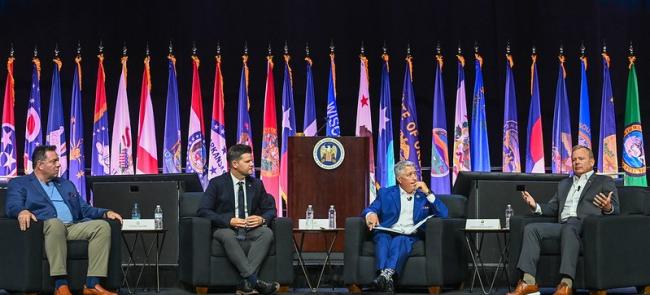
He spoke at the NGAUS conference in 2014 (above) in Chicago and 2016 in Baltimore.
His uniformed service spanned 33 years, beginning in 1982, immediately after graduating from the University of South Carolina School of Law. He commissioned as an officer in the Judge Advocate General’s Corps and served on active duty until 1988.
He transitioned to the South Carolina Air Guard in 1989 and was called to active duty during the first Gulf War to prepare troops for deployment.
Graham joined the Air Force Reserve in 1995 upon being elected to the House and frequently completed brief active-duty stints in Iraq and Afghanistan during the Global War on Terror.
He retired as colonel. He held his retirement ceremony June 24, 2015, at the National Guard Memorial, the NGAUS headquarters in Washington, D.C.
Among those in attendance were several of his Senate colleagues from both sides of the aisle, retired Gen. David Petraeus, who commanded troops in Iraq and Afghanistan, and then-Vice President Joe Biden, who has served in the Senate for many years with Graham.
—By John Goheen