then Add to Home Screen.
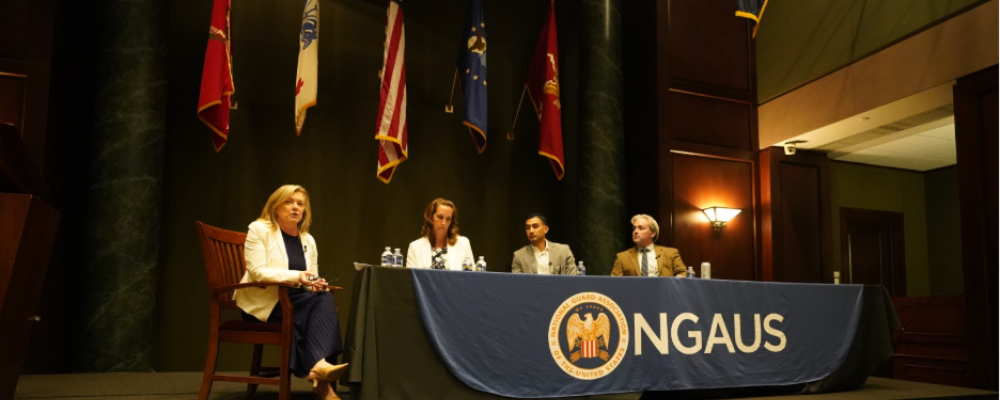
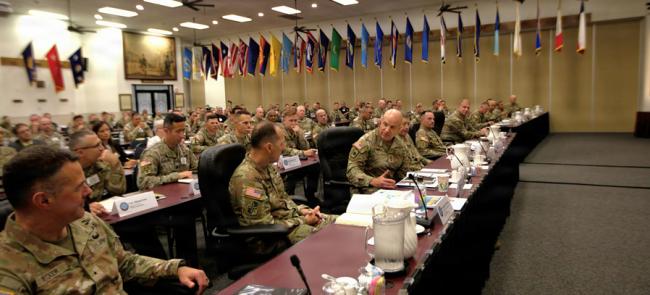
Congressional staffers and officials of veteran and military service organizations gathered at the National Guard Memorial on Monday to participate in a Mental Health Symposium hosted by NGAUS.
Retired Army Maj. Gen. Francis M. McGinn, the association’s president, said the symposium was a continuation of NGAUS efforts to highlight the “very important topic” of mental health and some of the unique challenges it poses to Guardsmen.
“The mental health challenges of the Guard is probably more difficult than in the active because we don’t have the resources,” said McGinn.
“In reality, it produces pressures that we don’t always see,” he added.
In January, NGAUS participated in the Washington, D.C. premiere of Sheepdog, a movie focused on post-traumatic growth.
As McGinn noted, the film’s producer and director, Steven Grayhm will participate in a panel discussion of post-traumatic growth at the 148th General Conference & Exhibition, Aug. 28-31 in Indianapolis.
The three panels Monday touched on different aspects of the issue, including The Guard Reality – Serving in Two Worlds, Policy and System Gaps, and Building Better Support Systems.
Reps. Zach Nunn, R-Iowa and Sheri Biggs, R-S.C., provided brief remarks at the conclusion.
Chief Master Sgt. Monica Aragon, the senior enlisted advisor to the joint staff at the Maryland Air National Guard, delivered the keynote speech focused on her personal story of facing mental health adversity in her family.
She said she “had no idea how to navigate” her situation after her husband separated from the Air Guard after 14 years of service, with his final role as a remotely piloted aircraft pilot.
“The battle rhythm has changed” with the Guard serving as a 24-hour a day, seven days a week operational force said Aragon. “Mental health struggles don’t wait until drill weekend.”
Aragon did speak about the improvement of Guard care in recent years, including the Maryland National Guard’s Old Line Resilience campaign. She stressed everybody has a role to play in protecting those facing adversity. She noted 67 Guardsmen died by suicide in the first six months of the year.
The first panel was moderated by Terri Taenilian of RAND, a nonprofit institution often used to research and develop policy, including on military mental health.
Retired Command Sgt. Maj. John Gipe, the EANGUS president, said of the first panel topic, “[Guardsmen] don’t live separate lives in two worlds, but live one life trying to do two jobs.”
Josh Hilewitz, a retired Army aviator and former Texas Guardsmen who was also on the panel, added, “navigation of three different lives … the family unit is critical.”
Jon Eisberg, the NGAUS vice president for government affairs and Julian Plamann, the NGAUS deputy director of government affairs moderated the other panels.
Participants spoke about the unique or rather complex system Guardsmen face when dealing with either their own mental health or that of a loved one.
Susan Starnes, integrated primary prevention manager at the Maryland Air Guard, went so far as to call family members “force multipliers.”
Plamann said of the many challenges in the Guard, “we don’t fit into one-size fits all … it’s about meeting people where they’re at.”
Other panel guests included congressional and VA staff members, along with area CEOs.
Nate Guajardo, the national security adviser for Sen. Richard Blumenthal, D-Conn., talked about “the massive knowledge gap in what is available for the Guard.”
Chris Bennett, professional staffer for the House Veterans Affairs Committee, went further saying, “I think it comes down to the duty status problem … working off a [decades old] model of the Guard being a strategic reserve.”
Both Guajardo and Bennett shared some of their personal experiences away from Capitol Hill having served in the Guard.
On the topic of readiness, John Wordin, the chief executive of LifeScore, a whole-health wellness platform, said, “Really, I’d say resilience is readiness.”
Nunn, himself, a former Guardsmen who currently serves as a colonel in the Air Force Reserve, talked of his “enduring commitment to help our Guardsmen.”
Biggs said she “saw a lot of brokenness when I was in the Middle East in 2018” as a nurse with the Mississippi Air National Guard.
The event was conceived by Alex Scaffo, a former New Jersey Army Guardsmen and HillVets fellow at NGAUS.
Video of the symposium can be found here.
—By Rich Arnold
PHOTO: (from left) Terri Tanielian, senior adjunct behavior and social scientist at RAND; Susan Starnes, the integrated primary prevention manager of the Maryland Air National Guard; Nate Guajardo, the national security advisor for Sen. Richard Blumenthal, D-Conn.; and Chris Bennett, professional staff member for the House Veterans Affairs Committee