then Add to Home Screen.
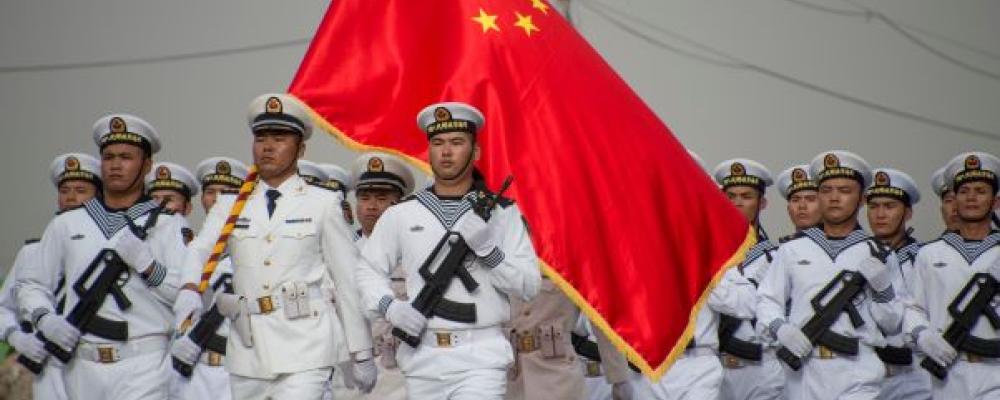
China’s military modernization poses a direct and growing threat to U.S. security, according to a new Pentagon assessment released last week.
The Department of War’s required annual report on the People’s Liberation Army describes Beijing’s recent military expansion as “historic,” noting plans to field six additional aircraft carriers by 2035, bringing its total to nine — just behind the U.S. fleet of 11.
As stated in the report, China’s nuclear warhead arsenal remained in the “low 600s” in 2024, reflecting slower growth than in previous years, but the Pentagon projects it will exceed 1,000 warheads by 2030.
Beijing has also advanced its early warning and counterstrike capabilities, enabling faster retaliatory responses, even before incoming warheads can detonate.
China’s military focus is currently on the First Island Chain that runs from the Japanese archipelago to the Malay Peninsula. Beijing recognizes this region as the strategic center of gravity for its goals in the region.
President Xi Jinping frames these developments as part of his goal to build a “world class” military capable of rivaling the United States by 2049. China’s reported defense budget grew 5.2% from 2023 to 2024, though the Pentagon notes that official figures likely understate total military spending.
This rapid military expansion has increased risks to the U.S. homeland as Beijing now fields a substantial, and growing, arsenal of nuclear, maritime, long range strike, cyber and space systems capable of threatening U.S. security.
Cyber-espionage has become an effective military weapon. In 2024, cyber espionage operations such as Volt Typhoon penetrated U.S. critical infrastructure, disrupting U.S. military operations and harming national interests.
The PLA continues progressing toward its 2027 objectives: achieving decisive victory over Taiwan, establishing strategic parity with the United States in nuclear and other strategic domains, and deterring neighboring countries.
Xi has instructed the PLA to be prepared to seize Taiwan by 2027 and has studied Russia’s failures in Ukraine to refine China’s own operational planning and modernization efforts.
To this end, the PLA is refining multiple contingency options to forcibly “reunify” Taiwan, including an amphibious invasion, large scale firepower strikes and potentially a maritime blockade.
Throughout 2024, the PLA exercised components of these scenarios, including strikes on sea and land targets, simulated attacks on U.S. forces in the Pacific, and operations blocking access to key ports.
The report also highlights China’s deepening but cautious strategic partnership with Russia, driven by a shared interest in countering the United States. Yet mutual distrust continues to limit the relationship for the time being.
The overall threat assessment comes as Washington and Beijing have shown signs of renewed diplomatic engagement.
President Donald Trump recently accepted an invitation to visit China in April and has invited Xi for a state visit later next year. Trump described the bilateral relationship as “extremely strong” and emphasized the importance of frequent communication and the ability to “set our sights on the big picture.”
At the same time, the Joint Force will remain prepared to defend U.S. interests in the Indo Pacific. Deterrence through strength — rather than confrontation — will remain the Pentagon’s priority.
—By Michael Metz