then Add to Home Screen.
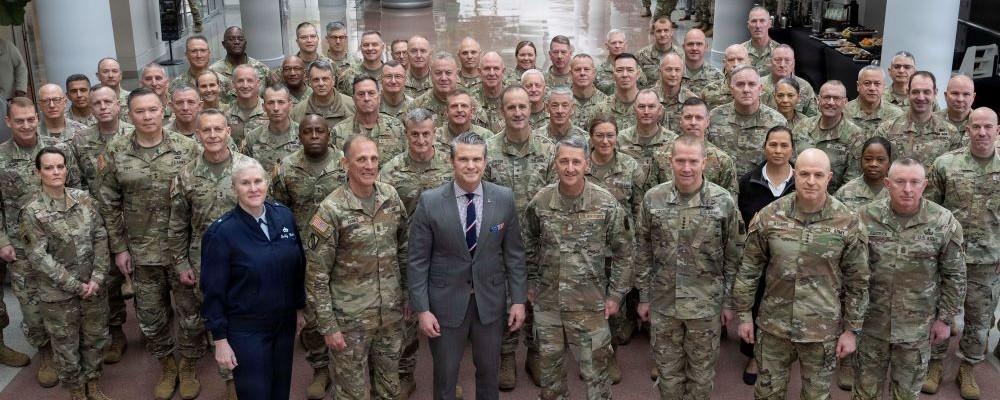
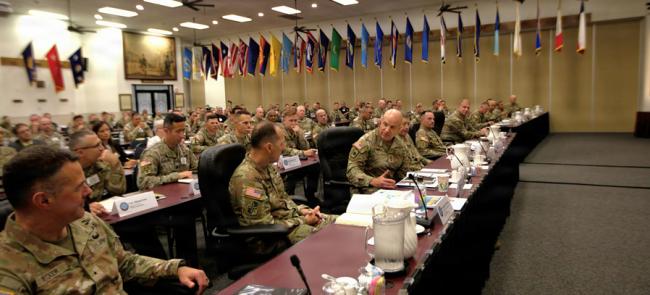
Secretary of War Pete Hegseth underscored the Department of War’s top priorities in a meeting with National Guard leaders Feb. 25 at the Herbert R. Temple Army National Guard Readiness Center in Arlington, Virginia.
They are restoring the warrior ethos, rebuilding the military and reestablishing deterrence.
In attendance were the adjutants general and Air Force Gen. Steven Nordhaus, National Guard Bureau chief, Army Gen. Thomas Carden, NGB vice chief and Senior Enlisted Advisor John Raines.
The adjutants general were in the Washington, D.C., area this week for their annual three-day winter meeting. They met Monday and Tuesday at the National Guard Memorial, the NGAUS headquarters, as the Adjutants General Association of the United States.
During the Feb. 25 meeting, Hegseth outlined the Guard’s critical alignment with the 2026 National Defense Strategy — the Pentagon’s guiding document for implementing the core pillars of President Donald Trump’s National Security Strategy: America first, peace through strength and common sense.
Hegseth praised the “great work being done” by the Guard in support of the NDS, which prioritizes homeland defense first, deterring China in the Indo-Pacific region through strength rather than confrontation, increasing burden-sharing with allies and partners and supercharging the U.S. defense industrial base.
“This group is central to reestablishing the United States’ deterrence,” Hegseth told the adjutants general. “That charge fell quickly to the National Guard, which has been instrumental in establishing 100% operational control of our southern border — the baseline of our deterrence. The Guard fills gaps as we are layering more effects to close them.”
Hegseth emphasized that the U.S. cannot be a sovereign country without control of its own borders. Since January 2025, more than 18,000 Guardsmen have supported operations on the southern border, contributing to the lowest level of U.S.-Mexico border crossings in over 50 years.
The secretary also highlighted cities like Memphis, Tennessee, New Orleans and Washington, which, he said, have each seen sharp reductions in violent crime, due in part to a uniformed Guard presence working alongside law enforcement partners.
“I salute those who embraced coming alongside law enforcement agencies to make our cities safer,” Hegseth said. “It’s just like in the aftermath of natural disasters — the Guard adds huge value, and they make people feel safer where they live. Their incredible professionalism goes a long way.”
During the State of the Union the evening before, Trump awarded two West Virginia Guardsmen, Air Force Staff Sgt. Andrew Wolfe and Army Spc. Sarah Beckstrom, the Purple Heart, following the attack in Washington that took Beckstrom’s life while both were on duty as part of the D.C. Safe and Beautiful Task Force.
The secretary reminded the generals that the Guard is vital to homeland defense.
Army Guardsmen in Alaska, California and Colorado operate the department's only capability to defeat intercontinental ballistic missile strikes with defensive interceptor missiles.
In addition, 16 of the 17 Aerospace Alert Control sites are operated by Air Guardsmen in conjunction with North American Aerospace Defense Command, to launch fighters at any time to intercept, inspect, influence and defeat potential airborne threats, 24/7. Guardsmen also sustain enduring missions in counterdrug operations and cyber defense.
With 435,000 total service members, the Guard provides 20% of the U.S. joint force at about 4% of the defense budget. Regarding force strength, the Army Guard constitutes 40% of the Army’s operational force, fielding eight full divisions, while the Air Guard provides 30% of the Air Force’s operational forces across 90 wings.
Hegseth also applauded the Guard’s integral role in high-profile missions such as Operation Midnight Hammer, which showcased exquisite warfighting capabilities and combat experience.
A former Army Guard infantry officer who served in units across six states, he noted the unique skill sets that reside in the Guard, where members balance civilian careers with service.
He stressed the Guard also advances both the second and third pillars of the NDS — deterring China in the Indo-Pacific region through strength rather than confrontation and increasing burden-sharing with allies and partners — through State Partnership Program.
The SPP now encompasses partnerships with 116 nations linked to the National Guard of a state, territory or D.C. Of those, 18 are in the Indo-Pacific area of operations, and 30 are in Central and South America, supporting counter-narcoterrorism efforts and enabling partners to lead regionally.
“Military-to-military partnerships pay off in spades, and the SPP is a bedrock of that,” he said. “Countries are ready to go when they see we are with them.”
He noted the ingenuity of Guard Soldiers and Airmen in leveraging skills and experience to help shape future warfighting equipment.
“We welcome your feedback and bottom-up input from the troop-level to know we’re fielding the right systems, when and where we need them.”
On the personnel side, Hegseth said one facet of restoring the warrior ethos is to reduce or eliminate unnecessary “mandatory” trainings and slideshow briefings and instead, empower commanders and noncommissioned officers to lead lethality-focused training.
“We hope it makes drill weekend and annual training a little better,” he said.
—By Master Sgt. Zach Sheely,
National Guard Bureau