then Add to Home Screen.
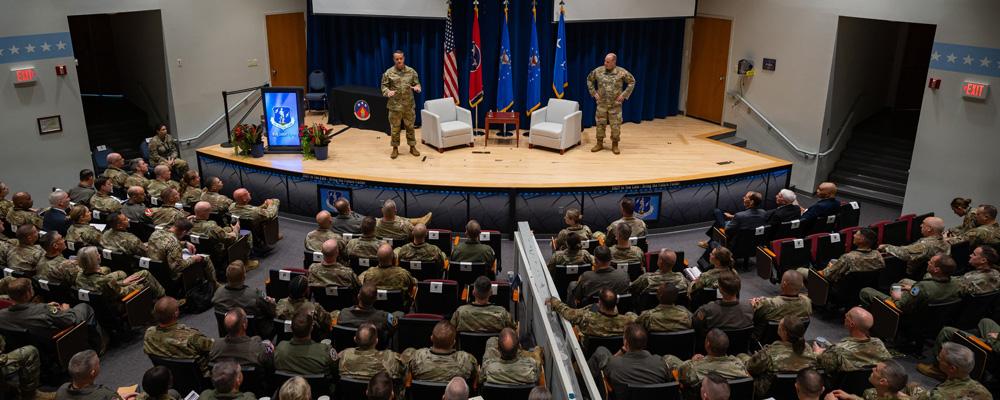
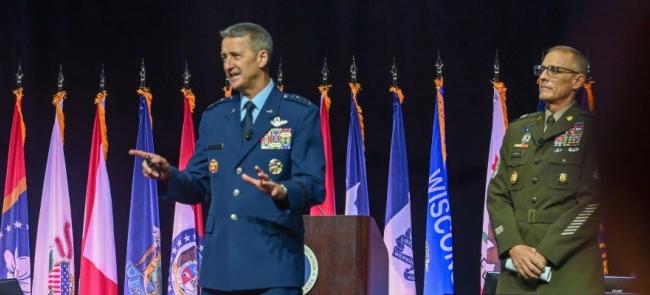
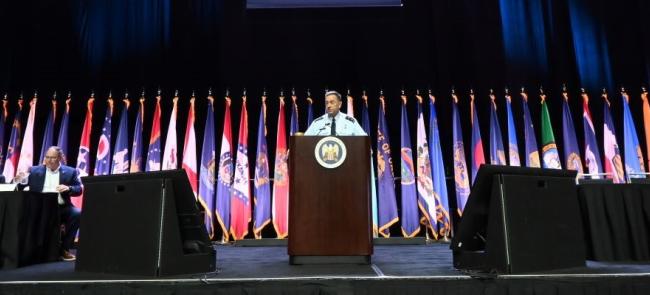
The acting director of the Air National Guard hosted ANG wing commanders from across the nation April 29-30 to discuss readiness and how to bring the future faster at the annual Wing Leader Fly-In at McGhee Tyson Air National Guard Base in Tennessee.
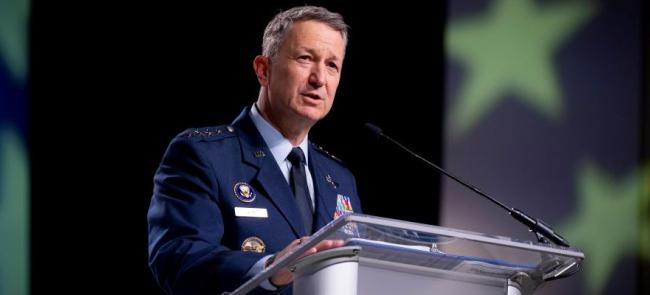
Maj. Gen. Duke Pirak thanked those in attendance for carrying out Air Guard priorities — including protecting the homeland and supporting several named operations and conflicts.
“Through your efforts, we’ve made profound progress in ANG wartime readiness by developing our people, modernizing and recapitalizing the force, and unleashing the innovative power of our Airmen,” Pirak said. “But the work is not done.”
Chief Master Sgt. Josh Moore, the command chief of the Air Guard, also spoke to the group, which included senior enlisted leaders from all 90 Air Guard wings.
This year’s theme focused on “bringing the future faster.” It emphasized Pirak’s new lines of effort: Recalibrate for Wartime Footing; Retool for Combat with the Air Expeditionary Wing 2.0; Reengineer the ANG Capability Portfolio; and Recruit and Retain.
Recalibrate for Wartime Footing
“We cannot afford to wait to bring the future faster,” Pirak said. “Very often in conflict, we don’t get to choose when or how. So, this is our challenge: As leaders, we need to support our Airmen in today’s fight while recognizing that our biggest challenges may be lurking in the not-too-distant future.”
He emphasized the need for the Air Guard to be a lethal, modernized and fully combat-ready force driven by multi-capable Airmen defending the nation at home and abroad.
To illustrate recalibrating for wartime footing, Pirak introduced Col. Michael J. Blair, the commander of the Vermont Air Guard’s 158th Fighter Wing.
“Our Airmen cannot afford peacetime processes and timelines,” said Blair, whose fifth-generation F-35A Lightning II fighter and Airmen have recently supported multiple contingency deployments.
Retool for Combat
As the combat-ready and combat-proven reserve of the Air Force, the ANG will organize, train, and equip in line with the Air Expeditionary Wing 2.0 concept.
This modified approach to generating and deploying combat airpower directs units to maintain an elevated state of readiness to deter adversaries and win in high-end conflict.
“We are an indispensable part of the Total Force,” said Brig. Gen. Jeremy Ford, the Air Guard’s director of operations. “We need to make sure we all understand what it means to be ‘fight tonight’ ready. To me, it’s a culture.”
Reengineer the ANG Capability Portfolio
The congressionally directed National Guard and Reserve Equipment Account was also a topic of conversation.
The Air Guard has lost nearly 60% of its purchasing power since 2013, when accounting for decreasing appropriations and the effects of inflation. The ANG uses NGREA to help achieve its modernization imperatives as well as to address emerging concerns or shortfalls.
“My biggest concern is our Airmen are ready, but we’re not properly equipped,” said Brig. Gen. Matt McDonough, the director of strategy, design and requirements at the National Guard Bureau. "If we get the strategy right, we’re building the force we need five to 10 years from now. The biggest thing I could use from [wing leaders] is advocacy. We need more purchasing power.”
Said Pirak, “The urgency of the now must not blind us to both the opportunity and threats in the programmatic landscape. We must secure our strategic future by investing in missions more optimally postured for the National Defense Strategy.”
Lt. Col. Tyler Johnson, the director of the Air National Guard Readiness Center Innovation Office, explained how the ANG is innovating and supporting the Pentagon’s priority of Supercharging the Defense Industrial Base, including recruiting companies to help solve growing threats and enabling field-level innovation.
“We’re not just doing tech push, but also problem pull,” Johnson said. “We need to provide access and advocacy to your Airmen, so we can do more unconventional things in unconventional ways.”
Recruit and Retain
Pirak discussed his final LOE, Recruit and Retain, by emphasizing the importance of balancing end-strength numbers with accessioning the right people while also increasing retention.
“Retention is not about money, it’s about culture,” Pirak said. “We achieved record accessions last year, but when retention rates fall below 92%, our ability to grow is challenged. 92% is achievable. We can do this.”
Col. Mark Williams, director, Recruiting and Retention, NGB, provided a sneak peek at the Air Guard’s new recruiting campaign: “Guard What Matters,” which is hitting the market this Spring/Summer timeframe.
He also informed wing leaders about several initiatives that reinforce his aim to “Grow the Force (recruit), Keep the Talent, (retain), in order to Sustain Combat Power (readiness).”
They include including three-year contracts and bonuses, an increase in marketing budget, a social media influencer collaboration program and a new creative toolkit that will provide wings with more than 100 templates for customizable recruiting campaigns at the local, state and wing levels.
“We will win the next war because of you and what you do today,” Pirak said. “Just at the moment we think we can’t do much more, that’s when we’ll have to step up and do it again.”
—Master Sgt. Sarah M. McClanahan