then Add to Home Screen.
At the 148th General Conference & Exhibition, Aug. 28-31 in Indianapolis, there will be plenty of free time for attendees to explore the city.
While known being the “racing capital of the world,” Indianapolis boasts a unique distinction from other cities of which it is equally proud.
“No other city in the United States maintains as many acres dedicated to honoring veterans, and only Washington D.C. has more veterans' monuments,” said retired Brig. Gen. J. Stewart Goodwin, the recently retired executive director of the Indiana War Memorials Commission, in a statement on the commission’s website.
The similarities between the cities might be due to both having Alexander Ralston as their surveyor and designer.
Why does Indianapolis have so many war memorials?
“We are the quiet patriots,” Linda Conti, the conference chairperson, said. “Our state has not only sent many soldiers to fight, our manufacturing sector produced many of the airplanes, trucks, cars, ammo, steel and medical supplies needed for the war efforts.”
The Indiana War Memorials Commission was created by the state legislature in 1923 with the mission of designing, building and operating the Indiana War Memorial Plaza Historic District.
The district is now on the National Register of Historic Places.
The Indiana War Memorials Foundation supports the museums and memorials comprising the district. Those include: the Indiana War Memorial, the Soldiers & Sailors Monument, Veterans Memorial Plaza, American Legion Mall with the World War II, Korea and Vietnam Memorials, the USS Indianapolis National Memorial, the Medal of Honor Memorial and the 9/11 Memorial.
Conference organizers strongly suggest attendees take a free walking tour through the city to see these sites. The memorials are contained within a roughly 3-mile loop that spans five city blocks.
“It’s quite spectacular,” said Conti. “Anyone who enjoys history will enjoy the tour.” She said the tour can completed in its entirety in about two hours, but you don’t have to see them all.
A guided tour via the conference app is in the works. More details about the app will be available this summer.
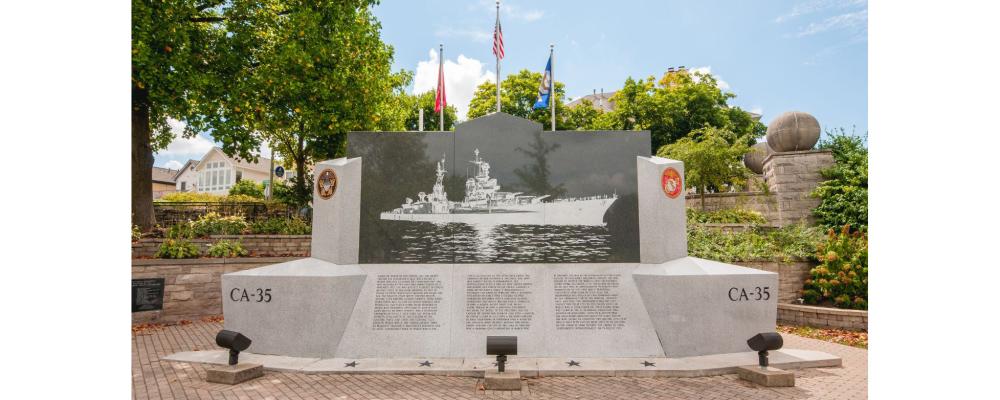
Most of the memorials are self-explanatory and many know the story of the USS Indianapolis (pictured above).
The USS Indianapolis was a Navy cruiser that was sunk by a Japanese submarine after delivering key components for the atomic bomb in 1945. Only 316 survived out of nearly 1,200 sailors in the Navy’s worst single loss of life at sea. The Navy only learned of the sinking four days later when survivors were sighted in the water by Navy aircraft. Those who didn’t perish by the torpedo hit and during the 12-minute sinking had to survive heat and dehydration while floating in shark-infested waters waiting to be saved.
While you may walk around the sights day and night, Conti says the Soldiers and Sailors Monument is “beautiful in the morning light.” The space where the monument resides was initially designated by Ralston to be the Governor’s Mansion.
And she recommends visiting the Medal of Honor Memorial at night. The Fun Run racers will stride past the MoH memorial, which is also visible across the downtown canal from the Indiana State Museum, site of the Governor’s Farewell on the conference’s final night.
The Indiana War Memorial Museum will also host the Retired/Separated Caucus Luncheon on Sunday, Aug. 30. The outside of this grand memorial is made with Indiana limestone, but the inside stone came from European countries that teamed up with the United States to win the war.
“It’s really a nice area of town,” said Conti.
More information about the conference is available here.
—By Richard Arnold