then Add to Home Screen.
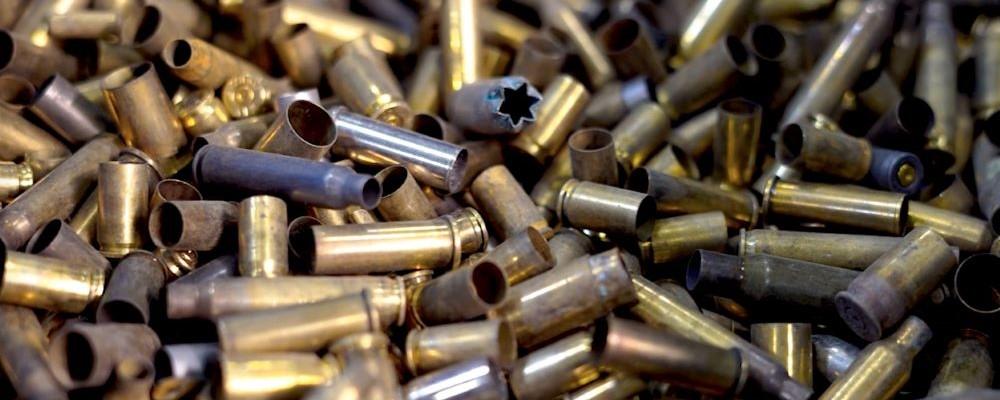
Live-fire training is a daily reality for National Guard units, with thousands of rounds expended during a single training cycle. The result is a large and continuous stream of spent brass that must be managed under strict property, safety, and accountability rules.
Although a fired casing is, in simple terms, empty metal, most government agencies do not treat it that way. Because the material originates from controlled weapons systems, it is often classified as sensitive. Policies typically require that brass be tracked, secured, and either reused within approved channels or rendered unusable so it cannot be turned back into ammunition or diverted into unauthorized hands.
This is where demilitarization (demil) enters the process. Before brass can leave many military installations, it must be physically crushed or flattened so it can no longer be reloaded. This step deters theft, prevents resale, and provides a clear audit trail showing the material is no longer ammunition related. Once rendered inert, the brass can move through conventional scrap streams, greatly simplifying transport and regulatory compliance.
The work is typically done with roller mills and other types of crushing equipment used in scrap handling and metal recycling, allowing large volumes of cartridge cases to be processed efficiently. The compression of the shells size also allows for less expensive freight charges to the recycler.
Although crushing spent brass casings is a relatively simple process, there is always the possibility that an unfired round could enter the recycling stream. The concern is that a live cartridge could discharge under pressure and create a safety hazard.
However, according to recycling expert John Neuens of BCA Industries, a company that provides recycling systems for the U.S. Army and Air Force as well as some of the world’s largest recyclers, the actual risk is minimal. When a round is not confined in a firearm chamber, its energy is limited, and modern roller mills used for this work incorporate design features that contain the event and prevent any release beyond the crushing chamber.
Recycling Challenges
In recycling operations, loose brass casings present handling challenges because they are hollow, resilient, and prone to interlocking. A roller mill addresses these issues by collapsing the casings’ structure, flattening them or partially cracking them so they behave more like solid scrap.
“The operating principle is straightforward,” says Neuens, whose company offers a Cartridge Crusher manufactured entirely in the United States. “Brass casings are fed continuously into a pair of counter-rotating steel rollers. The rollers are set with a controlled gap that is narrow enough to crush and flatten the casings without excessively fragmenting them.”
In this application, roller mills function more like heavy-duty crushers than grinders. The rollers are often hardened and wear-resistant to accommodate brass that may contain dirt, primer remnants, or other contaminants.
Built with a robust dual-roller system, the machine compresses and crushes spent shells quickly and consistently, significantly reducing their volume for easier storage, transport, and metal reclamation.
According to Neuens, these roller mills feature a generously sized hopper capable of accepting a wide range of casing sizes from .22 caliber through .50 caliber.
An integrated magnetic separation system further improves efficiency by automatically removing ferrous components before crushing, ensuring that recovered materials are cleaner and more valuable for downstream recycling processes.
According to Neuens, safety considerations remain critical in systems handling cartridge brass. However, the equipment is specifically engineered to safely process material even in the presence of live rounds, minimizing risk.
To do this, Neuens explains that the entry area of the roller mill is engineered with internal baffling designed to fully contain fragments, ensuring that no particles can escape.
“Gunpowder in a cartridge is meant to burn and create gas, not explode like a bomb,” explains Neuens. “In a gun, the chamber and barrel trap that gas so pressure builds behind the bullet and pushes it to high speed. Without that confinement, the gas expands in all directions. If a round ignites outside a chamber, there’s no strong, focused pressure.”
The roller mill is also available in scalable configurations, allowing it to be engineered as a compact, self-contained mobile unit without compromising performance or functionality.
“This configuration would be well suited for operations with multiple locations, allowing shells to be crushed on-site rather than transported between facilities. The material can then be processed immediately and sold directly to a brass recycling or reclamation operation,” says Neuens.
According to Neuens, many military bases “have barrels and barrels of shells sometimes mixed with live rounds” because they cannot move the material legally without demilitarization and are unaware that reasonably priced equipment is available to address the issue.
However, what begins as a byproduct of firearms training can ultimately become a managed industrial commodity. Once the brass is made safe, accountable, and compliant, military installations can sell it through approved scrap contracts or public sales to commercial recyclers and brass buyers, who purchase by weight at prevailing metal prices and return it to industrial or ammunition supply chains.
For more information: call 414-353-1002; fax 414-353-1003; email [email protected]; visit www.bca-industries.com or write to BCA Industries, 7036 N Teutonia Ave., Milwaukee, WI 53209.