then Add to Home Screen.

Leaders from several military and veteran service organizations are urging Congress to move quickly on legislation they say would modernize and simplify the way National Guard and Reserve members are placed on duty, paid and credited for their service.
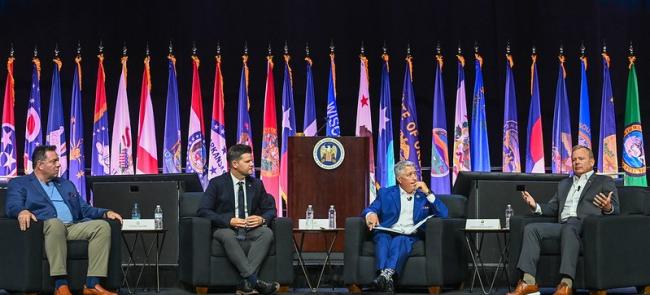
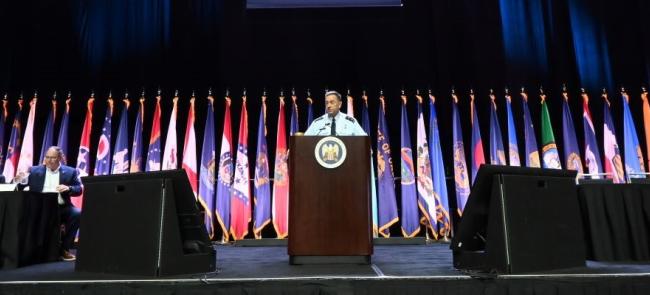
The push came during a June 17 press conference hosted by NGAUS in support of the Duty Status Reform Act, a bipartisan Senate bill (S. 4801) introduced the day before, that would reduce the existing 30 duty statuses to just four.
Sens. Jerry Moran, R-Kan., and Jacky Rosen, D-Nev., sponsored the legislation. Reps. Gil Cisneros, D-Calif., and Jack Bergman, R-Mich., introduced the Duty Status Reform Act (H.R. 6976) in the House in January.
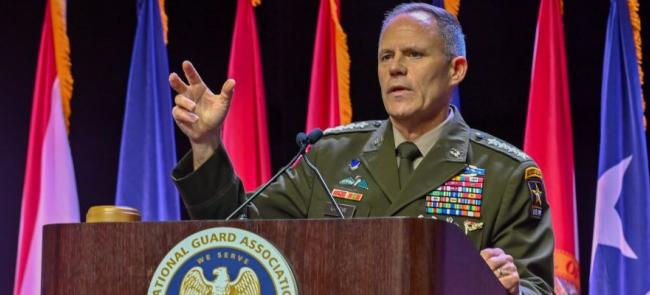
Retired Maj. Gen. Francis M. McGinn, the NGAUS president, thanked the bipartisan and bicameral leaders in Congress for bringing the issue to what he called “an important moment.”
He said duty status reform has been a long-standing priority for the Guard and Reserve community because the current system is “too complicated, too outdated and too burdensome” for today’s missions.
The event was held at the National Guard Memorial, the NGAUS headquarters in a room named after former Rep. Sonny Montgomery D-Miss., who was widely known as “Mr. National Guard.”
McGinn invoked the bipartisan spirit of the former National Guardsman and longtime champion of service members’ benefits.
“Taking care of the men and women who serve is not a partisan issue,” McGinn said. “It’s a national obligation.”
Representatives from the Military Officers Association of America, the Enlisted Association of the National Guard of the United States, With Honor Action, the Reserve Organization of America and the American Legion echoed that message.
Retired Lt. Col. Susie Dunham, director of Government Relations for Currently Serving Affairs for MOAA and a recently retired reserve-component member, said the current system can create gaps in health care, education and housing benefits for Guard and Reserve members.
Nick Weinstein, legislative director of EANGUS, said the National Guard has evolved into an operational force responding to overseas missions, domestic emergencies and natural disasters. Yet, he said, service members performing the same mission in the same location can receive different pay, benefits, health care coverage and protections simply because they are serving under different orders.
“This is not just unfair,” Weinstein said. “It is bad policy.”
Kaylan Swartz, vice president for government affairs at With Honor Action, pointed to the bill as an example of bipartisan veteran leadership. She credited Cisneros and Bergman, both veterans, with helping craft what she called a “common sense policy fix” for an overly complex system.
Retired Maj. Gen. John B. Hashem, ROA’s chief executive officer, said America’s Guard and Reserve members deserve one modern duty status system.
During the opening days of Operation Epic Fury, he said, some Guard and Reserve members went through four or five different duty statuses while performing a continuous mission.
“This complexity creates confusion, creates administrative burden, complicates personnel management, slows mobilization, and creates inequities that can follow service members long after they leave uniform duty,” said Hashem.
During a question-and-answer session, McGinn said supporters are hopeful Congress can act but understand the pressures of a crowded legislative calendar. If action slips into next year, he said, NGAUS and its partners will continue mobilizing members to build support in every state.
McGinn also said cost concerns have slowed progress, but he argued reform would not carry a large price tag and could save money by reducing waste and improving budgeting and programming.
Hashem added that delays in mobilizing Guard and Reserve forces often stem from the complicated process of determining which duty status applies.
The message from the coalition was clear: duty status reform is overdue, bipartisan, and necessary to align the law with how the reserve components serve today.
To learn more about this issue and to get involved, visit the NGAUS Action Center and have your voice heard.
—By Michael Metz