then Add to Home Screen.
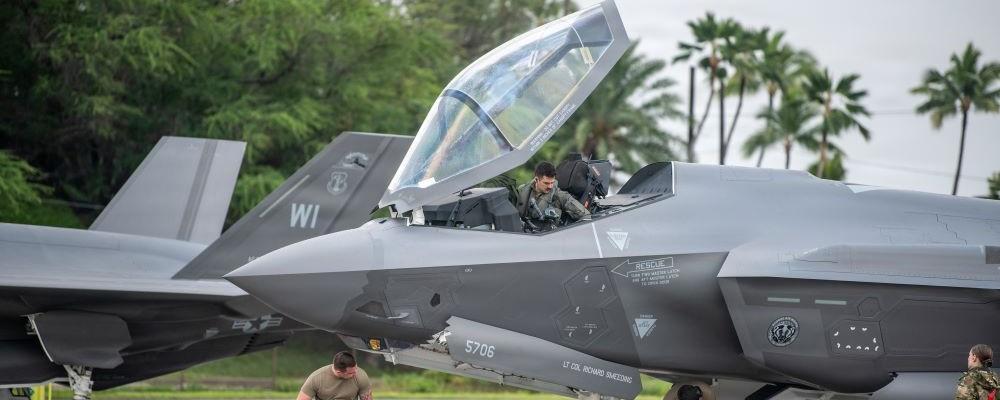
A new Hudson Institute report delivers a stark warning: the U.S. Air Force could be defeated by China in a future conflict if it does not fundamentally change its force design and operational approach.
The study, Flipping the Script: Redesigning the US Air Force for Decisive Advantage, argues that despite decades of strong performance, the USAF is entering a period of deep vulnerability driven by aging aircraft, low readiness, and a force structure that no longer matches the realities of modern warfare.
The Hudson Institute is a research organization that convenes leading officials with policy experts to deliberate on today's most pressing issues on foreign and domestic policy, national security, economics, and international relations.
According to the report, the Air Force’s traditional model — built on sequential, expeditionary power projection — is increasingly ineffective against a well-armed, fast mobilizing peer competitor like the People’s Republic of China.
China can mass-target U.S. forces as they deploy, exploit predictable airfield vulnerabilities, and potentially achieve its objectives — such as seizing Taiwan — before the U.S. could build up combat power.
Even with increased spending on aircraft and readiness, the analysis concludes that China could defeat the U.S. and its allies in a major campaign within the next decade unless major reforms are implemented.
The Air Force has tried to modernize by divesting thousands of aircraft and shedding force structure, more than any other service in attempts to modernize. It is on track to cut even more, especially fighter and attack aircraft, in exchange for a smaller fleet of similar, largely short-range assets to offset rising operations and support costs.
To flip the script, the authors propose building on the Air Force’s “One Force” design, with a three part force design built on complementary mission areas: Edge Force, Pulsed Force and Core Force, supported by key enabling capabilities.
Edge Force would consist of highly mobile, runway independent units positioned forward in allied territory. These would include truck launched anti ship missiles, stratospheric balloon based surveillance, long range surface to air missiles, and unmanned aerial systems for electronic and lethal attacks. Designed to operate under high risk, these units would disrupt Chinese kill chains while creating new ones for U.S. forces.
Pulsed Force would rely on long range platforms—bombers, ICBMs, and other assets—capable of generating powerful episodic effects from well defended airfields. These strikes would dismantle key nodes in Chinese defenses.
Core Force would provide day-to-day presence, forward deployments, and rapid surge capacity using distributed airfields. Missions include counter air, strike, mobility, ISR, and command-and-control operations.
Underpinning these forces are two critical enablers: counter C5ISRT and Resilient Airfields. Counter C5ISRT capabilities would degrade and deceive Chinese sensing and targeting. Resilient Airfields — ranging from lightly defended strips to hardened strongpoints — would provide survivable operating hubs without requiring uniform hardening of all bases.
The authors argue that this redesigned force would help deter Chinese aggression, provide credible early combat power, and preserve U.S. strength for a protracted conflict. It would also be more affordable, easier to scale, and more adaptable to other theaters such as Europe or the Middle East.
The report concludes that only a fundamentally reimagined Air Force — more flexible, distributed, and unpredictable — can maintain U.S. airpower dominance in the face of China’s rapidly advancing military capabilities.
—By Michael Metz