then Add to Home Screen.
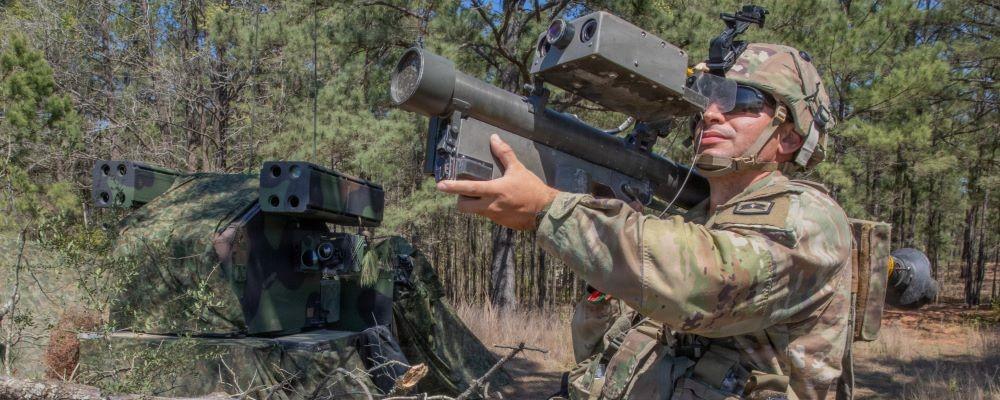
Soldiers with the Florida Army National Guard’s 3rd Battalion, 265th Air Defense Artillery Regiment last month trained alongside the 82nd Airborne Division at the Joint Readiness Training Center at Fort Polk, Louisiana.
It was the first time an Army Guard unit has integrated into an active-duty Army combat training center rotation under the new Minuteman Rotation concept.
The concept aligns Army Guard annual training with combat training center rotations, enabling units to meet their 15-day requirement while operating alongside active-duty formations.
Leaders said the approach increases readiness and interoperability across the Total Force.
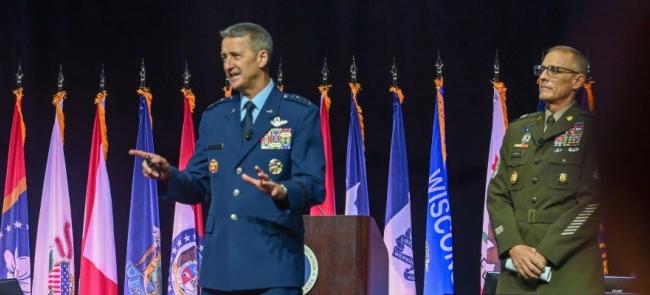
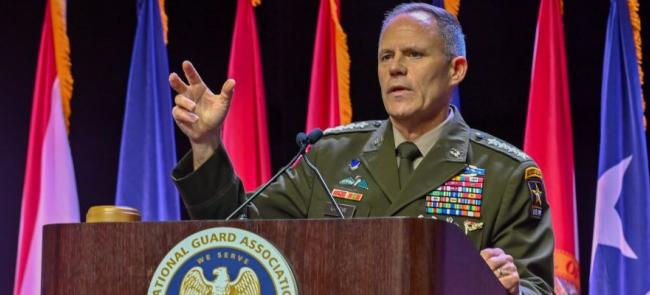
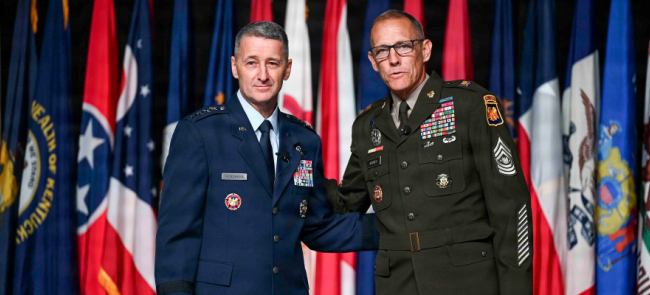
Senior Army Guard leaders visited the rotation March 19-20, including Lt. Gen. Jonathan Stubbs, the Army Guard director, and Command Sgt. Maj. James (Brian) Kendrick, the Army Guard’s senior enlisted Soldier.
“This is about building a Total Force that can close with and destroy the enemy,” Stubbs said during the visit. “What we are seeing here is a National Guard battalion fully integrated with an active-duty brigade, delivering a capability that is critical on today’s battlefield.”
The approach does not replace traditional Army Guard CTC rotations but expands access to high-end training while supporting Soldiers’ civilian careers, education and communities, Stubbs added. The goal is to integrate an Army Guard element into every CTC rotation.
At JRTC, units contend with a near-peer opposing force, limited resources and extended operations. The environment tests a unit’s ability to operate under stress while maintaining command and control across dispersed terrain.
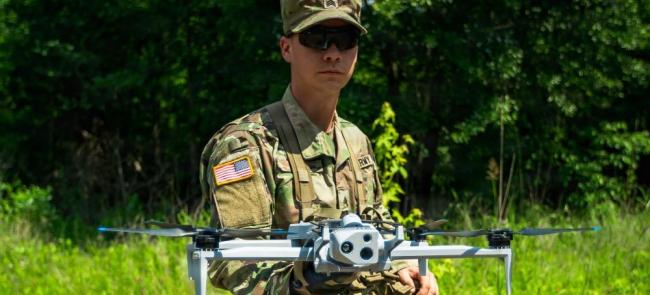
The Florida battalion provided short-range air defense capabilities during the rotation, focusing on countering unmanned aircraft systems and low-altitude threats.
Soldiers employed Sentinel radar and Avenger air defense systems while repositioning with maneuver elements to protect command posts, logistics nodes and key terrain.
A live battery moved with the brigade throughout the exercise, while the battalion headquarters operated as a division-level air defense element in a simulated environment. Leaders said the integration allowed the unit to train as it would fight in a real-world conflict.
Lt. Col. Adam Bailey, the battalion commander, said the unit prepared for the rotation through multiple command-post exercises with the 82nd before arriving at JRTC.
“Coming to JRTC, we rapidly integrated into division’s scheme of maneuver and protection plan,” Bailey explained. “That enabled us to execute a true Short Range Air Defense-mission in support of a division.”
The Panther Brigade’s dispersed operations increased exposure to aerial threats, particularly small drones capable of disrupting command and control or target-sustainment operations.
Col. Daniel Leard, the commander of the 82nd’s 3rd Brigade Combat Team, said the Army Guard unit filled a critical capability gap.
“Air defense is a critical enabler – we could not have executed our mission without them,” Leard said. “The Soldiers of 3-265 ADA integrated with our team on the fly. They were experts on their systems and that made an immediate impact.”
Kendrick, who previously served as the command sergeant major of the Florida Guard, said the training reflects how the force will operate in future conflicts.
“This is exactly where our Soldiers need to be,” Kendrick said. “Training at this level, with this kind of realism, ensures they are ready to deploy and fight as part of a larger team.”
—By Lt. Col. Carla Raisler,
National Guard Bureau