then Add to Home Screen.
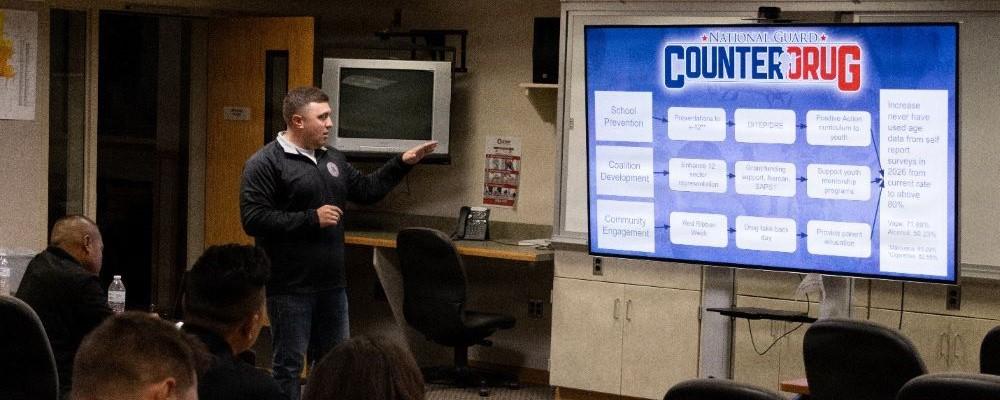
Drug trafficking networks often cross state and international borders, and analysts with the National Guard Counterdrug program are helping law enforcement officials identify trafficking routes and connect investigations across jurisdictions to disrupt and stop the flow of illicit drugs.
“Borders serve as the main line of defense for preventing drugs from entering the U.S., but threats posed by illicit drug trafficking do not stop there,” said Col. Laurie Rodriguez, the National Guard Bureau Counterdrug division chief. “They exist in all states.”
In one recent investigation, Guard analysts identified text-based communications tied to a fentanyl trafficking network operating across six states. Their work contributed to the seizure of 196,000 fentanyl pills and additional narcotics arrests, Rodriguez said.
The investigation was one of thousands supported each year by the program, which provides analytical, reconnaissance, operational and training support to law enforcement agencies throughout all 54 states, territories and the District of Columbia.
Congress authorized the program in 1989. Since then, the mission has expanded well beyond its early efforts focused on marijuana eradication.
Nationwide, nearly 3,000 Guard personnel support those efforts as part of the program. All serve on Title 32 status and remain under control of their governors while supporting federal, state, local and tribal law enforcement agencies.
The program is structured differently in each state based on the needs of those partnerships,
Rodriguez said.
Today’s drug trafficking organizations operate more like sophisticated criminal enterprises than isolated local groups, using communications, financial and transportation networks that often span jurisdictions and international borders, she added.
Much of the program’s mission now centers on criminal intelligence analysis and interagency coordination.
Guard analysts assigned to High Intensity Drug Trafficking Areas, state intelligence hubs known as fusion centers and multiagency task forces help law enforcement investigators identify trafficking routes, communication patterns, financial links and organizational structures connected to larger criminal networks.
“Analysts act as a force multiplier and bridge gaps between local, state and federal law enforcement partners,” Rodriguez said.
Lt. Col. Matt Howard, head of the Georgia National Guard Counterdrug Task Force, said Guard personnel often help connect agencies and investigative efforts that may otherwise operate separately.
“I think we are sometimes the bridge between elements or agencies where we can get folks to kind of work together,” he said. “I think we're really the trusted brokers.”
Beyond analysis, the Counterdrug program provides military-unique capabilities many law enforcement agencies cannot sustain independently, Rodriguez said.
Reconnaissance teams use fixed- and rotary-wing aircraft and specialized equipment to identify trafficking corridors and illegal drug activity, while other personnel provide communications, transportation, engineering and language translation support.
“I’ve worked with law enforcement agencies that have like 12 people, counting the secretary,” Howard said. “They don’t have helicopters. They don't have an analysis person.”
The Counterdrug program brings those capabilities, Rodriguez said.
The program also operates five schools that train Guard members, law enforcement personnel and community organizations in areas including criminal intelligence analysis, ground reconnaissance and partnership development.
In fiscal year 2025, the Guard Counterdrug program supported more than 2,800 law enforcement agencies and contributed to narcotics-related seizures valued at approximately $15 billion, according to NGB figures.
—By Sgt. 1st Class Christy Sherman
Note: NGAUS has long sought full funding for the National Guard Counterdrug Program. For fiscal 2026, Congress, at the association’s behest, appropriated $305 million for the program, $195 million more than the president requested, and $30 million for Counterdrug schools, $23.6 million more than the president requested.