then Add to Home Screen.

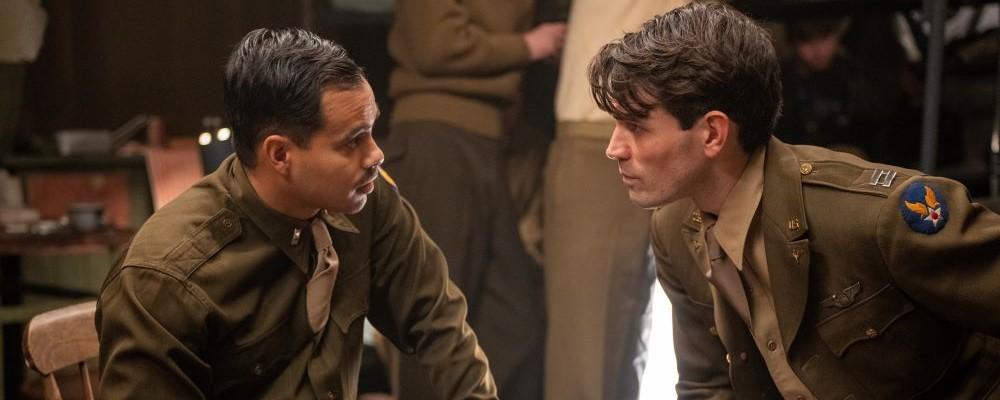
To generations of Americans, Jimmy Stewart is known for playing George Bailey in the classic movie It’s a Wonderful Life. The upcoming film JIMMY tells the story of a different role — that of a combat pilot in World War II and how it impacted his life.
NGAUS has partnered with JIMMY to support military and veteran communities.
A wartime diary Stewart kept became one of the film’s emotional touchstones. After Stewart’s death his daughters discovered it in a drawer beside his bed.
“There was one day when he was on the ground and he sent [his men] off on a mission … and a lot of them didn’t come back,” said his daughter, Kelly Stewart Harcourt.
“And this is from the diary: The next day they had a very successful day. They went, bombed their target and came back. They didn’t lose anybody, and everybody was laughing, and cheering, and singing. And dad writes, ‘It seems awful for everybody to be laughing and singing today when yesterday we lost all those men, but I guess that's the way things are in this dirty, stinking war.’”
That quiet burden is the heart of JIMMY, directed by Aaron Burns and starring KJ Apa (pictured above) as Stewart. The film traces the actor’s journey from winning the Academy Award for The Philadelphia Story through his enlistment in the U.S. Army Air Corps, his combat missions over Europe and, finally, processing the trauma of war through a return to Hollywood.
Fighting to Fight
In February 1941, a month after winning the Academy Award, Stewart enlisted.
Despite significant hurdles, including being underweight, his age and MGM studio chief Louis B. Mayer’s efforts to get Stewart’s draft notice canceled, Stewart was determined to serve.
Stewart was an avid aviator and had a commercial pilot’s license, which he used to apply for an Air Corps commission. He then gained enough weight to qualify and entered the service months before the attack on Pearl Harbor.
“He was fighting to fight,” Stewart Harcourt said.
As a B-24 Liberator commander, Stewart would fly over 20 combat missions over Europe and eventually became a brigadier general in the Air Force Reserve.
A Message of Hope
Both Burns and Stewart Harcourt said they want moviegoers to walk away with a message of hope. That you can come back from a traumatic experience.
“He rarely discussed the war with his children,” Stewart Harcourt said. Her mother told them that nightmares followed him home and persisted into the 1950s.
“He came back from the war saying he didn't know whether he was an out-of-work pilot or an out-of-work actor, and he’s been gone for four years.”
Burns added that he realized Stewart had gone to war and came home broken but found his healing through the making of It’s a Wonderful Life.
“Even if It’s a Wonderful Life hadn't come along, I think eventually dad would have got back into making film somehow. He kept up hope.”
JIMMY opens nationwide Nov. 6, just ahead of Veterans Day.
Military Legacy
Stewart’s military service extended far beyond active duty. During a panel discussion at the Air & Space Forces Association’s Air, Space & Cyber Conference, Lt. Gen. Andrew J. Gebara, director of staff, headquarters U.S. Air Force, said, “When I was a bomb wing commander at Barksdale AFB, Louisiana, in the 2nd Bomb Wing, we had a picture of Jimmy Stewart up on the headquarters because, as you may know, at the end of the war, he was the 2nd Bomb Wing vice commander, so a person that enlisted, fought his way through the ranks, became a bombing vice commander in like four years.”
During the same panel, Kathleen Ferguson, chief of the board, Air & Space Forces Association, stated, “The Air Force Association was founded by people who understood what air power could mean to America's future. One of them was Jimmy Stewart.”
Stewart continued his military career after WWII by serving in the Air Force Reserves.
“Just to be able to continue to serve in the military was very important to him. And when he retired, when he was 68, I think it left a big hole in his life,” said Stewart Harcourt.
Stewart’s military career spanned 27 years, two months and nine days.
—By Michael Metz