then Add to Home Screen.

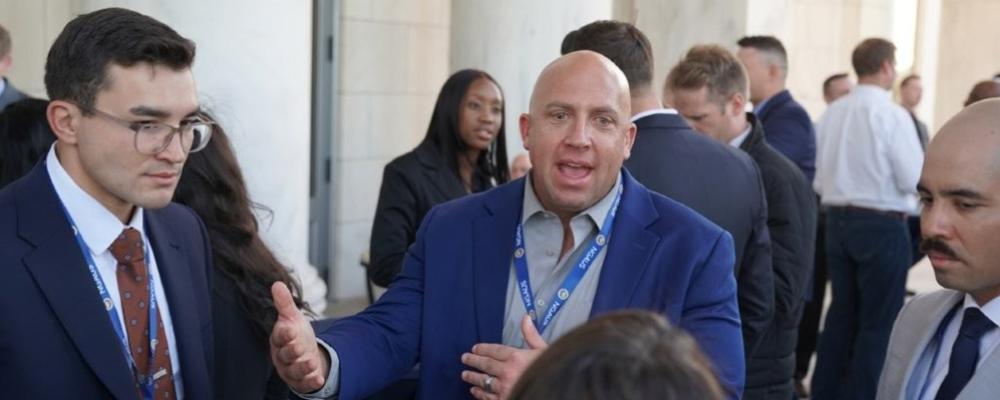
First Lt. Brandon Kreikemeier had an apt description of his experience at last week’s NGAUS Capitol Summit at the National Guard Memorial, the association’s headquarters, in Washington, D.C.
“It’s a peek behind the curtain to see how the sausage is made,” said the Nebraska Army National Guard officer.
Michigan Army Guard Capt. JaBarry Smith agreed, calling it “one of the best things I’ve done as a company-grade officer.”
Their experience was by design.
Capitol Summit brings selected Guard company-grade officers from across the country twice a year to the nation’s capital for a unique first-hand look at the legislative process and the significant role NGAUS plays in it.
“The primary purpose of this event is professional development,” said Jon Eisberg, the NGAUS vice president for government affairs. “Advocacy and professional development are core missions of NGAUS, and it is incredibly rewarding to see young officers grow through our program. Our members need to know these opportunities exist.”
Last week’s event drew CGOs from as far away as Alaska and the U.S. Virgin Islands and demonstrated how they and other association members can help advance the association’s priorities.
They heard from NGAUS staff, National Guard Bureau leadership, congressional staffers and other advocacy experts. (See photos)
Speakers included Gen. Thomas Carden, the vice chief of the National Guard Bureau; Lt. Gen. Jonathan Stubbs, the director of the Army National Guard; and Brig. Gen. Jeremy Ford, the director of Air National Guard operations at Joint Base Andrews.
Participation is open to association members from second lieutenant to captain, including warrant officers up to chief warrant officer 2. All expenses are paid for by NGAUS.
In addition to the speakers and panel discussions, attendees were given engagement tips and strategies from the NGAUS government affairs team before traveling over to Capitol Hill for meetings with congressional offices in both the House and Senate.
“Everyone benefits from the NGAUS Capitol Summit,” said Eisberg. “Attendees learn about the legislative process and how to engage with Capitol Hill. Members of Congress and their staff can meet with their constituents and learn about National Guard issues.”
Other participants shared their parting thoughts at the summit-closing congressional reception at the Longworth House Office Building across the street from the U.S. Capitol.
Kansas Army Guard Capt. Thomas Miller had only previously been to the nation’s capital once when he was a kid and called the Capitol Summit” very enlightening.”
“It’s a great broadening opportunity to see how to support ourselves,” he added.
He said a highlight was meeting the other officers “from the 54.”
Maine Air Guard Capt. Omar Gonzaga said there was so much going on during his multiday visit to NGAUS.
“It’s great to understand the impact we can have here,” he said. “And it provides a great forum to ask questions.”
Puerto Rico Army Guard Capt. Kevin Lam Gonzalez came to Capitol Summit after attending the 148th General Conference & Exhibition in Indianapolis, in August.
He was part of the planning committee that was sent there and will be attending next year’s conference in Salt Lake City, as Puerto Rico prepares to host the association’s 150th conference in 2028. He still wanted to talk about the Indianapolis conference.
“I really enjoyed meeting other people at all the receptions at both the [general] conference and here,” he said.
South Carolina Air Guard 1st Lt. Michelle Jenkins said she enjoyed learning about the bigger issues, such as duty-status reform, instead of just focusing on the priorities in her state.
Her advice to future participants is to “read through the [NGAUS] priorities and be prepared.”
U.S. Virgin Islands Army Guard 1st Lt. Keyvil King said she was glad to finally get the chance to attend Capitol Summit.
As for what she thought, “It got me fired up,” King said. “It motivates me to do more.”
NGAUS hosts two events a year, normally in October and April.
“Events like this are critically important for our membership, our advocacy, and for the 54 states, territories, and the District of Columbia,” said Eisberg.
Interested officers should contact their state/territory association leadership if they would like to attend future summits.
More information is available here.
—By Rich Arnold