then Add to Home Screen.

You’re the Unicorn Employers Covet
America’s workforce is entering a period of significant turbulence. Artificial intelligence is changing how organizations operate. A generation of experienced professionals is nearing retirement. Meanwhile, employee engagement remains a persistent challenge for employers across the country.
Together, these forces create uncertainty for many organizations, but they also create extraordinary opportunities for those prepared to lead.
For National Guard professionals, this moment represents more than a career challenge. It is a strategic opening. The Guard provides a rare environment in which individuals can build discipline, technical proficiency, leadership experience, resilience and professional networks while also contributing full time in the civilian workforce.
When those two worlds are intentionally connected, they can accelerate one another.
This is a golden opportunity to become what every organization is searching for: Someone who delivers uncommon results, adapts quickly, strengthens teams and brings value across multiple environments. In this day and age, a unicorn.
For Guardsmen, the path to becoming that kind of high-value professional begins with a simple but powerful mindset: If you’re full time, treat every day of your military career as preparation for the last day of your military career.
Ask yourself: Where do I want to be when that day arrives? What capabilities, relationships, credentials and experiences have I built? What value will I bring to my next assignment, my employer, my community and my family?
Then ask yourself this: How do I get to where I want to be?
Today, not tomorrow, become the architect of your present state and your future state.
In the civilian workplace, Guardsmen should learn to translate military experience into language employers understand.
Balancing two careers
For traditional, part-time Guardsmen, balancing a military role with a civilian career can feel like managing two full-time identities. But when approached with purpose, the combination can become a powerful advantage. The skills, discipline and perspective developed in uniform can strengthen performance in the workplace, while civilian experience can make Guardsmen more effective leaders, problem-solvers and teammates in the military.
The key is to maximize your Guard career, which can become a powerful differentiator in the private sector. Whether your goal is to own a business, lead inside an organization or contribute as a trusted professional, the Guard gives you access to experiences many civilian employers cannot easily provide. You live in two professional worlds, and that dual perspective can become a meaningful advantage when you learn to leverage it.
The first step is recognizing that the two careers are not separate lanes. They are mutually reinforcing. Military service builds leadership under pressure, accountability, adaptability, teamwork and mission focus. Civilian employment develops technical expertise, customer awareness, business judgment, communication skills and professional networks. Guardsmen who intentionally transfer lessons between both worlds can become more valuable in each.
The key is to look for alignment. Skills developed in uniform can strengthen performance at work. Lessons learned in the civilian sector can improve performance in the Guard. Leadership, communication, decision-making, logistics, technology, accountability and operational planning are not limited to one environment. They will travel with you. The professional who recognizes that transferability begins to separate from the crowd.
What does this mean?
In the civilian workplace, Guardsmen should learn to translate military experience into language employers understand. Instead of simply listing rank, schools or deployments, explain outcomes: led a team of XX Guardsmen to achieve XX, managed $XX in equipment, coordinated logistics that resulted in XX, solved problems under time pressure or maintained readiness standards — which led to $XX in cost savings/improved efficiency ratings, etc.
Those examples show employers concrete value. A platoon leader, for instance, may have experience in personnel management, safety, scheduling, coaching and conflict resolution. A logistics specialist may bring inventory control, compliance, transportation planning and risk management skills. Connect these military duties to business results.
Guardsmen can also use their military mindset to stand out at work. Employers value people who show up prepared, meet deadlines, communicate clearly and remain calm when plans change. The Guard reinforces all of those habits. Those behaviors build trust with supervisors and coworkers, especially when paired with humility and professionalism.
At the same time, civilian careers can strengthen military performance. A Guardsman who works in information technology, health care, law enforcement, construction, finance, education, communications or management brings real-world expertise that can improve unit readiness. Civilian experience often sharpens technical skills, exposes service members to new technologies and teaches them how different organizations solve problems. Guardsmen should look for ways to share that knowledge with their units.
Communication is essential. Guardsmen should keep civilian employers informed about military obligations as early as possible, provide schedules when available and explain how they are preparing to minimize disruption. Clear communication helps build employer support and prevents misunderstandings. Federal protections such as the Uniformed Services Employment and Reemployment Rights Act are important, but the strongest relationships are built on trust, planning and mutual respect.
Success also requires honest time management. Serving in the Guard while building a civilian career can create stress, especially during annual training, deployments, schools or periods of increased operational tempo. Guardsmen should plan ahead, protect recovery time, use benefits wisely and ask for help before small problems become major ones.
All leaders are searching for people who can deliver reliable results, adapt under pressure and raise the performance of those around them.
How do we get there?
In my work with leaders, organizations and military professionals, I have found that self-confidence is built through three connected dimensions. I call this the AAA Model to Building Self-Confidence: Aptitude, Application and Attitude. When actively developed in both Guard life and civilian employment, these three dimensions create momentum, alignment and professional leverage.
Aptitude is the knowledge and capability you build through education, training, certification and experience. The military is one of the most significant providers of professional and skill development in the world. Every course, assignment, deployment, qualification and leadership opportunity can expand your capacity.
Application is the ability to translate what you know into results. The Guard gives you access to a broad professional network and a wide range of practical situations where capability must be demonstrated, not merely discussed. Your civilian workplace provides another arena where those same skills can be applied, refined and made visible.
Attitude is the mindset that determines whether you use those opportunities fully. It includes curiosity, humility, resilience, discipline and the willingness to collaborate with people whose backgrounds and perspectives differ from your own. When you remove self-imposed limits and look for ways to contribute, your value grows.
Most small and mid-size employers cannot offer the depth of structured development available through a military career. At the same time, many civilian employers can offer broader and faster opportunities to apply what you know, build business impact and demonstrate leadership. The professional advantage comes from using both environments intentionally.
After more than three decades working with adjutants general, command sergeants majors, C-suite leaders, privately held companies and family businesses, I have seen a consistent pattern: All leaders are searching for people who can deliver reliable results, adapt under pressure and raise the performance of those around them.
That is the essence of the professional unicorn. It is not about being flashy or self-promotional. It is about becoming the person who has made the most of every assignment, learned from every opportunity and developed the ability to generate successful outcomes in environments where others remain average.
One practical way to build that standard of performance is to understand the seven key performance indicators that appear in every meaningful role, whether military or civilian.
I refer to them as the TDR-KSA framework: Tasks, Duties, Responsibilities, Knowledge, Skills, Abilities and Span of Control and Influence. Together, they offer a blueprint for performance and development.
Start with the first three indicators:
1. Tasks — For every military occupational specialty, job, role or project you have held, have you fully understood and owned the tasks assigned to you? Mastering the task is the foundation of credibility.
2. Duties — Beyond the formal description, have you understood how your duties connect to the larger mission? Professionals who see the whole system perform with greater purpose and consistency.
3. Responsibilities — Do you wait to be held accountable, or are you self-accountable? The most valuable professionals pursue excellence even when no one is watching.
To reach a higher level of performance, those first three elements must be supported by deeper professional capacity.
That leads to the next four indicators:
4. Knowledge — Are you pursuing every relevant technical, non-technical, formal and informal learning opportunity available to you? Credentials, certifications, degrees and practical knowledge all compound over time.
5. Skills — Can you perform your craft at a high level and teach others to do the same? Skill becomes most valuable when it is current, practiced and transferable.
6. Abilities — Are you viewed as a trusted performer or subject-matter expert in your rank, role or professional field? Ability is demonstrated through consistent execution.
7. Span of Control and Influence — Can you lead, manage, sustain and influence results across people, processes and pressure? Organizations need leaders who can do more than understand leadership; they need leaders who can practice it.
Ego can derail potential in any environment, including in the military and the civilian workplace. Results, however, remain a powerful equalizer. The professional who consistently performs, learns, adapts and contributes builds credibility that cannot be easily dismissed.
In other words, results are the greatest equalizer, not self-promotion or intentions.
If you want to accelerate your success, work to align your Guard MOS and your civilian job as strategically as possible. Even when the two roles are not identical, the underlying competencies often overlap. Leadership, planning, communication, risk management, accountability and execution have value everywhere.
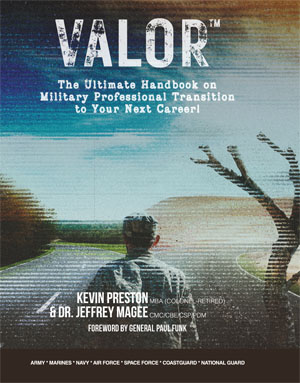
This is also the focus of VALOR: The Ultimate Handbook on Military Professional Transition to Your Next Career, a resource I co-wrote with Col. Kevin Preston, a retired Maryland Army Guardsman, with the 5-Step VALOR Model to help military professionals approach transition and advancement with clarity, confidence and strategic intent. Much of it also applies to the traditional Guardsmen with a demanding full-time civilian career.
Military transition and career advancement should not be treated as reactive events. They should be managed as deliberate campaigns. Every duty assignment, professional contact, training experience and leadership challenge can help shape the next stage of your military and civilian life.
A useful way to assess your value is to evaluate how you help an organization become better, faster, different or more cost-effective.
Developing your unicorn brand should mirror sound military planning: deliberate, strategic, milestone-driven and grounded in values. If you consistently apply the AAA Model and TDR-KSA framework, you will continue to enrich your capabilities and position yourself as the kind of person others want on their team.
Degreed Unicorn Time: Use education strategically. Pursue degrees, certifications and professional credentials that support both your Guard trajectory and your civilian career. If you have a thesis, capstone or applied project, consider focusing it on a problem in your civilian industry or employer organization. The goal is to make one investment serve both professional arenas.
Deployment Unicorn Time: Treat every challenge, mobilization, deployment or high-pressure assignment as a source of lessons learned. Conduct your own after-action review. What did you learn about leadership, communication, logistics, teamwork, discipline or resilience? How can those lessons improve your civilian organization? This is where your Guard experience becomes a catalyst for broader impact.
The larger point is simple: military professionals should not see themselves merely as job seekers or role holders. They should see themselves as high-value talent assets capable of shaping their next chapter with intention.
That process requires disciplined action. It means accepting transitions as part of professional life, dreaming expansively, planning deliberately, focusing sharply, building meaningful relationships, branding intentionally and executing professionally.
When your career is treated as a multiyear mission rather than a last-minute scramble, the transition becomes less intimidating and far more powerful. You are not waiting for an opportunity to appear. You are preparing for it, creating it and positioning yourself to make the most of it.
DR. JEFFREY MAGEE is the best-selling author of more than 39 books translated into 21 languages, including graduate management textbooks and trade books. He holds multiple professional certifications, including Certified Management Consultant, Certified Board Executive, Certified Speaking Professional and Certified Professional Direct Marketer. He has worked with Guard leaders in multiple states on matters related to recruiting and retention, leadership and adapting to change. Learn more about him at www.jeffreymagee.com.