then Add to Home Screen.
Smarter Tools, Smarter Force
Last December, the Pentagon unveiled GenAI.mil as part of its push to create an “AI-first” workforce across all branches of the military.
Secretary of Defense Pete Hegseth called it “a giant step toward mass AI adoption” and said it would enable “every member of our workforce” to be “more efficient and impactful.” GenAI.mil gives service members access to the artificial intelligence tools Google Gemini, ChatGPT and xAI in a secure network.
While the National Guard has used AI for years with mission-specific tools to monitor hurricanes, wildfires and other emergencies, generative AI presents a different challenge. The rapid rollout presents an immediate challenge: teaching troops how to use technologies whose capabilities, limitations and risks are still being understood.
In interviews with National Guard Bureau officials, they said they have a vision for what AI literacy should look like, but training is being done at the state level.
Kenneth McNeill, NGB’s chief information officer and director of the Command, Control, Communications and Computers Systems Directorate, said standards will ultimately be set by leadership, as with “any other type of training or guidance or policy.”
Currently, those standards are still broad. Delester Brown, the chief data and AI officer at the Guard Bureau, described “AI literacy” for a typical Guardsman as “a foundational understanding of AI concepts, the tools, and the applications, as well as the ability to use those types of AI systems effectively in whatever their role is.”
In the meantime, McNeill added that they “encourage the states to do local-type training” and that they are “aware that some states are doing two-day seminars and things of that nature.”
Training from the ground up
Some of that training is happening from the ground up.
Throughout her civilian and military career, Lt. Col. Kelly Ihme, who holds a doctorate in organization development and leadership psychology, has worked in a range of scientific and technical fields, including medicine, cyber, targeting and intelligence.
Today, she’s an assistant professor at the Army War College in Carlisle, Pennsylvania, and the senior intelligence officer for the Pennsylvania Air Guard. She describes herself as an early adopter of AI. Ihme first began using AI tools like ChatGPT in her civilian work, and as her interest and expertise grew, her command asked her to teach others.
“A lot of people find it very scary, and just like with any new technology, we should be cautious,” Ihme says. “Trust but verify.”
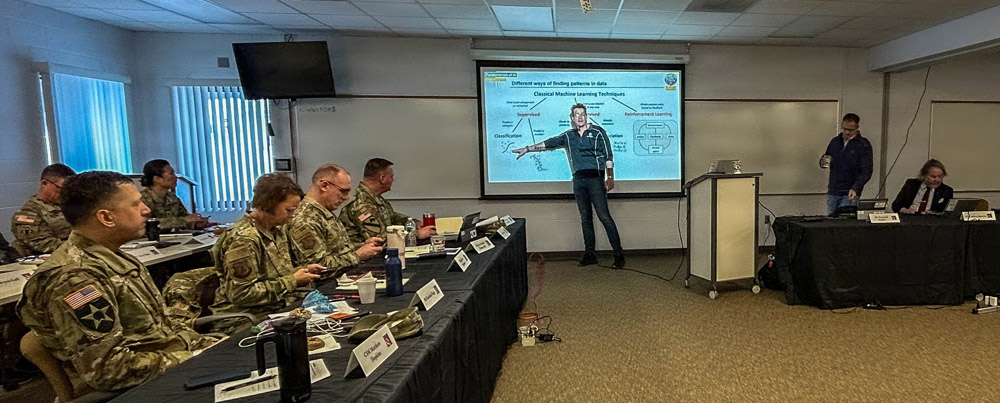
What started as faculty training evolved into a formal curriculum: her AI 101 course. By June 2025, she was hosting workshops for Guard units across the country and by video — about two per month, she says. And she’s also put the course material online (see links below) for those who can’t attend the course.
Some AI course material
Two online practical guides produced by Lt. Col. Kelly Ihme, the Pennsylvania Air National Guard’s senior intelligence officer and an assistant professor at the Army War College:
■ Understanding AI: Foundations for Strategic Application
■ Mastering AI Integration for Military Educators and Leaders
The course introduces the fundamentals of AI, answering questions like what it is, what it isn’t and how to use it for students who range from complete beginners to regular users in their civilian jobs.
“You know, [AI tools are] not thinking, reasoning things. It’s not The Matrix. It is really, really good predictive math,” Ihme says. “And from there, we talk about trust and ethics, responsibility and the importance of foundational skills in a particular area.”
After establishing that foundation, her instruction shifts to prompt management and integrating AI into everyday workflows.
“I’m not going to use AI to learn quantum physics. I’m probably going to go to school for that,” she adds. “But I’m an expert in other areas, so I’m going to use AI in the areas of my expertise to make my life easier and work a little faster.”
During instruction, Ihme uses commercial platforms like ChatGPT and Gemini, emphasizing that the underlying strategies apply across systems, including the military’s own generative AI tools.
From awareness to execution
Other states are taking similar approaches, tailored to their own needs. Chief Master Sgt. Erik Wolford, the Michigan Guard’s senior enlisted leader for initiatives, coordinated a three-day workshop in January for his state.
His “Artificial Intelligence Leader Course” was born out of a combination of necessity and opportunity. He explains that the idea came from attending an AI course around 2024 hosted by the Office of Naval Research. He says he saw immediate value in the material.
“I thought this would be really good to bring back to the state of Michigan and provide some opportunities to Guardsmen and our senior leaders to help them understand kind of how things were unfolding,” he says.
Wolford then began organizing the event by developing the curriculum and inviting instructors from Naval Research and the Air Force Research Laboratory. The first two days, attended by command staff and leaders from other state agencies, focused on how AI can be used “to enhance leadership, not replace it.”
For some in the senior leadership, he says the workshop “demystified what AI is” but the goal was to put everyone in attendance on the same page so they were aware of the technology and its capabilities.
Given the range of AI experience in the room, he says he wanted to get everyone thinking about the question: “how can we intentionally integrate this within our formations?”
If you don’t have an understanding of [A1], and you fast forward another 15 months or two years, you’re probably going to be behind if you’re not already.
—Chief Master Sgt. Erik Wolford, the Michigan Guard’s senior enlisted leader for initiatives
“If you don’t have an understanding of it, and you fast forward another 15 months or two years, you’re probably going to be behind if you’re not already,” Wolford says, adding, “It’s just a reality at this point that we have to understand and be able to make decisions in that space.”
The third day targeted practitioners, including company-grade officers and mid- to senior-level noncommissioned officers.
“We focused on moving from theory into execution and talking through tangible parts of AI,” he says, describing the final day as more of a hands-on workshop.
Changing everyday work
For many Guardsmen, the shift is already tangible.
Before attending Ihme’s beginner’s course, Maj. Jeremy Whitmer, secretary of the general staff for the Pennsylvania Guard, described himself as a curious but tepid AI user.
“I didn’t actually apply it in the way that it was meant to be applied. I used it more like a search engine,” he says, recalling prompts like, “what’s the fastest a cheetah can run?”
His interest in the course was driven in part by directives coming from the Pentagon. “I figured this would be a great opportunity for me to really learn the basics of AI and its capabilities,” he adds.
Through the course, Whitmer says he came to understand that AI platforms don’t “know” everything but instead can be shaped and improved through prompting. Since then, he has come to see tools like ChatGPT as “a valuable tool” for improving workflows.
“I’ve used it for all kinds of things, from helping develop policies to writing talking points to planning dinners for international dignitaries,” Whitmer says. “Figuring out the … types of food and the quantities that I need to order. I’ve used it for things that I never thought I’d use AI for.”
Capt. Andrew Ward, the operations division chief for the Pennsylvania Guard, also attended Ihme’s course. He says he had “tinkered” with AI before attending the course, but he never used it for “work in day-to-day life.”
“I like to joke with people that I kind of used it as Google on steroids to help me look up answers faster,” he says. “So, that’s where I was before, you know, going to the intro AI course. And of course, now after, it’s like, I’m always looking for ways to use it to make my job much quicker and more efficient.”
He started using AI tools for “time- consuming, menial repetitive tasks.” For example, he and his team used AI to create PowerPoint briefings for an annual workshop for human resource professionals in his state. The tools helped them punch up talking points, summarize long, complex documents and keep presentations within a certain time limit.
“It just makes little products like that much faster,” he said, adding, “what could take days or even weeks to develop from scratch now only takes maybe a couple of hours to build.”
Since the Pentagon rolled out GenAI.mil, he’s able to use the AI tool for more sensitive work like reviewing and summarizing individual personnel information ahead of promotions or assignments.
He explains that the task requires reviewing dense packets of information only to extract specific details for a brief career summary. Instead of taking three hours to review 20 packets, GenAI can complete the task in about five minutes.
Elsewhere, a groundbreaking new AI tool developed by an Oklahoma Army Guard Soldier is set to transform the way the state processes military awards, potentially saving administrative staff thousands of hours of paperwork.
Staff Sgt. Herbert Hailey, an information technology specialist with the Oklahoma Army Guard Recruiting and Retention Battalion, developed the tool after being asked to streamline the process of identifying Guardsmen eligible for time-in-service awards.
The traditional awards process requires administrative personnel to manually review each Soldier’s NGB-23A retirement points record, evaluate service history and calculate years of qualifying service.
Drawing on skills gained during a specialized Oklahoma Army Guard-hosted AI and data training course delivered by Skillquest, Hailey used advanced prompting within the Army Vantage platform to develop an AI-powered widget that automates much of that work.
Hailey says his development of the awards widget is not just about streamlining processes.
“It’s about creating better quality of life for our staff members while positively impacting our service population’s readiness,” he explains.
Administrative savings are already significant. Within his battalion alone, submitting every Soldier for a single award would normally require about 483 hours of administrative labor. When scaled across the Oklahoma Guard, the tool is projected to save more than 20,400 hours per award cycle.
Human factor
Across the Guard, instructors and students alike describe AI as a tool that can dramatically speed up workflows without replacing the people using it.
While AI 101 introduces the tools and how to use them, Ihme’s advanced course, AI 201, shifts to a deeper question: What are the thinking skills humans need to make AI consistently produce something useful.
The course teaches what she describes as “a set of seven skills” — questions users must ask themselves as they work with AI systems. She says it’s “more than just prompt engineering,” emphasizing that effective use requires clarity of thought, context, and intent.
She explains that AI cannot interpret the nonverbal cues, tone or the relationship dynamics that shape human communication, and those limitations become especially relevant in military settings.
“When we look at leadership situations and military situations, we link this to commander’s intent,” she says. “An AI can never really understand commander’s intent, and it would take a lot of context to build a prompt that would have that level of fidelity in it.”
Ultimately, she says, the progression is clear: “Human thinking becomes more important as we go from 101 to 201.”
For many Guardsmen, that lesson carries over directly into daily work. Ward says while the technology can streamline time-consuming tasks, it requires careful oversight, particularly when dealing with sensitive information. “It only produces what you give it,” he explains.
Because AI systems draw from a mix of high- and low-quality information, he says users must verify what they get back.
“You have to double-check the quality of what it gives you,” Ward says. “I would never trust AI to do someone’s job.”
As the military expands access to AI tools, the Guard’s experience suggests the real challenge isn’t deploying the technology — it’s training people to use it well. Brown, the chief data and AI officer at NGB, says what’s unfolding is less about the technology itself and more about augmentation.
“We’re not in the business of artificial intelligence,” he explains. “We’re in the business of amplified intelligence.”
DANIEL TERRILL, a former U.S. Marine and police officer, is a Chicago-based freelance writer who specializes in firearms and military subjects. He can be reached via [email protected].
Military AI use growing very fast
Service members’ use of artificial intelligence is up by roughly 1,420,000 users, a 1,775% increase over the past calendar year.
Emil Michael, the Pentagon’s chief technology officer, provided the figure during a panel discussion at the Special Operations Forces Week 2026 convention, a three-day annual event held in May in Tampa, Florida.
He noted that before he took the job nearly a year ago, the department had an average of about 80,000 AI-users across its more than 3 million personnel. Today, it has about 1.5 million users out of the 3 million.
Michael said the U.S. military uses AI across three layered dimensions: The enterprise level, the intelligence level and the warfighting level, which he described as the most important of the three.
“[We’re] embedding [AI] into our systems, so that warfighters can use it to be more precise, to be faster, to make better decisions and [to] bring combat power to the battlefield in a way that shortens time of any conflict, protects our warfighters to the maximum extent possible … and, frankly be as lethal as possible — which is what our warfighters want to do,” he said.
— NGAUS staff report