then Add to Home Screen.
Shock & Awe
With the proper leadership, time and resources, Army National Guard brigade combat teams can be just as effective as their active-component counterparts. They can also bring something extra to the fight.
Those are two of the big takeaways from the recent performance of the 53rd Infantry Brigade Combat Team at the National Training Center on Fort Irwin, California, say those involved in the rotation. The brigade is predominately Florida Army Guard units scattered across the state, but it does include one Alabama Guard rifle battalion.
NTC is considered the Army’s crucible of training. The service sends BCTs — both active and Guard — to the 1,000-square-mile patch of the Mojave Desert to experience the closest thing to combat short of a shooting war. “Hell on earth” is the way many Soldiers describe the rugged terrain and often-oppressive heat in “the box,” the simulated combat zone at NTC.
But as tough as the conditions can be, even more formidable is the opposition that rotating units face in a nearly two-week series of unscripted mock battles. Soldiers of the 11th Armored Cavalry, the OPFOR, are at home in the high Mojave. They know every mountain and rock formation. They are also experts in U.S. Army tactics, yet don’t always employ them, opting sometimes for the latest lessons from modern conflicts, like Ukraine.
Observers describe the OPFOR at NTC as “world class” and the Army’s equivalent of the Harlem Globetrotters. It loses with only slightly more frequency.
All this is by design. Army officials want the force-on-force experience at NTC to be mentally and physically demanding. That way rotating units can identify shortcomings and learn from their mistakes without the real-world consequences of actual combat.
Leaders of the 53rd IBCT left the California desert in late August after nearly a month with a better sense of where they stand with their Mission Essential Task List. They also departed knowing they often caught their opponents flat-footed.
Most rotating units are tank or Styker brigades. They have a lot of firepower but lack the agility of a light-infantry unit. Consequently, the OPFOR wasn’t familiar with the mobility the Florida Army Guard brigade could employ. They got a taste in the first battle.
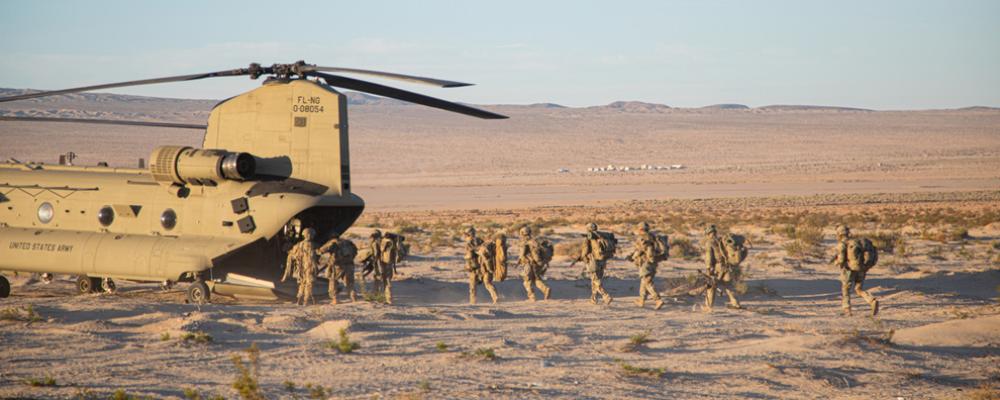
“We came out swinging with a battalion-sized air assault to seize the first objective in the offensive, which overwhelmed the enemy and allowed us to get a good foothold,” says Col. Sam Sargeant, the 53rd IBCT’s commander. “It is somewhat unique for NTC to even see air assault just due to most [rotating] brigades being armor brigades.”
There isn’t a big scoreboard at NTC. After each battle, observer/ controllers and leaders on both sides compare notes and decide the outcome. After shocking the OPFOR with the air assault, the 53rd IBCT achieved two of three objectives, but failing to take the third meant the first clash was stalemate, a tie, says Maj. Gen. Robert Carruthers, Florida’s assistant adjutant general-Army and the brigade’s senior trainer for NTC.
The first encounter set the tone for nearly two weeks of force-on-force exercises. Although the Florida Army Guard-based brigade lost the next battle, it prevailed “decisively” in each of the last three, Carruthers says.
Sargeant attributes his brigade’s success to fighting on its own terms. Air assaults are a mission-essential task, and the 53rd IBCT conducted two. The second was at night and on top of an enemy position during the fourth battle. It caught the OPFOR “completely by surprise,” he says. On land, his rifle units moved mostly on foot and in the dark, avoiding open terrain. They spent their days in the high-ground sizing up their objectives and the OPFOR below.
In addition to bringing tactics rarely seen at NTC, the 53rd ICBT brought some communications equipment that was new to the fight. The OPFOR frequently targets communications. The brigade never lost its comms, Carruthers says.
News of the Florida Army Guard brigade’s performance traveled fast.
“The 53rd IBCT did an incredible job, an amazing job at NTC,” Maj. Gen. Robert B. Davis, then the deputy director of the Army National Guard, told the Army Separate Session at the 147th General Conference & Exhibition on Aug. 25. “The CSA [Gen. Randy A. George, the Army chief of staff] is talking about it. Gen. [Andrew] Poppas at [Army] Forces Command is talking about it.”
We were able to showcase exactly how to fight in that terrain with a light-infantry brigade.
—Col. Sam Sargeant, the commander of the Florida Army National Guard's 53rd Infantry Brigade Combat Team
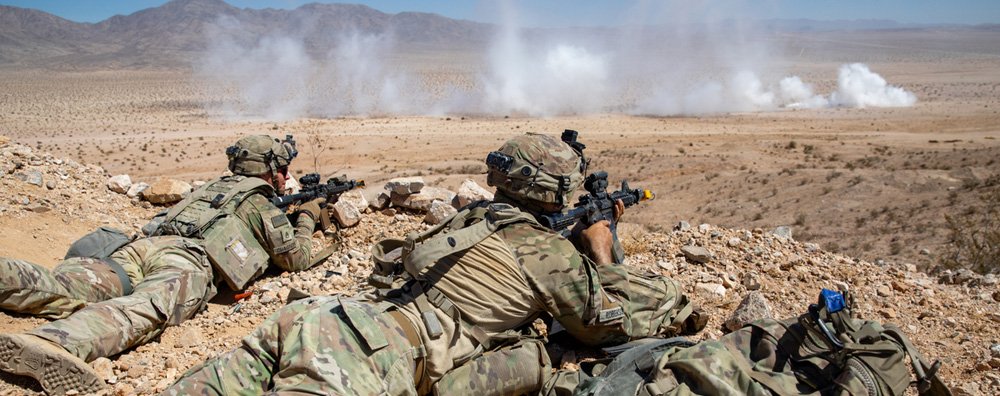
NTC is one of two Army maneuver combat training centers in the United States that prepare units and train leaders for large-scale combat operations. The other is the Joint Readiness Training Center at Fort Polk, Louisiana, which focuses on light-infantry brigades.
Each CTC hosts about 10 rotations annually. The Army Guard has 27 of the Army’s 59 BCTs but only gets to send one brigade a year to each training center, which makes rotations coveted. So, when the NTC opportunity became available three years ago, the 53rd IBCT grabbed it.
“We saw it as an opportunity to create generational readiness,” recalls Carruthers, who experienced NTC early in his career as an armor officer. “So, it was incredibly important for the officers and Soldiers of the brigade to maximize the opportunity by being as ready as they could be to train at the highest level that NTC affords. We had to treat it like it was the last chance to do something like this before they have to go off to a real fight.”
For two years, the brigade’s NTC rotation became the Florida Guard’s highest priority. “It was our Super Bowl, and the adjutant general [Maj. Gen. John Haas] fully supported it,” Carruthers says. Officials shifted resources to provide the 53rd IBCT with added training days and ammunition. There were no home-station drills for the brigade. All training was in the field.
In addition to upping combat training requirements, leaders down to the squad level pushed physical training. To fight in the box, Soldiers would need above-the-standard fitness. They reached that level largely on their own time.
“Young people today get a bad rap. They’re supposedly not as fit as previous generations,” says Lt. Col. Dan Brown, the commander of the brigade’s 1st Squadron, 153rd Cavalry Regiment. “But our Soldiers were ready to go into the fight. And that required giving up a lot of personal time early mornings for ruck marching, running and lifting.”
Meanwhile, Florida Army Guard officials went shopping for some of the latest equipment. Officials acquired more than 40 different drones for surveillance and reconnaissance. Some were purchased off the shelf, while others were provided by companies in exchange for Soldier feedback.
The 53rd IBCT also brought Android Team Awareness Kit phones and Starlink communications to NTC. The Starlink satellite terminals are only the size of a pizza box but provide three times the network speed of legacy communications terminals, says Lt. Col. Ralph Sullenberger, the Florida Army Guard’s deputy G6 (command/ control/communications/computers).
The old terminals were used to create a little deception. “The old dish, along with a radio broadcasting multiple frequencies, was positioned on the battlefield to simulate a command post talking on the radio and diverted the OPFOR and observer/controllers from the real command post,” Sullenberger explains.
At the same time, the ATAK phones, which are encrypted, enabled brigade leaders to share real-time updates and environment tracking.
“It gave the commanders instant feedback on what was happening in the battle, versus having to wait on information,” says Command Sgt. Maj. James Reid, the brigade’s senior enlisted Soldier. “It’s effective because we use it during hurricanes and how we use it on the tactical side is a carryover from that experience in real-world settings.”
Florida often calls the full brigade after hurricanes, which seem to hit the Sunshine State every year. Sargeant says his unit’s storm response experience bolsters its warfighting skill. While the mission isn’t as “physically demanding as combat, the mental capacity is there,” he explains. “We get out of our armories on a mass scale with all our equipment. … Big tasks kind of come naturally to this brigade, because we do them every year.”
All the new equipment contributed to the Florida Army Guard’s largest logistics movement since World War II.
Task Force Gator was the name of the full contingent that went to NTC. It included both the 53rd IBCT and supporting units, approximately 5,500 Guardsmen from 16 states in all. Finland and Romania also contributed troops.
Among the enablers was 1st Battalion, 111th Aviation Regiment, headquartered in Florida, which provided the aircraft for the air assaults. Crews flew 16 helicopters approximately 2,000 miles to Fort Irwin and then went straight into the box. They redeployed the same way for a total roundtrip of 4,000 miles. The “self-deployment” was a major training objective, Carruthers says.
Florida Army Guard officials made sure all involved were thoroughly familiar with the program at NTC before the mock battles started. More than 300 leaders from across the task force traveled to Fort Irwin last February for a 10-day leadership training program, which included walks in the box. And every task-force Soldier completed a 5-kilometer night road march with night-vision equipment during the RSOI (reception, staging and onward integration) portion of the rotation in late July.
“I made the aviators do it, the truck drivers, the logistics units, not just the infantry folks,” Carruthers says. “It’s important for the all the support folks to understand how difficult it is for infantry Soldiers to move under those conditions.”
We saw it as an opportunity to create generational readiness.
—Maj. Gen. Robert Carruthers, the assistant adjutant general-Army of the Florida National Guard
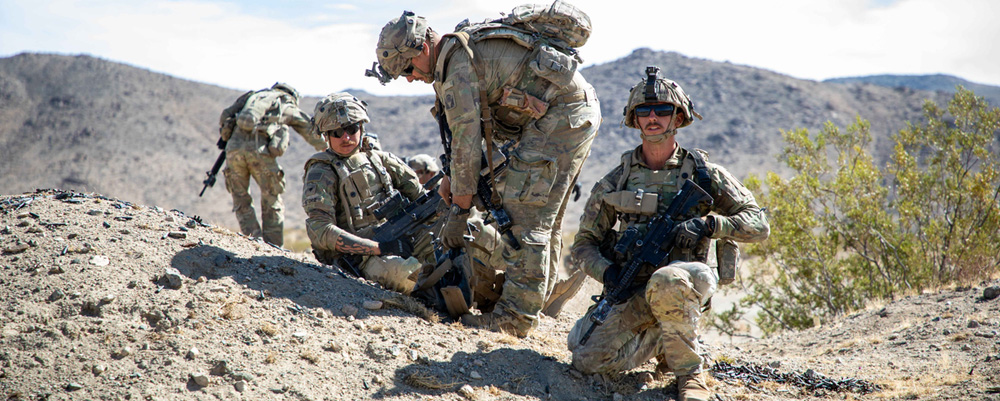
All the action in the box culminated with the fifth battle, the 53rd IBT’s mission to dislodge the OPFOR from Razish, an urban settlement resembling a small city in Iraq or Afghanistan. It features hundreds of buildings, tunnels and other detailed infrastructure.
Razish sits tucked up against the John Wayne Foothills and Tiefort Mountain. The topography essentially dictates an approach from the north. Assaulting the city from any other direction is difficult, especially the south, which requires a long, grueling climb on foot up a mountain and then a descent down a cliff.
Sargeant, the brigade commander, knew the OPFOR expected the assault from the north through what is known as the Central Corridor. He sent a part of his mounted cavalry squadron toward Razish from there to draw attention while all three of his rifle battalions attacked from the south.
Everything went according to plan. Once again, the OPFOR was surprised. The lead battalion entered the back of the city almost unopposed at about 2 a.m. The other two battalions followed quickly. The brigade then repulsed the counterattack, and the battle was over not long after sun-up, Sargeant says.
Brown, the cavalry squadron command, says brigade Soldiers got “a lot of kudos” from the OPFOR in the after-action report that followed the final battle. “Even down to the Soldier level, we heard, ‘Man, your guys are really a good unit. You’re coming at us in ways we’ve never seen at NTC,’” he says.
A series of live-fire exercises followed the force-on-force portion of the training.
“Despite our success, [the OPFOR] still gave us an absolute hell of a fight, and they had some wins, too,” Sargeant says. “But I think we were able to showcase exactly how to fight in that terrain with a light-infantry brigade. And we learned a lot.”
Sgt. Spencer Rhodes, a member of the Florida Army National Guard’s 107th Mobile Public Affairs Detachment, contributed reporting to this story.
JOHN GOHEEN is the NGAUS director of communications. He can be reached at [email protected].
TOP PHOTO: Soldiers with the 53rd Infantry Brigade Combat Team set out on an air assault at the National Training Center on Fort Irwin, California. (CPL. ANNA MAE TUMACDER)