then Add to Home Screen.
Drone Awakening
Last summer, the Department of War launched its “drone dominance” initiative to rapidly expand the military’s use of inexpensive commercial drones.
The effort was shaped in large part by lessons from the war in Ukraine, where small, disposable drones have often proven more lethal than the million-dollar unmanned aerial systems fielded by modern militaries. It’s an area Pentagon leaders acknowledge where the U.S. military is lagging behind.
Soon after announcing the initiative, the department released a curated list of roughly 41 approved drone models that units could buy without going through the standard procurement process. Most of them are built by American firms, but the list also includes some produced by companies in Europe and Israel.
By December, officials went further, unveiling plans to acquire as many as 300,000 drones over the next wo years using $1 billion appropriated last year in the Big Beautiful Bill. And on Feb. 3 they announced the 25 vendors invited to compete in Phase I of its Drone Dominance Program, an acquisition initiative intended to accelerate the development and fielding of low-cost UAS for one-way attack missions.
With that influx of systems, defense leaders say they hope to strengthen the domestic drone industry and drive down costs. The goal is to eventually make it feasible to purchase large quantities of small drones through regular budgets rather than special funding pushes.
Although the initiative is framed as a modernization effort, Army National Guard leaders in some states see it as formal recognition of changes already underway. In recent interviews, officers from units in Florida, Oklahoma, Oregon and Wisconsin described ongoing efforts to integrate commercial drone technology into training and operations.
In each case, creativity as well as urgency were paramount to success.
The Florida approach
In 2023, the Florida Army Guard began preparing for the 53rd Infantry Brigade Combat Team’s 2025 rotation at the National Training Center at Fort Irwin, California. Maj. Gen. Robert Carruthers, the assistant adjutant general-Army, called the opportunity “a really big deal because we don’t get that many [NTC] rotations.”
Wanting to make the most of what he described as the Army’s “premier training event,” Carruthers said his Soldiers needed to be ready to fight with the kinds of drones reshaping the battlefield in Ukraine, where they are used for surveillance, disruption and attack. There was just one problem: the Florida Army Guard didn’t have any.
The Army had recently decommissioned Florida’s aging RQ-7 Shadow drones that had been in use for more than 20 years. The gas-powered aircraft are nearly 12 feet long and require a runway and significant logistical support, which made them increasingly outmatched by smaller, more flexible commercial systems.
Although the Army suggested possible replacements, Carruthers says the service offered little guidance on funding or policy. Yet it did encourage units to experiment.
“If we gave dozens to hundreds of smaller drones to Soldiers in the field, it could endanger our helicopters because they’re going to be flying into the same airspace,” he recalls. “We didn’t have rules yet … but the first thing was just getting some drones.”
After researching several options, his team identified two suitable replacements — the Teal 2 and Black Widow, both manufactured by Teal Drones. Carruthers believed the systems would support the Guard’s federal warfighting mission, but to secure available state funding, which was the only money at his disposal, he also had to justify them for state use.
He explains the drones would be valuable for reconnaissance and surveillance during domestic emergencies, including hurricane response and damage assessment. The state ultimately funded the purchase of 48 drones for just over $800,000.
Meanwhile, Florida retrained its former Shadow operators to fly and teach others to operate the new systems. By the time the unit arrived at NTC, Carruthers said his troops were “fairly well equipped.” Their inventories also included drones provided by companies in exchange for Soldier feedback.
“Compared to other units, we showed up with probably a lot more than other units had at the time, and we kind of did it on our own,” he says.
Funding makes everything challenging.
—Lt. Col. Brent Hill of the Oklahoma Army National Guard
The Oklahoma approach
For Exercise Thunderstruck 2.0 in September at Camp Gruber Training Center, Oklahoma, the Oklahoma Army Guard drew heavily from lessons in Ukraine.
Lt. Col. Brent Hill, the director of the Oklahoma Guard’s counter-UAS and launched-effects program, says his leadership team had closely monitored the conflict. “The war opened our eyes,” he says, describing how small drones have reshaped the modern battlefield.
Ukrainian officials have credited drones with an increasing share of battlefield casualties. Ukraine’s military told the Kyiv Post in a recent report that its drone killed approximately 33,000 Russian troops in December 2025, claiming that figure represented more Russian soldiers killed in a month than the Kremlin was able to recruit.
Those figures — while difficult to independently verify — underscore how inexpensive, widely available systems can have outsized effects in combat. That reality, Hill says, pushed Oklahoma Guard leaders to explore how they could acquire and train with similar platforms.
Hill explains that the Oklahoma Guard began researching drones comparable to those seen in Ukraine. Like their counterparts in Florida, leaders recognized the need for small unmanned systems for federal warfighting missions while also seeking ways to justify their use in domestic response to secure funding until formal policy caught up.
The Oklahoma Guard ultimately selected the Skydio X10 drone as its primary small UAS. Costing roughly $20,000 each, Hill said the system is not intended to deliver munitions — even though it could — but rather to serve as “a medium-range to short-range reconnaissance” drone.
“It’s basically a utility player on the baseball field,” he says, noting the drone carries a high-end sensor suite including night vision, thermal imaging and 3D mapping capabilities — features useful in both combat training and domestic disaster response.
During Operation Thunderstruck, soldiers and airmen trained in scenarios modeled on combat in Ukraine, including assaults on and defenses of trench networks while small drones hovered overhead. In place of explosives, the aircraft dropped tennis balls — an exercise Hill says was designed to prepare troops for the psychological and tactical challenges of operating under constant aerial observation.
The Oklahoma Guard is also partnering with Oklahoma State University in developing dual-use UAS and counter-UAS technology.
The Oregon approach
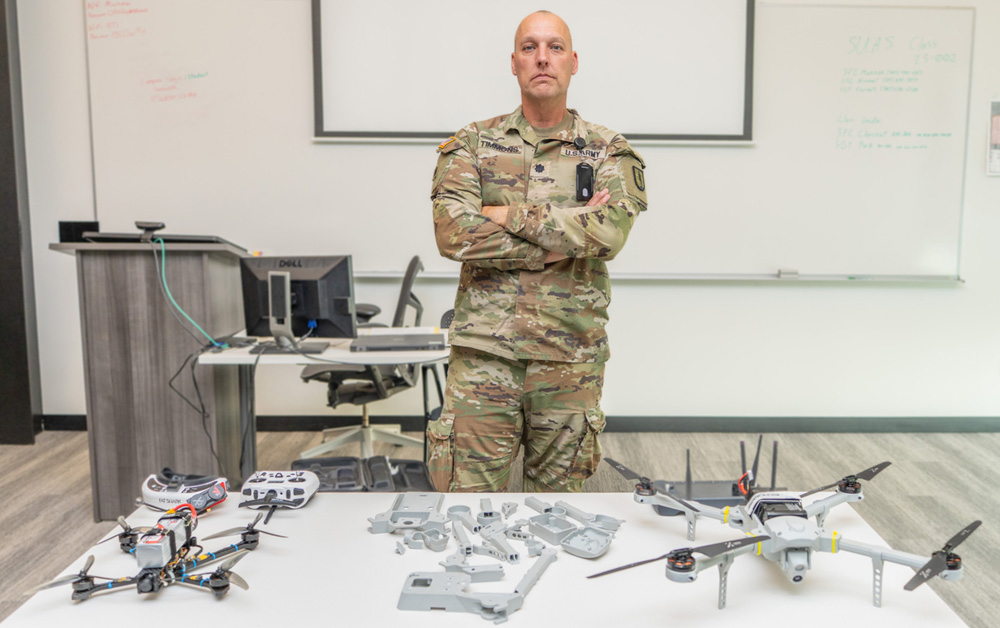
The Oregon Army Guard is transforming its UAS training at the 249th Regional Training Institute by introducing advanced platforms.
In September, the RTI at Rees Training Center Hermiston, Oregon, hosted two distinct training events — a specialized master small UAS pilot course focused on the Flightwave Edge 130 system Sept. 3-5, followed by the broader sUAS course Sept. 3-12.
The training represents a significant evolution from the Army RQ-11B Raven systems that were divested in March 2024. Students now learn on the Skydio RQ-28A Sky Ranger, a small rucksack-portable quadcopter drone used for short-range reconnaissance missions, along with the more advanced Edge 130 platform.
The Edge 130, manufactured by Red Cat Holdings’ Flightwave division, represents a significant upgrade in capabilities. The aircraft features vertical takeoff and landing capabilities, transitioning to fixed-wing flight, which provides 60 minutes of flight time in vertical mode and 90 minutes in fixed-wing configuration.
But the most innovative aspect of Oregon’s UAS program is the 3D printing of drones to supplement expensive commercial systems. Lt. Col. Mark Timmons, the RTI commander, initiated this effort after recognizing the financial constraints of relying solely on $45,000 commercial platforms.
“Where do we go once we get them here and we want to loan these out to various UAS operators? What’s going to happen?” Timmons says. “We know what’s going to happen. They’re going to crash.”
Working with Echo MAV, a company specializing in legally compliant components, Oregon has developed prototypes that cost between $2,000 and $5,000, including ground control stations. The initiative draws inspiration from similar programs at the 101st Airborne Division and 25th Infantry Division.
The Wisconsin approach
Lt. Col. Pete Owens, the executive officer of the Wisconsin Army Guard’s 32nd Infantry Brigade Combat Team, says his unit purchased small drones in 2024 ahead of a rotation at the Joint Readiness Training Center on Fort Polk, Louisiana.
Because many of the roughly 5,000 Soldiers involved had not previously deployed, the goal was to expose them to the demands of large-scale combat operations. During the rotation, troops trained on tasks ranging from rail transport and perimeter security to convoy operations, medical evacuation, assaults, and ambushes.
Owens said drones were included because leaders wanted Soldiers to be “prepared for an evolving operational environment.” When selecting systems, the unit prioritized versatility, ease of use, long battery life and extended range.
Since then, Wisconsin’s drone strategy has continued to evolve.
“Our deputy adjutant general, Brig. Gen. Brion Aderman, has stated that his intent is to build a ‘rapidly deployable, dual-use sUAS capability’ within the Wisconsin Army National Guard,” Owens says.
Other units are also leading
Although drones of various types have been in use since the early 20th century, the market for modern commercial quadcopters expanded rapidly alongside the rise of smartphones. Since then, they have seen widespread adoption among civilians, first responders and, increasingly, the military. Within the Guard, several units have publicly highlighted their efforts to invest in and adapt to the technology at scale.
In November 2025, the Pennsylvania Guard announced it had expanded its use of commercial drones to “keep pace” with the changing battlefield. Chief Warrant Officer 2 Nathan Shea, the UAS operations officer at the UAS facility at Fort Indiantown Gap, Pennsylvania, said in a press release that “unmanned systems … are going to be a massive player in shaping future fights, and how we fight.”
According to the release, the Pennsylvania Guard has operated a UAS facility since 2007, when it began flying Shadow drones. The unit has since expanded into other systems, including some that are not yet official Army programs of record.
“It’s a great indoor, all-weather space that we get to utilize, and it focuses on building out tactics,” Shea said. “Every obstacle, as random as they may seem placed, has a very specific purpose. It’s meant to build accuracy for the pilots.”
A December release indicated Fort Indiantown Gap’s 1st Battalion, 166th Regiment – Regional Training Institute conducted Soldier Borne Sensor training at the facility to prepare instructors for future UAS integration.
The training familiarized cadre with SBS capabilities and basic flight operations using the Teledyne FLIR Black Hornet Nano, a micro-sized reconnaissance drone designed for squad-level employment. The release said modern conflict has shown that such drones have become indispensable tools for intelligence collection, force protection and battlefield control.
Staff Sgt. Luis Andujar, an instructor at the 166th Regiment, said the effort supports future updates to the sUAS operator course Program of Instruction, which is expected to incorporate SBS platforms alongside other sUAS categories.
“This kind of early familiarization allows us to build training the right way from the start,” he explained. “Once the POI is published, we’ll be ready to effectively train Soldiers on these systems.”
Pennsylvania is not alone. In 2024, the South Carolina Army Guard also began training with the Black Hornet. In a press release, Master Sgt. Eric Lawrence, the chief instructor for the 4th Battalion at the 218th Regional Training Institute, emphasized the importance of keeping pace with rapid technological change on the battlefield.
“One of the primary objectives we must keep in mind is that our adversaries have access to the same technology,” Lawrence said. “This reality requires the Guard to not only master the use of our equipment but also develop strategies to counter similar technologies if deployed by enemy forces.”
Unmanned systems ... are going to be a massive player in shaping future fights, and how we fight.
—Chief Warrant Officer 2 Nathan Shea of the Pennsylvania Army National Guard
A change in attitude
Guard leaders say one of the biggest shifts driven by the drone initiative is cultural. While military aircraft have traditionally been treated as scarce, high-value assets, small drones are increasingly viewed as expendable tools.
The Army’s old Shadow drone, for example, costs roughly $300,000 per aircraft, plus another $1.6 million for its ground control station and support equipment. Operators also had to attend a 15-week course before flying one. By contrast, small UAS cost significantly less, and Soldiers can learn to operate them in a matter of days. That affordability allows units to take more risks during training.
Carruthers says if a small drone breaks or gets lost, “it’s not a big deal. We’ll just get another one. The costs are relatively low compared to everything else we have.” He compares them to large munitions, which units routinely expend in training.
Owens says leaders are trying to strike a balance — avoiding both a throwaway mentality and excessive caution.
“We are trying to build the mentality that sUAS are pieces of equipment that we have to operate frequently in order to build proficiency,” he says. “In a lot of ways, it is similar to an assigned weapon. Soldiers should be comfortable with them and able to employ them quickly and effectively.”
Looking ahead
By buying 300,000 drones by 2028, the department hopes to lower the average cost per drone to $5,000 or less. But some Guard leaders believe the transformation will go beyond procurement.
Hill predicts that more Guard troops may eventually print their own drones in the field. He and Carruthers both described the possibility of mobile drone labs — Conex boxes mounted on trucks and equipped with 3D printers and spare parts.
“That’s what Ukraine’s doing. They have their own brigade that does nothing but build drones every day,” Hill says. “Teaching soldiers how to build and fabricate drones is how you get more cost-effective.”
And at the Guard level, in the past six months, the Georgia Army Guard formed the Georgia UAS and Robotic Rapid Deployment team, a core group of six master trainers and aviators. In January 2026, the team launched the Georgia Guard’s first UAS operator’s course, to teach Guardsmen across the state to fly “low-cost autonomous systems.”
Hill said that while the authority exists, funding remains the hurdle.
“Funding makes everything challenging,” he says. “Regulatory, we can do it. We are authorized to build drones. They have to meet certain specifications. They can’t have certain parts on them … but it’s really the funding.”
DANIEL TERRILL, a former U.S. Marine and police officer, is a Chicago-based freelance writer who specializes in firearm and military subjects. He can be reached via [email protected].
TOP PHOTO: Cadre with the Pennsylvania Army Guard’s 1st Battalion, 166th Regiment — Regional Training Institute receives Soldier Borne Sensor training at Fort Indiantown Gap, Pennsylvania. (SGT. 1ST CLASS SHANE SMITH)
OUR TAKE
 Enhancing UAS/counter-UAS capabilities and authorities is among the NGAUS Joint Priorities for deliberations on fiscal 2027 defense legislation. The Army and Air Force can go a long way toward enhancing Guard UAS capabilities by including Army and Air Guard units early in the fielding plans for the 300,000 drones the Pentagon plans to acquire between now and 2028. Resources for the latest systems and tactics is also vital. And given their role in homeland defense, it’s also crucial that Guard units have the latest C-UAS systems. If there are any gaps, NGAUS will ask Congress for the resources to fill them. The Pentagon should also tap the Guard’s private sector expertise and innovation mindset. The Guard is used to doing more with less. An example is Air National Guard Air Force Reserve Command Test Center in Tucson, Arizona. Since 1981, it has found ways to use commercial-off-the shelf equipment to inexpensively keep older aircraft in the fight.