then Add to Home Screen.
Liberty Dogs
Retired Maj. Gen. Ondra Berry saw first-hand in the early aughts how Service Dogs could help Veterans when he worked for the chief of the National Guard Bureau. At the time, it was a “big ask” for Veterans to seek permission to bring their canine partners to work.
“But it gave them support they needed,” says Berry, who went on to become the adjutant general of Nevada from 2019 to 2024 and is currently the NGAUS vice chair-Air. “They were able to better navigate through the workforce. It also brought a sense of calm to the workplace, because not only was it doing something for those who had Service Dogs, it also allowed the rest of us to see what a canine could do for a Veteran.”
Berry now sees that impact through a new role — as chief executive officer of Liberty Dogs, a Reno, Nevada-based group that is organizing to breed, raise and train Service Dogs for placement, at no cost, with Veterans diagnosed with post-traumatic stress.
There are many groups nationwide that provide similar services, but Liberty Dogs is taking the effort to a whole new level.
The startup is constructing a 27-acre campus in Reno with space for training Service Dogs specializing in PTSD and physical mobility; structures for kennels and veterinary care; and temporary housing for Veterans to participate in a 12-day partnering program.
Berry says the facility and program are like nothing else currently available. “Not even close,” the retired Nevada Air Guardsman explains.
“We will have researchers, and this will be a schoolhouse for like organizations and practitioners to come and learn,” Berry adds. “In addition, the campus is more like a five-star Ritz Carlton than a Service Dog/ Veteran organization. It will be an experience unlike any a Veteran has been through. This place will be unreal. I pinch myself every day.”
Liberty Dogs is the vision of Nevada residents Dave and Cheryl Duffield and is fully funded through the Dave & Cheryl Duffield Foundation, which focuses on companion animals and disabled Veterans.
Berry says things are moving fast. There are already 75 dogs in the program. Many are Golden Retrievers or Labrador Retrievers, notoriously friendly breeds. They were “purpose-bred” and raised by local families. The program provides initial training, food and veterinary care. Shelter dogs will eventually be added. Formal Service Dog training begins at about 18 months.
Staff will move into the campus in March, and placements are scheduled to begin in June. Liberty Dogs aims to eventually place about 200 dogs a year.
We want to help Veterans live with dignity and purpose.
—Maj. Gen. Ondra Berry (Ret.), the chief executive officer of Liberty Dogs
Liberty Dogs eligibility
To be partnered with a Liberty Dog, Veterans must have a minimum 10% Department of Veteran Affairs disability rating and be able to travel for the 12-day pairing course, according to Cameron Pieters, the director of veteran programs and a former Nevada Guardsman.
Many factors are considered in pairing a specific dog with a Veteran, including the former service member’s needs, household and lifestyle. The canine’s personality and energy level are also evaluated.
“You may have a Veteran who’s highly active, who likes to run 26 miles a day. They need a dog with a lot of energy,” Pieters says. “You may have Veteran that’s a lot slower, that’s not quite as mobile as another one. So, we find a dog that’s a little bit slower moving.”
Still, Pieters acknowledged the first partnership may not be the right match. “That’s why we’ll have additional dogs that we can bring in,” he says. “So, hopefully, nobody goes away without a Service Dog.”
And the program doesn’t end when the Veteran goes home with their dog. Liberty Dogs will provide food and other assistance to ensure the partnership thrives.
“[They’re] not just handing them a dog and sending them out the door,” says Sarah Leighton, a research scientist with the University of Arizona College of Veterinary Medicine. “They’re there for the duration … This is a really long-term relationship that they’re developing.”
Leighton is one of the nation’s leading experts on the value of Service Dogs to Veterans. She was the lead researcher in a June 2024 JAMA Network Open study that found Veterans with “a trained psychiatric service dog” had less severe PTSD symptoms and “and higher psychosocial functioning” than those without dogs.
Puppy raisers needed
Berry says one key to the program’s success will be the availability of volunteer puppy raisers. The more puppy raisers we have,” he says, “the more dogs we can acquire.”
Former Marine Eryn Redmon Steed is currently a Volunteer Puppy Raiser for the program, having welcomed eight-week-old Annie into her home last March. Now about one-year old, Annie is already doing “what she was born to do,” she says.
While attending meetings with other Veterans, Redmon Steed says she saw Annie’s presence helped others in the rooms.
“You could see a person’s aura sort of change from down and dark to big smiles and hugging and loving on this puppy,” she says. “I know it’s not just me she’s affecting … To see how she bonded with my partner in the class, I could see how he was just looking at her. You could see the joy that just her presence was bringing him. I didn’t realize it was going to be so profound.
“I know I need to be healthy and happy,” Redmon Steed adds. “Part of what makes me healthy and happy is doing the same for other Veterans … to know I’m not alone in my daily struggles and to know what I’m doing may even save a life one day.”
When the time comes for Annie to leave for formal Service Dog training, Redmon Steed says she doesn’t know how she’s going to let go. But she does know “the why.”
Berry says Liberty Dogs would like to have more than 250 puppy raisers by the end of year. Currently, the program is working with not only volunteers in the community, but also some state prisons. “The inmates have a lot of more free time on their hands,” he says.
Liberty Dogs will also offer Veterans a free three-day wellness program, “A Pathway to Lasting Empowerment.” Berry says the curriculum covers “mental wellness, resilience, mindfulness, team building, personal growth, etc. “It will be available on and off campus.”
“We want to help Veterans live with dignity and purpose,” Berry says. “And Veterans will never pay us a dime. They’ve already paid enough.”
More information about Liberty Dogs is available at www.libertydogs.org.
The author is a freelance writer who specializes in military matters. She can be reached via magazine@ ngaus.org.
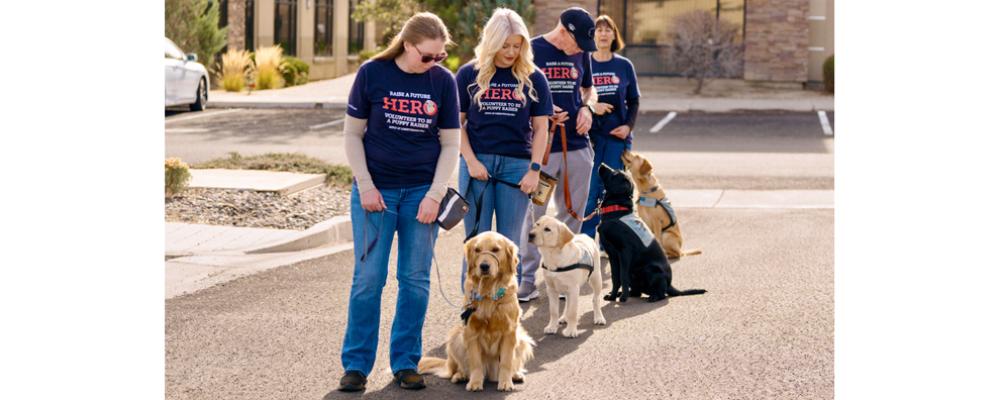
TOP PHOTO: Some Liberty Dogs puppy raisers conduct group training. Early socialization is a vital part of the puppy raising program. (Courtesy of Liberty Dogs)