then Add to Home Screen.
President’s Guard
If you walk into the Command Conference Room of the D.C. Armory in the nation’s capital, you will find a statue of Thomas Jefferson, the primary author of the Declaration of Independence and the third president of the United States (1801–1809).
Under the statue, you’ll see a bronze plaque with the quote: “More effectually to provide for the organization of the militia of the District of Columbia.”
Twenty years after the end of the American Revolution, the nation was growing rapidly but had no reason to expect invasion by a foreign power. Accordingly, and with the intent of our forefathers, America maintained a small standing army of only 3,200 men, and they mostly patrolled the borders. A large system of militias under state control provided the backbone of the nation’s defense.
Still, there was internal strife, and Jefferson thought the new capital and therefore the fledgling federal government could be vulnerable. Consequently, on March 3, 1802, Congress authorized the president to “organize the District’s militia.” In addition, Congress gave the president the power to appoint its officers. Their primary mission was to defend the federal government.
I had the privilege of commanding the District of Columbia National Guard from September 2023 to August 2025. Prior to command, I served as deputy director of the Army Guard. This combined experience shaped my views on the DCNG and its unique chain of command and how this special arrangement can be beneficial to homeland defense.
There have been no major changes to the law that created the D.C. Guard more than 200 years ago. It clearly places the force, when in a “militia status,” under the control of the president. Additionally, the commander in chief appoints the two-star commanding general and a one-star adjutant general for the organization. For nearly 150 years, the chain of command remained unchanged.
Following the end of World War II, Executive Order 10030 delegated control of the DCNG to the secretary of defense. Twenty years later, the secretary of defense delegated control of the DCNG to the secretary of the Army. It has remained that way ever since.
This chain of command makes the DCNG different from the other 53 states and territories, where the Guard falls under their governors unless mobilized by the president. In addition, the commanding general of the D.C. Guard has some unique authorities.

CG authorities
The commanding general is by no means a governor, but the position does have some governor-like authorities. Title 49 of the D.C. Code, completed in 1994, defines those authorities and gives the CG the power to “encamp” the DCNG. This is equivalent to a governor’s authority to mobilize the Guard for state/territory emergencies.
However, the CG does not have the authority to commit federal funds to pay for an encampment. This requires close coordination and authority from the Pentagon. Recent encampments include the 2025 Presidential Inauguration and the current D.C. Safe and Beautiful mission that began in August. The D.C. Guard serves under Title 32.
Guardsmen from other states/territories that deploy to the nation’s capital to augment the DCNG also serve under Title 32 under the authority of the president.
Other governor-like authorities include a provision in Title 10 federal law that “restricts the relocation or withdrawal of Army and Air National Guard units” without the consent of a state governor or, in the case of D.C., the commanding general. The statue balances federal military requirements with state control over the militia. And it’s a vital authority necessary to protect National Guard force structure.
Homeland defense
The DCNG routinely works with a myriad of district and federal agencies. One important partnership exists with the Military District of Washington, which also serves as the lead for Joint Task Force National Capital Region. This specialized joint task force operates under U.S. Northern Command to provide command and control for continuity of government and Defense Support of Civil Authority operations.
The DCNG and JTF-NCR routinely team up for National Special Security Events. In those situations, JTF-NCR provides command and control for Title 10 forces while the DCNG assumes command and control for Title 32 forces. The Presidential Inauguration is a good example of this arrangement.
However, in the advent of a national emergency, where the security of the nation’s capital is at risk, that might not be the case. Such an event provides some interesting options for the national command authority. The president, invoking the 1802 law, could assign D.C.’s defense to the CG. This would free up JTF-NCR to focus on continuity of government operations.
Another option might be to form a dual-status command under JTF-NCR. The DCNG would essentially be the command and control for all forces in a Title 32 status, similar to what is occurring now under the Safe and Beautiful mission.
A major step in this direction is the creation of specialized units to support law enforcement and homeland defense. On March 7, 2026, the D.C. National Guard activated the 260th Special Purpose Brigade. Pursuant to Executive Order 14339, the Army established the brigade to “... coordinate military support to civil authorities and protect critical infrastructure in the nation’s capital.”
The odd duck
Executive Order 14339 and the subsequent activation of the 260th SPB highlight the unique relationship between the office of the President and the D.C. Guard. Thomas Jefferson’s words echo today as these actions “more effectually ... provide for the organization of the militia of the District of Columbia.” It truly is the “President’s Guard.”
This special relationship makes the D.C. National Guard the “odd duck” among the other 53 states and territories. The chain of command, coupled with the “governor-like” authorities of the CG, allow the DCNG to function at a different level than other state/ territory militias, but its primary purpose remains, as it did in 1802, to defend the nation’s capital.
The force also contributes to the overseas war fight. The D.C. Guard deployed personnel during World War I and II, the conflicts in Korea and Vietnam, and more recent contingencies.
During my tenure as the CG, Soldiers and Airmen would shout “Capital Guardians” at all formations. This is the unofficial motto of the DCNG and it truly represents the organization and its mission. Although, the DCNG may be the odd duck amongst the 54, it lives up to the overall spirit and commitment of the National Guard — “Always Ready, Always There.”
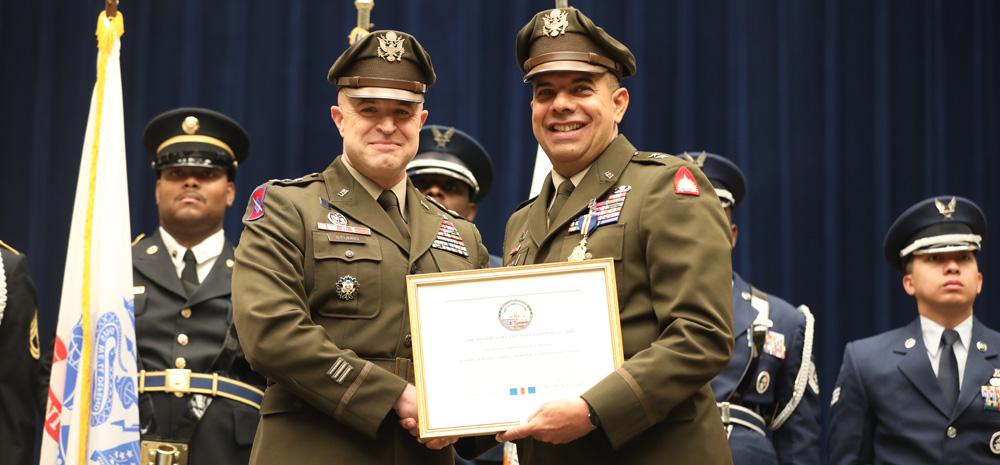
The author is a 1989 graduate of the U.S. Military Academy at West Point, New York. He served on active duty with the Army until 2000. He subsequently joined the New York Army National Guard. He was appointed deputy director of the Army Guard at the National Guard Bureau in 2020. In September 2023, he assumed command of the D.C. Guard, where he remained until his retirement Oct. 1, 2025.
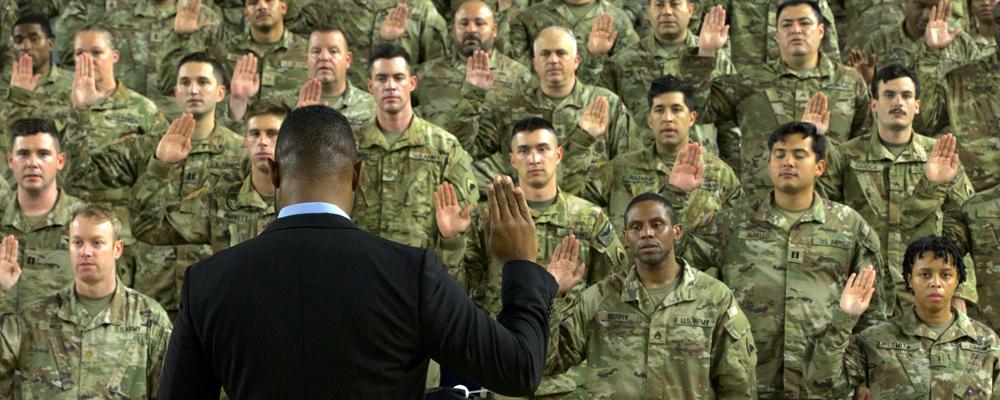
TOP PHOTO: D.C. Guardsmen participate in a deputizing ceremony for the D.C. Safe and Beautiful Mission on Aug. 13. (SPC. SHERALD MCAULAY)