then Add to Home Screen.
Portland Trailblazers
By Donald Lambert & John Goheen
Being the first at anything can be an adventure. It’s also a chance to make your mark. But it comes with responsibilities: You must blaze a proper trail for those who follow.
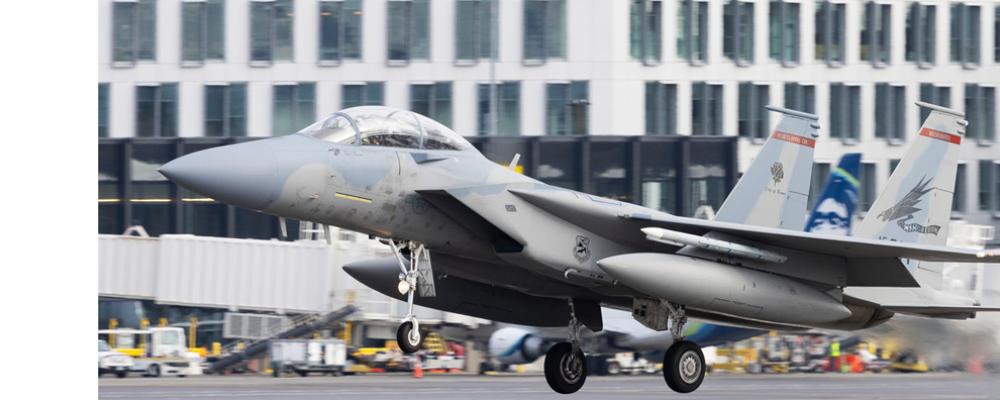
Just ask the pilots and ground personnel with the 142nd Wing. The Oregon Air National Guard wing is the first operational unit in the Air Force to receive the F-15EX Eagle II fighter.
The latest version of the venerable iconic F-15 began arriving at Air Guard base on Portland International Airport in June 2024. The unit now has nine, with a 10th set to be delivered by the end of February. Ultimately, the wing will get 21. It remains the only unit in the Air Force with the EX.
“It’s both exciting and challenging,” says Col. David “Pound” Christensen, the wing commander. “It’s exciting because we’ve been entrusted to build the foundation for the EX enterprise for the entire Air Force. Our support personnel, maintainers, pilots, they’re all creating what right looks like with the new weapon system. And that’s pretty cool.
“It’s challenging because the enterprise is growing and maturing as we execute,” he adds. “So, there’s significant evolving that’s going on with guidance, with the plans, things we learn about the airplane, things Boeing learns about the airplane.”
The F-15 is primarily an air-supremacy fighter. It has been in Air Force service since 1976. The wing has been flying the aircraft since 1990, first the A/B model before transitioning to the C/D in 2007. A and C models have one seat; the B, D and EX have two.
As the EX models arrive, they replace one-for-one older F-15C/Ds, which head to the aircraft boneyard at Davis-Monthan Air Force Base in Tucson, Arizona.
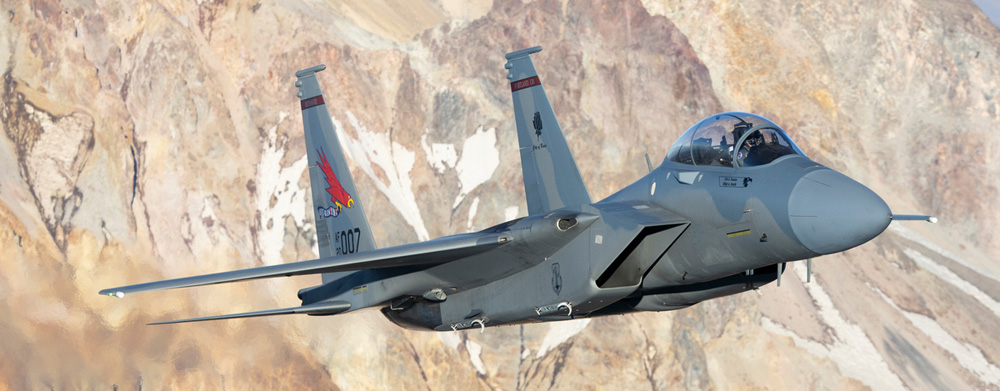
From the outside, the EX looks like its legacy siblings. Inside, however, things are very different.
“When [the F-15EX] first landed, we thought it looked very much like the C-model that’s parked next to it, but when you start digging into the avionics and all the different hardware, it’s really a new jet,” says Capt. Jordan “Zorro” Zamora, a pilot with the unit.
Key upgrades include a digital fly-by-wire system, advanced AN/APG-82 AESA radar, the Eagle Passive/ Active Warning and Survivability System for electronic warfare, more powerful engines and increased payload capacity.
It also features a modern glass cockpit with touchscreens, enabling both air-to-air and air-to-ground missions, compared to the F-15C’s analog-focused design, which was built strictly for air-to-air missions.
Master Sgt. Tad Benner, who has been with the Oregon Air Guard since 1987 and has worked as a weapons loader on F-15s at the 142nd, agrees the EX is a different kind of animal under the surface. “The cockpit is more like a Tesla than what you would imagine the inside of an F-15 would look like,” he says.
The EX is powered by two F110-GE-129 engines, each engine generating a thrust of 29,000 lbs., reaching top speeds of Mach 2.5, which is more than 1,900 mph. The F-15C could reach top speeds between Mach 2.2 and 2.25, when it was new.
Unit personnel are learning to use and maintain the advanced technology of the EXs while using their older C models to protect the skies over the United States from Northern California to the Canadian border as part of its Airspace Control Authority mission, Christensen says. That requires the unit to have pilots qualified in both aircraft.
We’ve been entrusted to build the foundation for the EX enterprise for the entire Air Force.
—Col. David “Pound” Christensen, the commander of the Oregon Air National Guard’s 142nd Wing
Controversial choice
The Air Force is retiring F-15C/Ds due to widespread structural fatigue. More than 75% of them are in some way performance limited; either in how fast they can fly or how much G-loading they can endure. Originally designed for 4,000 flight hours, the airframe was extended to 8,000 and some sustained more than 10,000 hours.
Service officials wanted to replace the entire fleet with the F-22 Raptor, a stealth fighter, but that strategy fell through when the Pentagon called an early halt to the purchase in 2011. That required the Air Force to retain the F-15C/Ds for the airspace control mission.
In 2020, the service announced a new plan to replace them at five Air Guard fighter operational units and a sixth that was the F-15 schoolhouse. The six would convert to either the new F-15EX or F-35A Lightning II stealth fighters. The 142nd was to be the first operational EX unit.
Opting for a modernized version of a 20th-centruy aircraft was controversial. The Air Force had been procuring only stealth fighters. But stealth wasn’t needed to defend the skies over the United States, officials said. The F-15 could also fly faster and farther than the F-35 — critical attributes when intercepting incoming aircraft.
In addition, the F-15 EX could be based at existing facilities. No need for the tens of millions of dollars in infrastructure upgrades required for F-35s. And while the F-35 is slightly less expensive, in part due to the number being built, the EX is cheaper to fly and has a longer service life.
The F-15EX also adds a wrinkle to the Air Force’s strike capability. It’s nonstealth “missile truck” that augments stealth platforms by carrying up to 12 air-to-air missiles or heavy stand-off munitions.
Gen. Kenneth S. Wilsbach, the Air Force’s new chief of staff, told the Senate Armed Services Committee during his Oct. 9 confirmation hearing last fall that the EX will have “the capability to carry weapons that very few other platforms do.”
These, he said, include “very long-range weapons, perhaps hypersonic weapons, that don’t fit in the internal weapons bay of our fifth- and future sixth-generation aircraft.”
Some changes
The 2020 recapitalization strategy included 144 EXs and the retirement of the last F-15C/Ds by this year, but cost delayed and truncated the plan.
The Air Force’s Long-Term Fighter Force Structure report submitted to Congress last year said the service will now keep some of the aging fighters through 2030 for the homeland mission. Last to go will be the F-15C/Ds at the California Air Guard’s 144th Fighter Wing in Fresno, California.
The report added that the Air Force will cull the fleet as the EX fielding progresses to retain only the most viable legacy F-15s — the Air Force refers to them as Platinum Eagles — in service.
Officials now plan to buy 129 EXs. The Air Force’s 18th Wing at Kadena Air Base in Okinawa, Japan, is next on the fielding list. It retired its last old F-15s in late 2024 and was supposed to begin receiving the advanced models this spring, but a machinist strike last fall at the Boeing plant in St. Louis has delayed those plans. The 18th Wing has relied on rotating fighter units to support the Pacific Air Forces missions.
The Louisiana Air Guard’s 159th Fighter Wing in New Orleans, the 144th FW and the Michigan Air Guard’s 127th Wing outside of Detroit are also in the fielding plan. Like the 144th FW, the 159th FW flies the F-15C/D. Projected delivery time is not public.
The Michigan unit operates the A-10 Thunderbolt II fighter, another aircraft the Air Force wants to retire soon. It wasn’t in the plan until President Donald Trump visited Selfridge Air National Guard last year and announced the EX would replace its A-10s.
The Long-Term Fighter Force Structure report also said Boeing is ramping up its manufacturing capacity in St. Louis and expects to deliver 126 F-15EXs by the end of 2030. The production line is currently shared with foreign military sales.
Former Air Guard F-15 units in Florida (125th Fighter Wing) and Massachusetts (104th Fighter Wing) and the schoolhouse in Oregon (173rd Fighter Wing) have retired their legacy aircraft. All three have begun to convert to the F-35A or soon will. Seymour Johnson Air Force Base in North Carolina is new home to the F-15 schoolhouse.
The F-15EX II has the capability to carry weapons that very few other platforms do.
—Gen. Kenneth S. Wilsbach, the chief of staff of the Air Force
Big attraction
Christensen says the 142nd Wing gets a lot of requests from other units on the fielding list to come see the F-15EX up close and pick the brains of his pilots and maintainers. He adds that it’s all part of being the first unit with a new aircraft.
“We’re happy to have them, and happy to show what we know,” Christensen says. “And then as we get closer to bedding down airplanes and other locations, we’ll do the best we can to send our folks out there to help as much as they want us to. We’ll be the subject matter expert’s forum to help get things rolling and keep the enterprise going.”
That the EX is a brand-new aircraft with technology and capabilities not found in previous models is one piece of advice wing members will likely share.
“For me, it’s pretty big learning curve as I started to learn the air to ground stuff,” says Christensen, who had flown older models for more than 20 years. “But the EX is a much more capable airplane overall.”
And while there is a 70% parts commonality with existing F-15s, maintainers, too, have also had to learn a “whole new system,” he says.
“The best example is the flight controls,” the wing commander explains. “Whereas we used to have hydraulic flight controls with rods and you had to set up the jet correctly with the riggings and things like that. That was a particular shop. Now, a different shop works the f light controls, because it is a fly-by-wire with a lot of electronics in it.”
Still, the entire wing appears to be quite happy with its place in the F-15EX fielding plan.
“It’s been a long time coming,” says Lt. Col. John “Sick” Friedman, an instructor pilot with the unit. “We’re kind of going from this antiquated platform that maybe isn’t as relevant in the modern fight today, to, I would argue, quite relevant with the F-15EX.”
Adds Benner, the longtime maintainer, “Because of the capabilities of this machine and the weapons platform, coupled with the caliber of maintainers and operators that we have, I think this [aircraft] would make any adversary want to invest more in diplomacy.”
DONALD LAMBERT is a former NGAUS staff writer. JOHN GOHEEN is the director of communications. He can be reached at [email protected].
OUR TAKE
 Recapitalization of the Air National Guard fighter fleet is a NGAUS legislative priority. The planned fielding of the F-15EX Eagle II fighters to units in California, Louisiana, Michigan and Oregon is critical to Air Guard fulfilling its obligations to the National Defense Strategy. This requires funding 24 F-15EX fighter aircraft every year until all four units are fully recapitalized. At the same time, the legacy aircraft of these units must not be retired until the new fighters arrive to help retain pilots and maintainers critical to conversion.
AT A GLANCE: F-15EX Eagle II
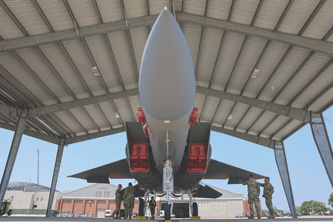
(1ST LT. ELISE WAHLSTROM)
Width: 42.8 feet (13 meters)
Length: 63.8 feet (19.4 meters)
Height: 18.5 feet (5.6 meters)
Maximum Takeoff Weight: 81,000 pounds (36,741 kilograms)
Power Plant: Two General Electric F100-PW-229 turbofans with afterburners, each 29,000-pound thrust
Maximum Speed: Mach 2.5
Ceiling: 50,000 feet (15,240 meters)
Payload: 29,500 pounds (13,381 kilograms)
Service Life: 20,000+ hours
Planned Production: 129
Source: Boeing