then Add to Home Screen.
New Wheels
A Virginia-based infantry formation recently became the first in the Army National Guard to receive the controversial Infantry Squad Vehicle as part of its conversion to a mobile brigade combat team.
“The ISV gives our infantry the reach to cover more objectives, get to them faster, exploit enemy weaknesses, catch the enemy off guard and maintain the initiative,” Col. Arthur S. Moore, commander of the 116th MBCT, said in a Virginia Guard press release. He called the vehicle’s adoption a critical step toward increasing the brigade’s battlefield mobility.
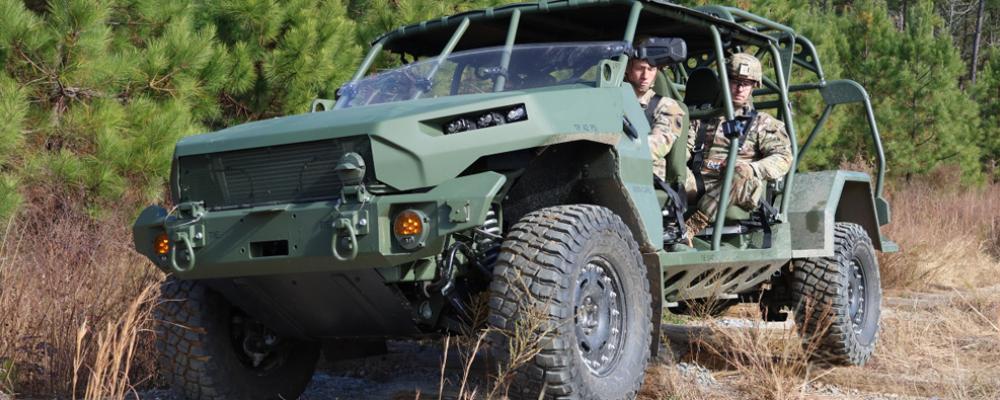
Although the ISV has received wide praise from military officials, it does have its critics. Without armor, doors, windows or even a roof, it looks more like a souped-up dune buggy than a traditional combat vehicle, fueling debate over how an exposed platform can survive real-world military operations.
Yet, the 116th — along with several active-component Army units that have already converted to MBCTs — offer a glimpse of how Soldiers will train with and employ the ISV.
The Army’s new ground combat formation and its key mobility instrument are also central to the Army Guard’s future. The force has 27 BCTs, including 20 infantry, five armored and two Stryker. Twenty -five (all but two of the armored BCTs) will convert to MBCTs as part of the Army Transformation Initiative announced last spring.
Lt. Gen. Jonathan Stubbs, director of the Army National Guard, told NATIONAL GUARD last summer that shifting toward MBCTs creates “a more agile, adaptive, lethal and affordable force.” He said the transformation is driven by the changing “character of war,” pointing to lessons learned from the war in Ukraine. He explained how small, inexpensive drones have made large, slow-moving armored vehicles increasingly vulnerable.
Reports from the war show combatants using both DIY and mass-produced drones for surveillance, “kamikaze” strikes against personnel and vehicles, electronic and communication disruption, supply-line interdiction and counterattacks — all of which seemingly reinforce the Army’s argument that mobility and dispersion are becoming more important than armor.
“There’s a quality of lethality associated with being more maneuverable, more agile, more adaptive,” Stubbs said. “And it’s not just lethality, but survivability.” He called the ISV “the hub” of the Army and Army Guard’s effort to improve troop “mobility.”
The Army developed the ISV through a multiyear effort to find an ultralight combat vehicle, and in 2019, contracted three companies to develop prototypes. According to a Congressional Research Service report, the designs had to be capable of carrying nine passengers, a total 3,200-pound payload and ready for immediate air transport.
In 2020, the Army ultimately awarded the contract to GM Defense, a subsidiary of the Detroit-based General Motors. For the ISV, the company modified the Chevrolet Colorado ZR2 off-road truck to meet military specifications and so it could be loaded into a CH-47 Chinook helicopter, slung from a UH-60 Black Hawk helicopter and airdropped from a C-130 Hercules cargo plane.
The ISV gives our infantry the reach to cover more objectives.
—Col. Arthur S. Moore, the commander of the Virginia Army National Guard’s 116th Mobile Brigade Combat Team
A ‘better boot’
After its debut, though, critics zeroed in on the fact that the ISV has no armor, and because of that, they argued that it was unsafe for combat. The criticism was largely based a Department of Defense report of the initial testing, calling it “not operationally suitable.”
In response, Army officials clarified that it wasn’t supposed to have armor, nor was it meant for direct combat. Steve Herrick, a product lead with the Army’s Program Executive Office for Combat Support and Combat Service Support, told Breaking Defense, “The primary role of the ISV is as a troop carrier to provide ground mobility to designated infantry rifle squads [and] reducing their need to cover large areas of terrain on foot.”
Since then, officials have stressed the transport aspect of the vehicle by calling it a “better boot.” They are also quick to point to the changes in the character of war illustrated by the fighting in Ukraine since 2022.
Some observers have compared the ISV to the World War II-era Jeep because it filled a similar role as a fast, multiuse transport vehicle for troops, weapons and reconnaissance missions. But the ISV’s commercial origins have attracted the most attention. Roughly 90% of the vehicle consists of off-the-shelf parts, making it easier to maintain, repair and modify than a typical defense-contracted system.
Retired Army Maj. Gen. John Ferrari, a senior fellow at the American Enterprise Institute, argued in The National Interest that the Army set an example for “innovation” by selecting a platform that is simpler and cheaper than most contracted systems.
“Because the ISV is inexpensive and fielded in numbers, Soldiers can test these emerging technologies in realistic conditions without risking multibillion-dollar assets,” Ferrari wrote. “The result is rapid iteration.”
The Army’s 2020 contract outlined plans to buy 649 ISVs for $214.3 million — roughly $330,200 per vehicle — placing it within the price range of other small Army vehicles. Ferrari added that the platform helps enable “nonstop innovation in warfare, almost in real time.”
That philosophy aligns with an Army initiative known as Transformation in Contact, which evaluates how personnel and tactics adapt to new technology. As part of that effort, the service is reorganizing traditional infantry brigades into mobility brigades built around fast, modular vehicles, according to an October 2024 article in the Army’s Line of Departure.
In the article, the Army outlined several ISV variants designed to replace legacy platforms (though, it’s important to note that they won’t be replaced completely). Alongside the basic squad carrier, variants include a command-and-control ISV, a mortar carrier, an anti-tank version and multiple flatbed configurations for hauling specialized equipment.
Other models are being showcased as well, like the ISV equipped with a BlueHalo LOCUST laser weapon system for counter-drone operations and an autonomous ISV.
Inside the ISV
The ISV has nine seats across four compact rows. The layout includes two front seats, three in the second row, two facing backward in the third, and two facing outward in the fourth. Each soldier buckles in with a four-point harness, while gear can be strapped to the roll cage or stowed along the vehicle’s sides.
Operating the ISV feels like driving a commercial truck. It has a push-button start; standard controls like a horn, lights, turn signal; and analog gauges for fuel, speed, and RPMs. A center digital display shows whether the vehicle is in two- or four-wheel drive and provides readouts for roll and pitch angles. Below the screen are more controls and auxiliary power outlets.
During a training exercise and demonstration last year at Fort Polk, Louisiana, Soldiers with the 101st Airborne Division trained with the ISV within the narrow scope of its intended purpose.
First Lt. Dan Reimchen described the ISV as “essentially a high-mobility vehicle that’s meant to transport troops and equipment from A to B.” He explained the goal was to use it “to get you as close to the X as possible” and then “dismount and take the fight to the enemy” without burning up too much energy.
Staff Sgt. Alex Hood explained that the ISV can carry “all the heavy things that we carry, to include our ruck, javelin systems, AT4s, Carl Gustaf, the Stingers, I mean, you name it. All the stuff that we have to carry with us to fight.” He added: “It kind of takes the weight off the Soldier’s back.”
And Cpl. Timothy Duey described driving an ISV as comparable to driving a normal pickup truck. “It maneuvers a lot better through the wood line than I thought it would,” he said. “It definitely maneuvers better than a Humvee.”
It kind of takes the weight off the Soldier’s back.
—Staff Sgt. Alex Hood of the U.S. Army’s 101st Airborne Division (Air Assault)
Guard debut
From Nov. 10 to 14, soldiers with the 116th MBCT completed a 40-hour Operator New Equipment Training course at Fort Pickett, Virginia.
Sgt. 1st Class Michael B. Wilcox, the brigade’s assistant operations noncommissioned officer, said the course focused on familiarizing master drivers and NCOs who would return to their companies and train other soldiers.
“We were able to learn the capabilities and put every block of instruction to use in a practical exercise in a training area on Fort Pickett,” Wilcox said.
The course included two tracks: one for operators and one for maintainers. Operators learned vehicle functionality, preventive and corrective maintenance, off-road driving, adverse terrain navigation, and casualty evacuation procedures. Maintainers focused on troubleshooting and repairs.
However, exactly what the training looks like varies by geography. During other exercises and demonstrations, training started with the basics and progressed into more complex conditions.
At Fort Campbell on the Kentucky–Tennessee border, soldiers trained on mud, steep terrain, rock gardens and waterlogged trails. Back in Fort Johnson, they incorporated aviation assets, sling-loading ISVs beneath a Chinook and rapidly transitioning from air insertion to ground movement.
Overseas, the Joint Multinational Readiness Center in Hohenfels, Germany, Soldiers trained with ISVs on snow and ice, and in sub-freezing temperatures. They practiced concealment techniques as well as loading and unloading gear in winter conditions and hiding the vehicle to avoid detection.
And in combat situations, Col. David Lamborn, commander of the 25th Infantry Division’s 2nd MBCT, told Defense One that Soldiers are practicing jumping out of the vehicle to fight on foot. Once a battlefield threat has been spotted, “that’s where you alter your movement techniques and you dismount,” he said.
Utility at home
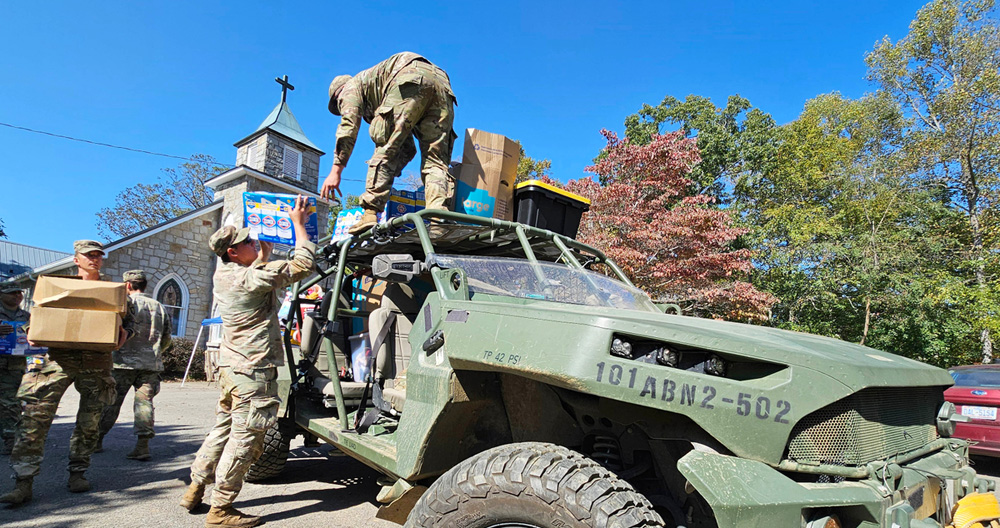
In October 2024, the Army deployed the 101st along with dozens of ISVs to North Carolina after Hurricane Helene. The mission provided a real-world test of the vehicle’s mobility as Soldiers cleared debris, transported supplies and moved personnel through a damaged, hard-to-reach area.
After the operation, officials described the ISV as “essential” thanks to its ability to reach any point in the operational area and deliver urgently needed relief supplies and equipment quickly despite blocked roads and widespread debris. The storm also underscored the limitations of legacy platforms. The task force also had trucks, but officials said they “lacked the simplicity and maneuverability of the ISV fleet” and were significantly slower.
Moore, the 116th MBCT commander, said initial fielding will position ISVs in key locations across units in Virginia and Kentucky for hands-on training ahead of the brigade’s upcoming Joint Readiness Training Center rotation in June 2026. “When fielding is complete, each infantry company will have enough ISVs to rapidly move every squad where they need to be,” he said.
Going forward, Moore said the brigade will adjust how it fights. Soldiers will integrate ISVs — along with drones and other new systems — into small-unit operations, but the core mission “to close with the enemy as light infantry remains unchanged.” But the combination of fast transport and enhanced reconnaissance tools, he added, means Soldiers will be able “to cover more objectives and get near them faster.”
DANIEL TERRILL, a former U.S. Marine and police officer, is a Chicago-based freelance writer who specializes in firearm and military subjects. He can be reached via [email protected].
TOP PHOTO: Soldiers with the 116th Mobile Brigade Combat Team conduct initial training on the Infantry Squad Vehicle Nov. 14 at Fort Pickett, Virginia. (COTTON PURYEAR)
AT A GLANCE: Mobile Infantry Brigade Team
The Army is creating mobile infantry brigade combat teams to address lessons learned from modern conflicts, such as the war in Ukraine, where traditional concentrated formations are vulnerable to persistent aerial surveillance and precision strikes.
By being smaller and more mobile, MBCTs can operate independently in austere environments while maintaining the ability to rapidly concentrate force when needed.
Key Characteristics
- Reduced Footprint: MBCTs are significantly leaner, dropping from the standard IBCT strength of about 4,500 Soldiers to roughly 1,900 soldiers. This reduction aims to decrease the unit’s electromagnetic and logistical footprints while increasing individual lethality.
- High Mobility: Unlike traditional infantry that traveled on foot, every MBCT rifle squad is equipped with the Infantry Squad Vehicle.
- Technological Density: Formations integrate advanced sensors, small unmanned aerial systems and electronic warfare tools down to the squad level.
Implementation Timeline
The Army officially began converting units in 2025, with a total of 25 IBCTs (14 active and 20 National Guard units eventually) slated for transition by 2028-2030. Three Guard armored BCTs and two Stryker BCTs will also convert. Two former Guard IBCTs (the 116th, headquartered in Virginia, and the 76th in Indiana) have already been redesigned.
Source: Congressional Research Service