then Add to Home Screen.
Mastering an Unseen Threat
By Lt. Col. Patrick O’Brien Boling & Maj. Jason Montgomery
Imagine a quiet Arkansas morning — coffee brewing, chores underway, errands planned — when the ground suddenly heaves violently. No siren. No forecast. Just the New Madrid Seismic Zone unleashing its power.
The last major NMSZ events struck in 1811–1812. They were a series of estimated magnitude 7.0–8.0 quakes that rang church bells in Boston, reversed the Mississippi River’s flow for hours, created temporary waterfalls, formed liquefaction lakes (“sand blows”) and sent saltwater surging into Louisiana’s lower parishes. Effects reached as far as Illinois, Texas and Virginia. River trade stopped.
Today, in the densely populated, infrastructure-heavy region, a repeat would be far worse, disrupting commerce, utilities and transportation across multiple states. Saltwater might infiltrate drinking-water systems in Louisiana’s lower five parishes. Flooding would sweep the valley plains. River trade would halt completely. East-west interstate and highway bridges would crack, bringing traffic to a halt.
The NMSZ stretches from southern Illinois through Missouri into northeast Arkansas, placing Memphis and Jonesboro, Arkansas, squarely in the highest-risk zone. The U.S. Geological Survey estimates a 7–10% chance of a magnitude 7.0–8.0 event and a 25–40% chance of a magnitude 6.0 or more in the next 50 years.
Liquefaction: the deadly twist
The region’s geology increases the danger. Unlike West Coast faults on firm bedrock, NMSZ soils along the Mississippi River are loose and water saturated. During strong shaking, liquefaction turns stable ground into quicksand-like liquid. Buildings tilt or sink. Roads buckle. Bridges fail.
The landscape becomes unrecognizable, trapping residents and delaying aid. Heavier rainfall from climate change will only worsen soil saturation and liquefaction risk.
A modern scenario of magnitude 7.7 (e.g., the Federal Emergency Management Agency’s Shaken Fury model or the Mid-America Earthquake Center studies) projects severe, widespread effects. Memphis — home to more than 1 million people in its metro area and just miles from fault lines — faces extensive damage to aging infrastructure. Unreinforced masonry buildings, older schools, fire/ police stations and unreinforced structures could collapse.
Liquefaction along the Mississippi and Wolf rivers would threaten downtown areas. Major bridges (including crossings over the Mississippi) could become impassable, halting search and rescue, evacuation and supply delivery. Power outages could affect millions across the region, with hospitals overwhelmed and travel severely delayed.
Jonesboro, Arkansas — a key northeast hub with around 135,000 residents — sits in the direct path of intense shaking. A major quake could cause structural damage to buildings, disrupt utilities, and isolate communities due to damaged roads and bridges.
Smaller towns in Arkansas like Blytheville, Marked Tree, Payneway and Trumann risk being cut off — turned into islands — with limited access to hospitals in Jonesboro or Memphis, Tennessee. Debris generation could reach millions of tons in Arkansas alone.
Broader regional fallout includes major damage in the Missouri Bootheel, western Kentucky and southern Illinois. St. Louis could experience significant shaking and strain on infrastructure.
Overall, a large event might force millions to relocate, cause tens of thousands of casualties/injuries, damage hundreds of hospitals, render 15-plus major bridges unusable and rack up direct economic losses nearing $300 billion across eight states (with indirect losses potentially double that). Transportation hubs like Memphis (home to FedEx Global Operations) amplify national supply-chain disruptions.
Infrastructure across the region is especially vulnerable. Only about 15% of Arkansas’s critical infrastructure has been seismically retrofitted — compared to more than 60% in California. Modern codes help in some areas, but older unreinforced masonry buildings (common in rural communities) and many private homes remain highly vulnerable.
Historically, the state has prioritized more frequent threats — ice storms, floods, tornadoes, wildfires — leaving seismic gaps.
NMSZ vs. San Andreas
The San Andreas Fault in California is a classic plate-boundary transform fault where the Pacific Plate slides past the North American Plate at about 37mm per year — driving frequent, predictable stress buildup and quakes.
The NMSZ, by contrast, is an intraplate seismic zone within the stable North American Plate interior — likely tied to an ancient, failed rift. No clear plate motion drives it, so deformation is slow or episodic, making recurrence harder to predict from GPS data.
Seismic waves travel farther and with less damping in the Midwest’s dense, older bedrock — shaking an area up to 20 times larger than a similar quake within fractured California geology. A magnitude 7 or greater NMSZ event could be felt more widely and more intensely in soft river sediments.
Probability differs too: San Andreas sees more regular moderate-to-large events, while NMSZ major quakes recur roughly every 500–1,200 years (last cluster 1811–1812). Yet a modern NMSZ rupture could cause greater national economic losses by disrupting Midwest transportation, pipelines and utilities — potentially rivaling or exceeding a San Andreas “Big One” in broad impact.
These contrasts emphasize why Arkansas’s all-hazards prep is vital: NMSZ risks are lower-frequency but high-consequence, with unique amplification factors.
An earthquake in the NMSZ would disrupt commerce, utilities and transportation across multiple states.
A multilayered framework
Considering the NMSZ’s special challenges, Arkansas is building a multilayered response strategy. It utilizes the Arkansas National Guard’s expertise alongside deep partnerships.
The Arkansas Division of Emergency Management, or ADEM, leads any response. The Guard maintains readiness through close cooperation with local emergency management coordinators, Arkansas State Police, Arkansas Department of Transportation, U.S. Army Corps of Engineers, Central U.S. Earthquake Consortium and FEMA Region 6 states (Louisiana, New Mexico, Oklahoma and Texas).
This approach prepares for earthquakes while boosting capacity across all crises — natural and human-induced. It assumes degraded infrastructure and fractured communications.
Key elements include redundant systems (satellite phones, ham radio, Starlink, a satellite internet provider), mapped secondary/ tertiary routes, strategic stockpiles (water, medical kits, generators, MREs at armories) and pre-planned integration of partner skills such as urban search-and-rescue and hazardous-materials response.
Wargaming the worst
Since 2023, the Arkansas Guard has run annual tabletop exercises at the All-Hazards Conference, focusing on NMSZ scenarios. These bring together ADEM, and other state and federal agencies to simulate real challenges.
In 2025, the director of military support, or DOMS, hosted a dedicated regional exercise. It integrated Guard units from FEMA Region 6 to test Emergency Management Assistance Compact processes. More than 200 participants focused on daily operational breakdowns.
Arkansas refined route assessment plans with alternate pathways to bypass damaged infrastructure. Oklahoma and New Mexico discussed insights on managing personnel/ equipment influxes. Texas provided hazardous materials and urban search-and-rescue expertise. Louisiana contributed commodity distribution and self-sustaining operations strategies, lessening the strain on local responders.
The exercise uncovered gaps in communications and staging areas. Fixes are now in progress. “Continuous collaboration and rehearsal of this joint plan expands our preparedness and response capacity to a no-notice event,” said Maj. Jason Montgomery, the Arkansas Army Guard DOMS operations officer.
ADEM is building redundant communications (satellite phones, ham radio). The Guard integrates technologies like Starlink to avoid seismic-vulnerable infrastructure, per Col. Tommy Edwards, the Arkansas Guard’s DOMS. State transportation officials map secondary routes. The Guard also develops multitiered stockpiling plans, as outlined in its 2025 Logistics Preparedness Overview.
Normally, Arkansas sends aid to hurricane states via EMAC, which enables states to assist each other during emergencies. A major NMSZ quake would reverse roles, requiring massive incoming support.
Since 2010, the Arkansas Guard has deployed more than 1,500 personnel to aid Florida, Louisiana, Texas and other states following hurricanes, wildfires and other disasters. These missions developed expertise in logistics, search-and-rescue, and inter-agency coordination.
Deployments taught the importance of anticipating damaged infrastructure and supply chain interruptions — directly applicable to NMSZ. Lessons from Hurricane Katrina (2005) shaped mass-evacuation and sheltering plans. Hurricane Harvey (2017) models inform rapid debris clearance.
This cross-pollination ensures earthquake preparedness enhances responses to floods, tornadoes, cyberattacks, pandemics and more. NMSZ planning likewise builds skills for receiving large-scale aid — a scenario Louisiana knows well during hurricanes. Joint EMAC drills create shared logistics standards, compatible communications and flexible frameworks across hazards.
Being ready for this type of event guarantees we are ready for anything.
—Brig. Gen. Chad Bridges, the adjutant general of Arkansas
A unique readiness challenge
“Earthquakes are no-notice events, and we haven’t seen a major one in the lifetime of our current members,” said Brig. Gen. Chad Bridges, the Arkansas adjutant general. “Being ready for this type of event guarantees we are ready for anything.”
Unlike predictable disasters, earthquakes demand immediate mobilization and decentralized command. The Guard ensures all personnel — Soldiers, Airmen, civilians — know their roles in the DOMS NMSZ joint plan.
High-risk units in Jonesboro and Blytheville use backup communications (portable radios, satellite uplinks). They run quarterly “actions on contact” drills simulating collapsed armories, severed supply lines and a loss of central command. These test independent operations while working with statewide efforts.
The Guard stockpiles water, MREs and essentials at regional armories. It has private-sector agreements for rapid delivery of fuel and equipment. Preparing for NMSZ extremes increases capacity to handle ice storms, chemical spills and other crises with similar logistics and communication requirements.
ADEM’s Community Emergency Response Team program has trained more than 5,000 Arkansans since 2015 in first aid, light search-and-rescue and disaster assessment — creating a vital network of neighbors ready to help until professionals arrive.
Regional model for resilience
Arkansas’s NMSZ focus is evolving into a wider regional strength. For Louisiana (a frequent recipient of Arkansas hurricane aid), it provides a template for managing massive inbound forces, multistate staging, and self-sustaining operations under strain. Shared exercises build EMAC muscle and adaptable standards across FEMA Region 6.
Continual investment in retrofitting, public education, resilience infrastructure, and cross-border coordination will keep pace with urban growth and climate shifts.
Arkansas’s proactive approach to the NMSZ not only prepares the state for a major earthquake but also strengthens responses to floods, hurricanes, ice storms, pandemics and more, sharing valuable lessons with regional partners like Louisiana.
When the ground shakes again, Arkansas — and its neighbors — will demonstrate that deliberate preparation, shared lessons and strong partnerships that are able to transform an unseen threat into a challenge the region is prepared to meet.
LT. COL. PATRICK O’BRIEN BOLING is the Louisiana National Guard’s deputy director of J5 strategy and policy, shaping long-term disaster and defense planning. He has published numerous articles on defense and disaster-related topics.
MAJ. JASON MONTGOMERY is the Arkansas National Guard’s J33 current operations officer and chief of plans for the state’s joint director of military support, coordinating large-scale responses to man-made and natural disasters.
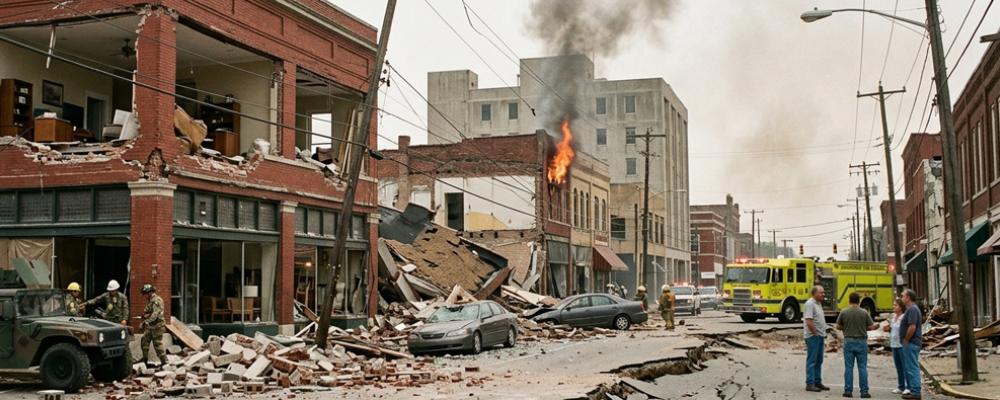
TOP PHOTO: An image produced by GEMINI, an artificial intelligence program, depicts a response in an urban area to an earthquake in the New Madrid Seismic Zone. (ARKANSAS NATIONAL GUARD)
Empowering Arkansans to act first
Community preparedness forms the foundation. The Arkansas Department of Emergency Management and the Arkansas National Guard urge residents to:
■ Make a plan — Designate an out-of-state contact, practice reunification and evacuation routes, rehearse “Drop, Cover, and Hold On,” and join the annual Great ShakeOut.
■ Build a kit — Stock 72 hours to 2 weeks of supplies: 1 gallon of water per person per day, nonperishable food, flashlight, battery-powered radio, first-aid kit, medications, clothing and pet supplies.
■ Keep informed — Use MyShake (where available), Ready. gov, ShakeOut.org, Arkansas Geological Survey resources and the iDrive Arkansas app for road conditions.
■ Act safely post-quake — Expect aftershocks, look for gas leaks/structural damage, avoid electrical risks, document damage for insurance and monitor updates via radio.