then Add to Home Screen.
Duty Status Reform
The association’s top priority in the fiscal 2027 legislation cycle is far from a new issue. It’s just taken Congress a long time to get what it needs to take action.
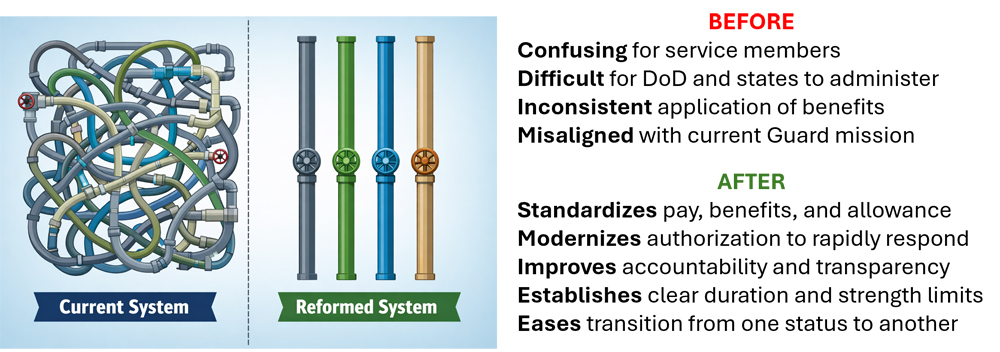
For decades, the National Guard and Reserves have struggled under a duty status system that is outdated, confusing, inefficient and inequitable, according to many in the Pentagon, on Capital Hill and elsewhere.
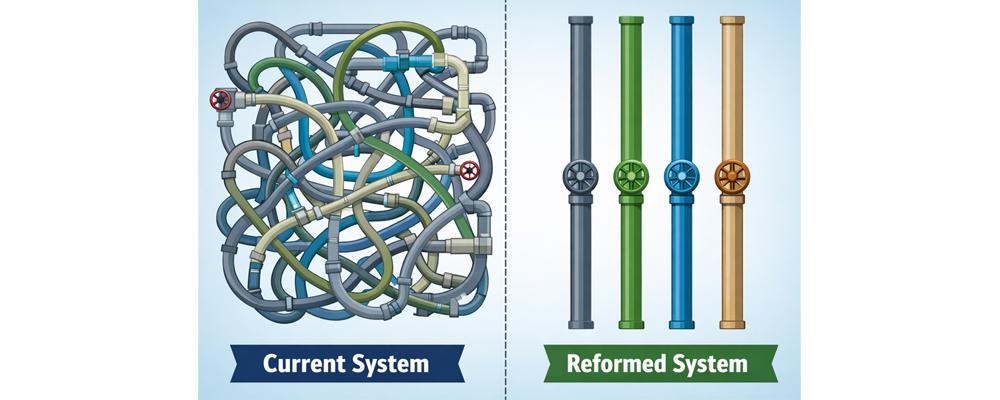
The current patchwork of more than 30 Guard and Reserves duty statuses cobbled together since the end of World War II also too often makes the Guard and Reserve difficult to access and administer, say observers. Readiness, mission accomplishment and retention also take a hit, they add.
For comparison, there is only one duty status for the active components. Everybody is always in the same status. And the benefits and entitlements are always the same, which is not the case for the Guard and Reserve.
Commissions and panels looking at Defense Department programs and processes for the last 25 years have strongly recommended Duty Status Reform.
The 2001 Quadrennial Defense Review, which was authorized by Congress but conducted by DoD, acknowledged the need for change. The duty status system, according to its final report, is “complex, aligns poorly to current training and mission support requirements, fosters inconsistencies in compensation, and complicates rather than supports effective budgeting.”
The independent Commission on the National Guard and Reserves, which Congress created in the fiscal 2005 National Defense Authorization Act, came to the same conclusion. “Today’s duty statuses are confusing and frustrating to both the reserve component members and their operational commanders,” it said in its 2008 final report.
The commission recommended DoD reduce the then-29 duty statuses to two — on duty or off duty. The idea was dead on arrival in the Guard and Reserve community, however, for its impact on drill pay. A typical drill weekend would go from four duty days for pay to two.
Retired Marine Corps Maj. Gen. Arnold Punaro chaired the commission. He later became chairman of the Reserve Forces Policy Board, where in 2013 he recommended the Pentagon work with Congress to reduce the then 32 duty statuses to six.
“While DoD has concurred with numerous recommendations from previous studies and reviews over the past decade to reduce the number of reserve duty statuses, there has been no movement to actually reduce the number of duty statuses,” he wrote in a memo to the defense secretary.
Lawmakers are key to any such movement. Duty statuses are in law and only Congress can reduce their number. At the time, however, lawmakers were contributing to the problem. Between 1999 and 2013, they added six new statuses.
One was mobilization authority 12304b. Congress created it in 2011 at the request of the Pentagon to provide easier access to Guard and Reserve units for preplanned operations. But 12304b lacked some of the benefits Guardsmen had grown accustomed to receiving for their service, including early retirement credit, Post-9/11 GI Bill accrual or transitional health care.
NGAUS worked with Congress to fix 12304b, but it took until 2020 for lawmakers to add all the missing mission benefits. However, it wasn’t until last summer for DoD to formally correct a “misinterpretation” and make early retirement for mobilizations under 12304b retroactive back to its first use in 2012.
Reform process begins
The Duty Status Reform Act introduced in Congress earlier this year is a product of the fiscal 2018 National Defense Authorization Act. Lawmakers included a provision in the annual policy directing the Pentagon submit legislation reforming the current duty status system.
The process took so long in part because reforming something this complex would itself be complex. There were many statues to change and many stakeholders affected. Potential second-, third- and fourth-order effects had to be identified, evaluated and contained. Costs were another consideration. It also passed through three administrations.
Initially, Guard leaders were concerned that reform could usurp the governor’s authority of the force in Title 32, but those fears subsided as work progressed.
A research report released last year by the RAND Corporation provides a window to the process and the Pentagon’s thinking. It was funded and reviewed by the Office of the Under Secretary of Defense for Personnel and Readiness.
Reserve Component Duty Status Reform, Analytical Contributions to a New Construct for Activating and Compensating Members of the National Guard and Reserves, makes clear that the Pentagon is aware of the many problems associated with the current duty status system.
Officials are also aware that “service members may experience disruptions in pay and benefits from one duty status to another.”
It also acknowledged that the “complex rules and procedures are highly ineffective and inhibit volunteerism.”
The legislation reduces the more than 30 duty statuses to four broad categories (see below). RAND describes them as four categories: Contingency Duty, Training and Support, Reserve Support Duty and Remote Assignments. Compensation and benefits are the same across all four. Duty for the Guard can be performed in either Title 10 (fully federal) or Title 32 (federally funded under the control of the governor).
Finally, RAND said, “Most changes to the proposed construct impose no change in cost.”
Meanwhile, a Winter 2026 Pentagon brochure touts DSR as “Modernizing the Total Force for the Future.” Gen. Dan Caine, a career Air Guard officer who is now the chairman of Joint Chiefs of Staff, recently characterized the current system as the “House of Pain of 30 different duty statuses.”
Legislation introduced
Reps. Gil Cisneros, D-Calif., and Jack Bergman, R-Mich., both members of the House Armed Services Committee, introduced the Duty Status Reform Act (H.R. 6976) in January.
“We owe it to our service members to deliver this much-needed change and ensure they are receiving equitable pay and benefits,” said Cisneros, a Navy veteran and former undersecretary of defense for personnel and readiness.
“Having worked on this issue during my time at the Pentagon, I learned about the complexity of the current duty status system and how it hurts our readiness and quality of life for service members,” he added.
“The Duty Status Reform Act is a commonsense win for our Reserve and National Guard service members,” said Bergman, a retired Marine Corps lieutenant general who spent time in the Army Guard early in his military career. “It cuts through decades of red tape to make sure those who serve get consistent benefits, clear orders and the support they’ve earned.”
The legislation is largely what the Pentagon provided late last year. It cleans up hundreds of pages and cleans up nearly 300 laws.
In addition to NGAUS, the Duty Status Reform Act has the strong support of the Association of the U.S. Army, Military Officers Association of America, Reserve Organization of America, Adjutants General Association of the United States and Enlisted Association of the National Guard of the United States.
Retired Maj. Gen. Francis M. McGinn, the NGAUS president, believes passage into law would be on par with the landmark legislation of the early 20th century that codified federal support and the Guard’s dual state/federal role.
“Duty Status Reform makes the Guard easier to use, easier to understand and easier to administer — especially when members transition between statuses,” McGinn explains. “When statuses are clear, pay is timely, health care coverage is continuous and commanders can focus on the mission instead of paperwork.”
The author is the NGAUS director of communications. He can be reached at [email protected].
Categories, Duty Types and Authorities Under Duty Status Reform
Category I — Contingency Duty
● War
● National emergency
● Disaster response
● Cyber/WMD events
● Presidential call-ups
● Preplanned missions
Category II — Training and Support
● Disciplinary jurisdiction
● Missing status
● Required active-duty training
● Active Guard and Reserve functions
Category III — Reserve Support Duty
● Annual training
● Musters IDT-like duties
● Additional training with consent
Category IV — Remote Assignments
● Flexible tasks
● Online learning
● Individual, nonsupervised duties