then Add to Home Screen.
A Conversation with Maj. Gen. Francis J. Evon Jr.
You can’t judge the influence of an advocacy group by its size.
Take the Adjutants General Association of the United States, for instance. It has only 54 members, but each one is the senior officer responsible for the training and readiness of the National Guard in their state or territory.
Collectively, they deliver nearly half of the Army’s combat power and more than a third of the Air Force’s aerial refueling, strategic lift and fighter capability. They also provide the first military responders in the homeland during disasters.
And all politics being local, most adjutants general have working relationships with their congressional delegations. Their direct lines are on the contacts list of many phones on Capitol Hill.
As a result, when the adjutants general coalesce on an issue, AGAUS gets attention.
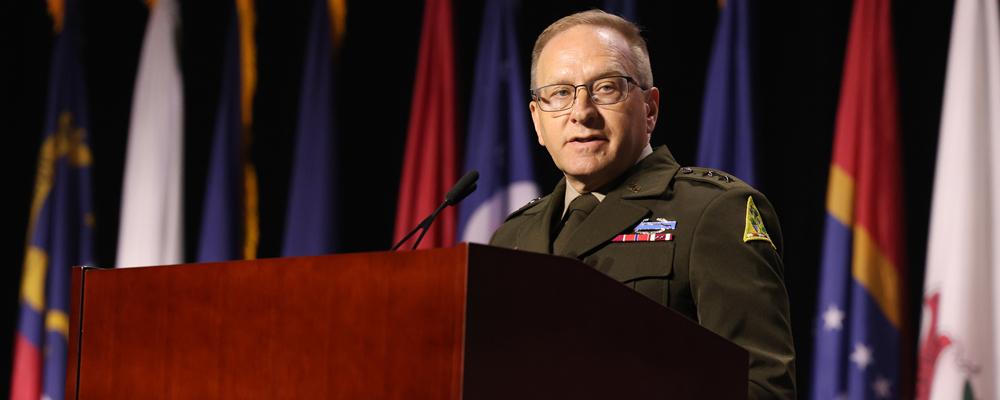
NATIONAL GUARD recently spoke with Army Maj. Gen. Francis J. Evon Jr., the adjutant general of Connecticut since 2018, and the newly elected president of the group. The conversation covered how AGAUS operates and its perspectives on some of the issues that today confront the Guard.
The TAGs have a channel of communications to the Pentagon in the chief of the National Guard Bureau. Your bosses have a conduit in the Council of Governors and you have NGAUS to work Capitol Hill. Why is it important for the adjutants general to have their own national voice?
It’s important because no one else sits where the TAGs sit. We live every day in the space between the state and federal missions. We understand both the governors’ priorities and the Department of Defense’s, the Department of War’s priorities. Our perspective does not exist anywhere else in the national security enterprise. AGAUS gives us the ability to speak collectively with the full weight of that experience. We are not theorizing about readiness or personnel policy; we are living it. When a federal budget stalls or when decisions in Washington ripple down to our armories, we feel it immediately.
The recent government shutdown is a perfect example. When pay stopped for our dual-status technicians, it was not a budget debate to us, it was a readiness crisis. Those are our people. We saw the impact firsthand that it had on them, their families, the readiness of whatever given platform or program that they work. AGAUS exists so that those realities are heard loud and clear before they become the next crisis.
How does AGAUS forge consensus when the priority of each adjutant general is the distinct needs of his or her own state or territory?
We build consensus by starting with what unites us, our people and our mission. Every TAG faces different challenges, but we are all accountable for the same outcome: a ready, modern and lethal National Guard.
We have conversations within and among ourselves that we don’t dance around. TAGs hold each other accountable. We call each other out. We bring the state-level realities to the table. We find out where there’s overlap. We identify shared priorities which typically revolve around full-time manning, modernization parity and force structure, and then we really move forward as one team with one voice. That unity gives us credibility. And when AGAUS speaks, it represents every state, territory and mission set, and that’s how I think we earn respect in Washington, for sure.
Nearly 40 states and territories have transitioned to new adjutants general since 2023. What impact does that have on AGAUS as a collective body?
It has been a good thing. Change brings energy. We have new TAGs with combat experience, cyber expertise and joint command backgrounds stepping into leadership at the right time. They are sharp, motivated and ready to drive progress.
That said, with so much turnover, continuity becomes that much more important, and AGAUS serves as that continuity. We make sure that leaders are plugged in as soon as that email announcement comes out from either the prospective state or from the chief of the National Guard Bureau. We’ve developed an AGAUS toolbox. We conduct new TAG orientation, and it’s really all to get them quickly plugged in and locked in on the larger issues.
They know that there are lifelines that they can call. I can’t tell you how many times I used lifelines in my early days as a TAG. Now, new TAGs are calling me. I think it was General [Daniel] Hokanson [former chief of the National Guard Bureau who was once the adjutant general of Oregon], who once told me that somebody’s probably gone through this problem that you are experiencing. So, the new TAGs know they are free to reach out, talk to someone, because we’re here to help each other.
AGAUS typically has a few formal priorities. What are your current priorities?
AGAUS is focused on three core priorities: people, force structure, and facilities. All three are essential to keeping the National Guard ready, relevant, and resilient.
Our first priority is people. That means full-time manning reform and technician modernization, along with better access to training and smart recruiting and retention incentives. Our full-time force is what sustains readiness every day, and we have to modernize how we support and retain that workforce.
Second is force structure and modernization. The Guard must modernize proportionally with the Active Component. That includes recapitalizing Air Guard combat forces, modernizing Army Guard artillery, air defense, and aviation units, and ensuring the Army Transformation Initiative preserves unit integrity and proportionality. The Guard is a combat operational force, and modernization has to reflect that reality.
Third is facilities. We need MILCON parity to modernize aging infrastructure and ensure our units can train and operate safely. We are also focused on resourcing counter-UAS capabilities across all 54 states and territories to address emerging threats.
The bottom line is simple. To remain ready, relevant, and resilient, the National Guard must be modernized concurrently and proportionally with the Active Component. That is the focus of AGAUS and that is what the nation expects from its Guard.
We know that the adjutants general and the National Guard Bureau are looking at technician reform. What can be done to improve the lives of dual-status technicians and their families?
Technician reform is overdue. Our technicians, especially our dual-status technicians, carry a massive share of the readiness load. They maintain our fleets, run our facilities and ensure our units can mobilize on time. They do all of this while navigating a personnel system that has not kept pace with the demands placed on them.
We need to be very clear about what just happened to them. Our dual-status technicians went more than 40 days without pay. They are the backbone of our full-time force, and yet when Washington shut down, they were the ones who suffered for it. Some of the hardest days were when our technicians were asking how to get on unemployment or how to apply for financial assistance. That cannot happen again.
Our Title 32 dual-status technicians are Guard members who showed up every day knowing they would not get paid. They did it because they believe in the mission and in the people they serve with, as did our Title 5 technicians. That level of loyalty deserves more than a thank you. It deserves protection. We also need to protect technician pay during future funding gaps. The shutdown made it clear how vulnerable the system is. No one should serve their state and nation only to be left without a paycheck.
Reform must start with recognizing technicians as an essential national security workforce. That means modernizing their pay and benefits structure, improving career mobility and reducing the administrative barriers that make the program harder than it needs to be. If we want ready units, we need a ready full-time force. Technician reform is not optional. It is a readiness requirement.
AGAUS does not have a continuing presence in the nation’s capital. You also have minimal full-time staff. How do the adjutants general convey their concerns and priorities to decision-makers in Washington?
That is actually one of our strengths. Every TAG is a direct line to influence their governor, their congressional delegation and their own communities. When you add that up across 54 states and territories, that is a national network with unmatched reach.
AGAUS does not need a massive office in Washington to be effective. We operate through relationships. TAGs talk to decision-makers every week, at home and in Washington, about what the Guard delivers and what it needs. Those conversations are grounded in results, not theory.
We coordinate closely with NGAUS, NGB and DoD leadership, but our advantage is that we do not just advocate from Washington, we advocate from every zip code in America. That is what makes the Guard’s voice impossible to ignore.
In addition, this is the first time that AGAUS has had an executive director. Retired Maj. Gen. Tim Orr, the former TAG of Iowa and former advisor for intergovernmental affairs for the National Guard Bureau, has been instrumental in this position.
How closely do you work with NGAUS?
Very close. I’m on text with [retired] General [Francis M.] McGinn [the association president] probably every other day. We talk on the phone at least twice a week. NGAUS and AGAUS are complementary, not competitive. NGAUS does outstanding work advocating for the Guard’s interests through its membership and legislative teams. AGAUS represents the operational leadership of the Guard, the adjutants general who are responsible for executing those missions.
We often deliver the same message from two different perspectives, NGAUS from the rank and file, and AGAUS from the leadership level. That balance is what gets results. At the end of the day, we are fighting for the same thing: people, readiness and modernization. When we are unified, we are very effective.
Today’s divisive politics find a way into almost every national policy debate. The country does seem to be divided into red states and blue states. But they’re all Guard states. How do the adjutants general bridge the political divide?
We bridge it by focusing on mission and people, not politics. Every governor, regardless of party, wants a National Guard that can protect their citizens, respond to disasters and defend the nation. That is our common ground. I truly believe the Guard is built on trust between Soldiers, Airmen and the communities they serve. That trust transcends politics. TAGs maintain that by staying apolitical, transparent and relentlessly focused on results.
When a hurricane hits or when Guardsmen deploy, nobody asks who is a Republican or a Democrat. They ask if we are ready. And the answer is always yes. That is how we bridge divides, by performing.
The Army and the Air Force ask a lot of the Guard, and so do the nation’s governors. Now, the president is calling out the Guard in numbers not seen in decades. Do you ever think too much is asked of our force?
It’s a hot topic. The Guard is always ready and always there to answer the call. That’s who we are. But it’s true to say that the demand signal right now is pretty high. It’s been high for a long time. It wasn’t too long ago when service chiefs questioned our accessibility and our cost.
What the Guard must guard against is over extension. More output requires proper resourcing, resourcing from funding perspective, from a full-time structure perspective, from a modernizing equipment perspective. And there are many questions right now on how we are cash-flowing some of these mission sets, and ultimately, where that money will come from and at what expense.
That’s why AGAUS keeps pushing for proportional full-time manning and modernization. That’s why we keep pushing for additional funding for some of these additional requirements or emerging requirements. We like to talk about the value proposition we offer the nation — the incredible return America gets from the Guard. That only continues if we invest in the readiness and the resilience of our force, in addition to the equipment and in addition and equally with the people and the families who make it work.
Why does all this reliance on the Guard not translate into a larger share of the defense budget?
It should translate, and that is part of the conversation we are having. The Guard delivers exceptional value for the nation. We provide 20% of the Joint Force at 4% of the budget, and we do it while supporting both federal and state missions. The challenge is that the budget process is often driven by legacy structures and historic assumptions about who does what. The Guard has evolved into a combat operational reserve, but the funding model has not fully caught up.
We are pushing hard for a budget share that reflects the output we deliver. That means more predictable modernization, proportional full-time manning and resourcing that aligns with the missions the nation expects us to perform. The return on investment is undeniable. Now we need the budget to align with that reality.
The Army has embarked on probably its most comprehensive transformation since the end of the Cold War. What excites you about the Army Transformation Initiative and what concerns you?
The transformation effort is necessary, and it is exciting to see the Army take a hard look at how we fight in a future, multidomain environment. What excites me is the opportunity for the Guard to be part of that change from the start, not as an afterthought. The Guard brings depth, experience and civilian expertise that make transformation real, not just theoretical. We have cyber experts, engineers, pilots and leaders who are operating at the cutting edge in their civilian lives. That is a strength no other component can match.
My concern is simple: Modernization and transformation must include the Guard from Day One. We cannot afford a gap between the active component and the combat operational reserve. We are one Army, and we must modernize that way.
Do you believe the advice of the adjutants general is considered when the services develop comprehensive modernization plans?
It is improving, but it needs to be stronger. The TAGs bring operational insight that is hard to replicate anywhere else in the system. We understand how these modernization decisions play out at the unit level, what they mean for readiness, training time and recruiting.
The services are starting to engage us earlier, which is a positive step. But we need to institutionalize that input. AGAUS is working to make sure TAG perspectives are built into planning, not bolted on at the end. The Guard is not a supporting act in modernization. We are a critical partner. When we modernize together, we get a more capable and more cohesive Joint Force.
The entire U.S. military is undergoing significant change. How important is it for not only the adjutants general but leaders at every echelon to tell their story to ensure the Guard maintains its place as the primary combat reserve of the Army and Air Force?
I’ll say that’s one of our greatest challenges, day to day. We must tell our story. It’s critical. If we don’t tell our story, someone else is going to tell it. And they’ll probably get it wrong. Every leader in the Guard from squad leader to adjutant general, the chief of the National Guard Bureau, has a responsibility to communicate what we do and why it matters. This continuous education of the American people, both internal and external, needs to happen.
The Guard has been in every fight for over the last two decades. We’ve led at home during the pandemic and some of the other toughest moments in our nation’s history. But often people forget that because we’re not talking about it. So, we need to tell our story clearly and consistently, and we have to include the sacrifices our families and our employees make. It’s not about credit, it’s about relevance. It’s about our future.
I visited some of my Airmen overseas during Thanksgiving and had the opportunity to speak with two active-duty brigade commanders. It was very eye-opening. They talked about what they had recently learned about the Guard, how they had discovered the value of the Guard. I asked, “Why did it take you to be an O-6 before you understood what the National Guard was all about?” It wasn’t their fault. We just need to do a better job of telling our story, day in and day out, both internal and external.
AGAUS PRIORITIES
- Force Structure: The National Guard provides 20% of the Joint Force at 4% of the defense budget. Cutting into that structure would weaken national defense.
- Full-Time Manning: The National Guard runs on its full-time force. They are the ones who keep the doors open and the equipment mission ready.
- Modernization: The National Guard needs current generation platforms and modern training environments that match the threats the force faces.
- Readiness: Everything AGAUS does, every policy AGAUS pushes is about making sure National Guardsmen and their units can answer the call.