then Add to Home Screen.
Twenty-five years ago, most Americans watched helplessly as terrorists carried out the Sept. 11 attacks. While it can still be difficult to comprehend what happened that day, what’s harder to fathom is how that sense of helplessness reached the highest levels of the federal government.
Even with the most powerful military force in the world, the nation’s leadership struggled to understand what was happening and what they could do to stop it.
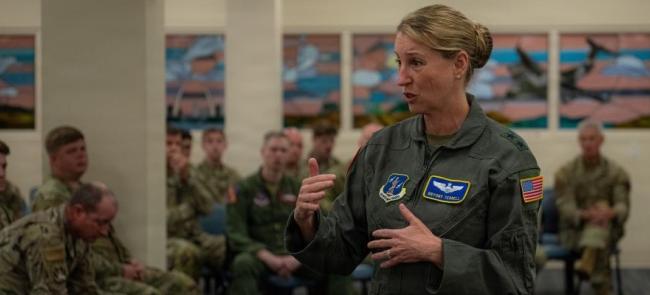
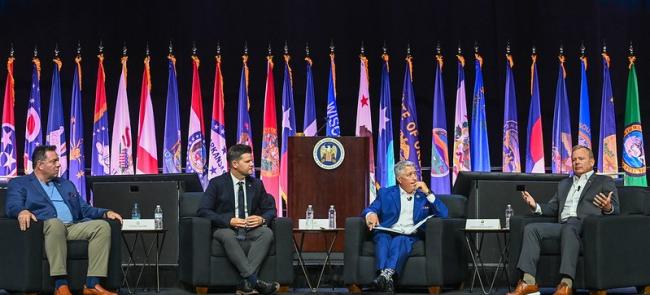
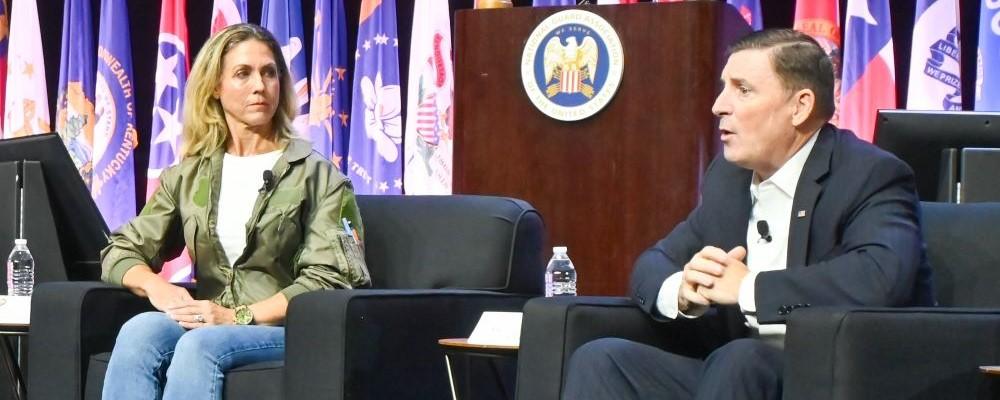
During a panel discussion at the 148th General Conference & Exhibition in Indianapolis, Bob Darling, a retired Marine Corps lieutenant colonel who served in the White House, and Heather “Lucky” Penney, a retired major and District of Columbia Air National Guard F-16 pilot, recounted how they scrambled to respond as a hijacked airliner headed toward the nation’s capital that morning.
Caught ‘flatfooted’
In 2001, Darling was the airlift operations liaison in the White House’s military office, where he helped manage logistics for the president.
“Everywhere [the president] goes, he needs limousines, helicopters, snipers, doctors — whatever he needs,” he told conference attendees.
Just after 9:03 a.m., when the second plane struck the south tower, Darling received the order to stand by for a White House-designated mission because of a full-blown terrorist event. In layman’s terms, that meant his office had to prepare orders to send federal agencies to New York City.
But at 9:37 a.m., a plane struck the Pentagon, and a few minutes later, the Secret Service evacuated the White House. Darling said a colonel came running in and told them to “lock up your classified information” and “go to the alternate site.”
As he made his way to the Presidential Emergency Operations Center, Darling noticed that the gates to the White House were wide open and Secret Service agents were carrying automatic weapons and shouting through bullhorns, telling everybody to run because another plane was inbound.
“Seeing the most secure piece of real estate in the world literally having professionals sprint off the compound — dropping their heels, purses, and sweaters — was just an unbelievable sight,” he said.
When Darling finally reached the PEOC, his mission immediately changed. The vice president’s military aide told him to “forget logistics just for a moment. Answer the phones. They’re ringing off the hook.”
On his first call, he learned that another plane had been hijacked 16 miles outside Pittsburgh and was headed for Washington, D.C. He turned to relay the information to the military aide, only to discover that Vice President Dick Cheney was standing behind him, along with his wife, national security adviser and others.
Darling said they were all trying to gather more information about the aircraft. But there was a problem: None of them had the authority to order military action. They took their orders from the National Command Authority, which consisted of the president and secretary of defense.
“For the first time in history, this million-man army felt leaderless. The National Command Authority was not available,” Darling said, adding that at the time, the president was aboard a flight out of Florida and the defense secretary was helping evacuate the wounded from the Pentagon.
“We kind of felt flatfooted. We didn’t feel like things were happening.”
A short time later, Darling received another report: An unidentified aircraft flying low and fast toward Washington was only 8 miles away. “The Secret Service was tracking this aircraft and we were literally counting down,” he said.
At one point, Cheney told him, “‘If the Secret Service can’t deal with it on the roof, everybody stand by for impact,’” Darling said. “I remember putting my hands on the console in front of me going: ‘The world’s greatest military superpower just said checkmate.’”
Then Darling overheard a Secret Service agent on the phone say, “Protect this house.” On the other end of that call was the 89th Airlift Squadron at Andrews Air Force Base, where Penney, a member of the 121st Fighter Squadron was preparing to take flight.
Scramble to intercept Flight 93
Penney said she learned about the attacks during her morning meeting. A tech sergeant ran into the room and said, “‘Hey, an airplane hit the World Trade Center.’” At first, she said it was hard to believe, but then, he came back and said, “‘Another aircraft hit the other World Trade Center and it was on purpose.’”
That was when they jumped into action.
“We went to the fighter squadron bar and we saw what everyone else saw that morning and we knew that we had to get airborne. We had to protect. It was very clear … that our nation was under attack,” she said.
But before they could do anything, they had several problems to overcome.
First, the base was operating with a skeleton crew. The unit had just completed an exercise, and its part-time Guardsmen had returned to their civilian jobs. They had enough personnel to launch only three aircraft.
Second, they weren’t prepared to respond with any real force. Penney explained that after the Soviet Union fell, the United States began cutting its military forces, including the Air Force and Air Guard.
“We used to sit alert because obviously we’re in Washington, D.C. It’s the seat of the free world. It’s the nation’s capital,” she said. “But we did not have an alert mission. So, we had no jets hot-cocked. We had no jets armed. And we also had no command and control.”
Third, they had no intelligence about the hijacked aircraft and no Concept of Operations to guide their response. “You don’t do anything without an air tasking order … We’re the world’s largest bureaucracy. We don’t do anything without a paper trail,” she said.
And even if they had been prepared, Penney said, they wouldn’t have known exactly what to do. The closest thing they had were alert plans for stopping Soviet bombers approaching from the Pacific.
“We were so disconnected, we didn’t even have those operations to deviate, to depart from, to improvise from,” she said. “Everyone had to make it up as we went along.”
When they were finally ready to launch, they had cobbled together what amounted to a suicide mission. Because they couldn’t get missiles or ammunition, the plan was to stop United Airlines Flight 93 by crashing Penney’s jet into the rear of the airliner. Doing so, she explained, would “aerodynamically destabilize the aircraft and it’ll just tip over and go straight into the ground.”
But by the time they were ready to launch, Flight 93 was already down in Pennsylvania, after passengers and crew members stormed the cockpit and prevented the hijackers from reaching their intended target in Washington.
Reflecting 25 years later
Twenty-five years later, Darling said the lesson he takes away from the Sept. 11 attacks is that “you can’t buy resilience.” Technology and warfare will always change, he said, but commanders need to trust and delegate decisions to lower-level leaders.
“Could that unit let the first lieutenant that just checked in make the decision of ‘go, no go’ on a certain mission criteria? Do we have the ability to adjust? Because that’s where resilience comes. It comes from the grassroots, the lowest level of the organization,” he said.
Looking back, Penney said she carries “deep regret” that she didn’t get airborne in time to take meaningful action against Flight 93. “We were a mission failure,” she said. “Let me just be point blank. We were a mission failure.”
Despite that, Penney said she takes pride in the fact that her fellow Guardsmen wanted to respond. She recalled seeing smoke rising from the Pentagon as she flew overhead, as well as cars backed up at the base.
“Every Guardsman got up from their job and said, ‘Boss, my nation needs me.’ And they reported for duty. They weren’t waiting to be activated. They weren’t waiting for the paperwork. They just knew that they needed to report for duty,” she said.
While she regrets that she wasn’t able to intercept Flight 93, she said, “thank God for the passengers” who acted on their own.
“None of them were veterans. None of them were Guardsmen. None of them were police officers, first responders, anything like that,” she said. “But they still, as ordinary citizens, made the decision to sacrifice their lives to protect us. In many ways, they are the ultimate citizen-soldiers.”
—By Daniel Terrell
Additional panel discussions and presentations from the 148th General Conference & Exhibition are available here.