then Add to Home Screen.
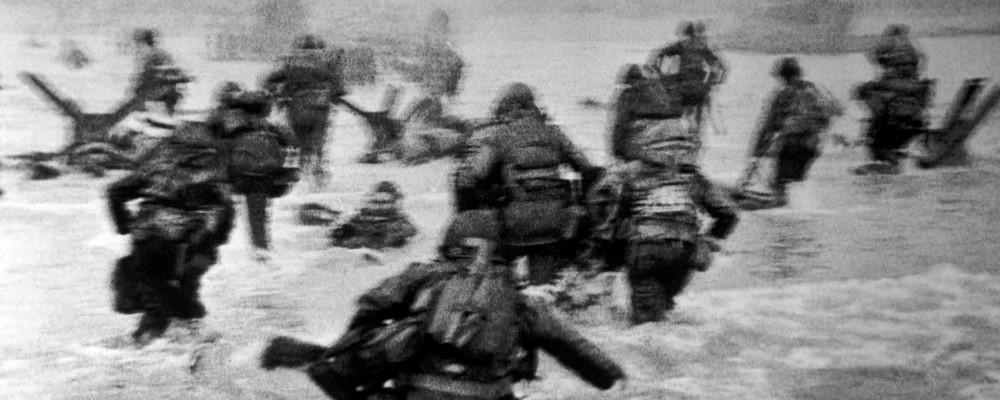
Saturday is the 82nd anniversary of D-Day, June 6, 1944, and NGAUS and the National Guard Educational Foundation are set to share the Guard’s role in the landings that began the liberation of Western Europe in World War II.
One event is a book talk by Alex Kershaw, the author of The Bedford Boys, One America Town’s D-day Sacrifice, scheduled for 4 p.m. June 4 at the National Guard Memorial, the association’s headquarters in Washington D.C.
The book tells the story of 19 young men from Bedford, Virginia, who died in the first bloody minutes of D-Day.
They were members of the Virginia Guard’s Company A, 116th Regiment, part of the 29th Infantry Division from Maryland, Virginia and the District of Columbia.
The regiment was part of the first wave of U.S. troops to hit Omaha Beach during the amphibious assault on Normandy, France.
Three more men from the town died later in the operation. Bedford, a rural community of just 3,000 residents in 1944, suffered the highest per capita loss of any U.S. community on D-Day.
This will be Kershaw’s second NGEF book talk. Last year, he spoke on The Liberator, One World War II Soldier’s 500-Day Odyssey From the Beaches of Sicily to the Gates of Dachau. It tells the story of Felix Sparks, an officer in the Guard’s 45th Infantry Division.
The book talk Thursday will be streamed online. More information is available here. Videos of previous book talks are available on the NGAUS YouTube channel.
In addition, retired Maj. Gen. Francis M. McGinn, the NGAUS president, will speak at a special D-Day commemoration Saturday evening at the Bedford Boys Tribute Center in Bedford, Virginia.
The town near Roanoke in southwest Virginia is also home the National D-Day Memorial in Bedford, Virgina. The memorial will host a special ceremony at 11 a.m. Saturday.
C-SPAN plans to air the Saturday ceremony as part of a full morning of D-Day programming.
Congress approved the memorial’s establishment in Bedford to recognize the town’s sacrifice in Operation Overlord, the code name for the landings.
Approximately 100 other Bedford residents died during World War II in other battles and other theaters.
More than 150,000 U.S., British and Canadian troops landed on the beaches of Normandy by the end of D-Day. Approximately 4,000 were killed.
At the time, the D-Day invasion was the largest naval, air and land operation in history, and within a few days about 326,000 troops, more than 50,000 vehicles and some 100,000 tons of equipment had landed, according to accounts.
By August 1944, all of northern France had been liberated, and in spring of 1945 the Allies had defeated the Germans. Historians often refer to D-Day as the beginning of the end of World War II.
The NGEF maintains a monument just off Omaha Beach in Vierville-sur-Mer, France. It sits on an older German bunker and honors all Guardsmen who fought in the European theater.
The memorial is the subject of a Minuteman Minute video produced last year.
—By John Goheen