then Add to Home Screen.
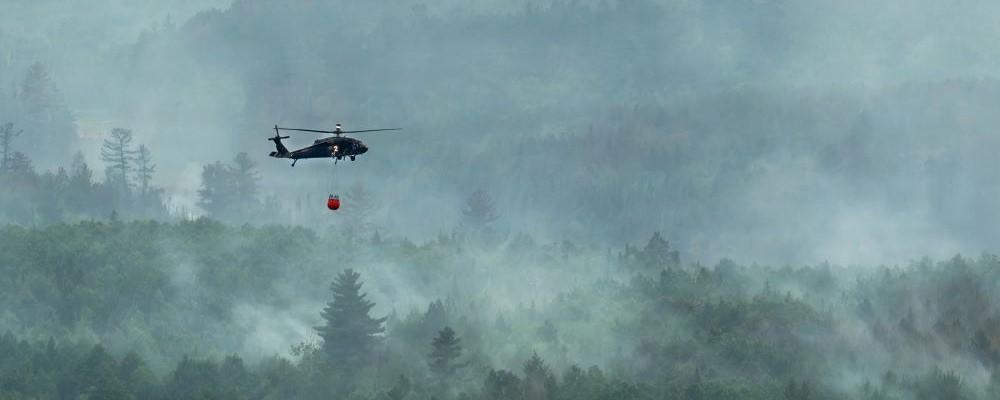
National Guard units are supporting wildfire suppression operations in multiple states, providing aerial firefighting aircraft, helicopters and personnel to assist civil authorities as significant wildfire activity continues across the Midwest and West.
The nation is at National Preparedness Level 5, the highest level.
Firefighters are working to suppress and contain 90 large fires across the country, including 10 new large incidents since Saturday, according to the National Interagency Fire Center website.
More than 25,000 firefighters and support personnel are engaged in nationwide fire activity, including 565 crews, 1,501 engines, 141 helicopters and 27 complex incident management teams.
So far this year, 42,157 fires have burned more than 4 million acres across the United States.
More than 160 Guard Soldiers and Airmen from California, Colorado, Minnesota, Nebraska, Washington and Wyoming have responded in the past month, providing specialized firefighting capabilities and personnel to support state and local agencies during the nation’s wildfire season.
“The National Guard is the most capable and experienced disaster response force in the nation,” said Air Force Gen. Steve Nordhaus, the chief of the National Guard Bureau, adding that partnerships and strong relationships with state and local authorities are the keys to success.
In the Midwest, more aerial wildfire suppression assistance was needed after 17 wildfires had started.
Minnesota Army Guard Soldiers and Airmen were activated to protect lives, prevent damage and help Minnesota agencies respond, according to Gov. Tim Walz’s Executive Order 26-08.
In support of that effort, the 34th Combat Aviation Brigade deployed one CH-47 Chinook and four UH-60 Black Hawk helicopters (above), crews and support personnel to fight the fast-moving and rapidly shifting fires.
Meanwhile, in Colorado, as the Aspen Acres fires burned in Pueblo, more than 80 Colorado Army Guard Soldiers took over for the Colorado State Patrol in staffing traffic control points, freeing the officers to resume their patrols and conduct roaming patrols within the affected burn areas, according to Colorado State Patrol Capt. Carrie Jackson.
“When the local resources are taxed beyond their ability to supply, we have to reach out to our partners for help,” Jackson said. “I could not do this without them [the National Guard].”
In California, the California Air Guard’s 146th Airlift Wing and Wyoming Air Guard’s 153rd Airlift Wing were mobilized to support aerial firefighting operations July 13.
While the 153rd AW flew to San Bernardino, California, the 146th AW headed to Santa Maria, California, where its crews supported wildfire suppression operations for three days before being relieved by the Air Force Reserve’s 302nd Airlift Wing from Peterson Space Force Base, Colorado.
All three units operate the Modular Airborne Firefighting System, a portable fire-retardant delivery system that can be inserted into C-130 Hercules aircraft, converting them into airtankers without structural modification.
While the U.S. Forest Service owns the MAFFS equipment, airlift wings provide the aircraft into which the systems are installed, as well as the flight crews and maintenance and support personnel to fly the missions.
Only four U.S. military airlift wings are equipped to operate MAFFS, and three are Air Guard units.
The 153rd AW activated airmen and two C-130s, one configured with MAFFS, were activated to support wildland firefighting operations in the western United States on July 13. In a single drop lasting less than 10 seconds, the airtanker can discharge up to 3,000 gallons of fire suppression material or water across a quarter-mile line.
“This is one of the most visible and rewarding missions we perform,” said Maj. Randi Carpenter, a navigator with the 153rd AW serving as mission commander for the activation. “Our crews understand that every drop they make helps a firefighter on the ground, and they take that responsibility seriously.”
—By Sgt. 1st Class Amber Peck
National Guard Bureau