then Add to Home Screen.
Fighting Words
What were they thinking? When the delegates to the Second Continental Congress signed the Declaration of Independence and indicted King George’s government, they were publicly committing treason. Had things gone differently, the British Crown would’ve had a list of whom to execute.
You might wonder what gave the founding fathers the confidence they would not be drawn and quartered. Many were prosperous merchants or lawyers. They were risking it all, and they knew it. “We mutually pledge to each other our Lives, our Fortunes and our sacred Honor,” they wrote in the document.
Why did they think they stood a chance against the world’s reigning superpower?
The militia of colonial America, whose lineage is carried by today’s National Guard, played a role in their thought process. The British army and navy might have been the best in the world in 1776, but the organized militia in the 13 rebellious colonies wasn’t starting from scratch. Most colonies set up their militias upon settlement a century earlier, and many had seen action.
But how did these disparate militia help secure American independence? To start, it’s worthwhile to understand the role of the militia in colonial American society.
America’s militia tradition
The colonies had inherited much from their British ancestors. Language, laws, traditions and beliefs crossed the Atlantic Ocean. Among the latter were a fear of a standing army and the British militia tradition.
The colonists’ distrust of a standing army grew from the painful lessons of conflicts and political upheaval between 1642 and 1690, including the English Civil War. During that period, Parliamentarian and Royalist forces fought for power, Parliament was overthrown or dissolved at least four times, King Charles I was tried and executed for treason, a Dutch army invaded England, and leaders on both sides abused their control of the military.
In the wake of that tumultuous period, Parliament gained power and subordinated the monarch to British law for the first time. The English legislature also prohibited a standing army in peacetime to prevent a king or someone like Lord Protector Oliver Cromwell — with the army at their back — from gaining too much power again.
We know the signatories were thinking about this. One of the 27 grievances listed in the Declaration of Independence was that the king, “has kept among us, in times of peace, Standing Armies without the Consent of our legislatures.”
The British militia tradition and its legal foundation of mandatory service dates to the 12th century. At its root, militias relied on the mandatory service of free male citizens for local defense. In the new world, colonial charters codified this practice and made it their own.
A uniquely American military organization soon evolved. Tensions with Native Americans and the proximity of other European powers needed larger, better organized and more active colonial militia than those in Britain. And there were conflicts, including the French and Indian War (1754-1763), which provided colonial militia with combat experience.
Despite their victory over France and its Native American allies, British regular troops lingered on the frontier and in major ports to maintain security. This was an affront to many colonists and an insult to colonial militia that had just proven their military prowess.
The British augmenting their forces early in the American Revolution with German mercenaries, typically known as Hessians, only inflamed the sentiment. The Declaration of Independence specifically called out the practice, listing as a grievance “large Armies of foreign Mercenaries to complete the works of death, desolation, and tyranny, already begun with circumstances of Cruelty.”
We mutually pledge to each other our Lives, our Fortunes and our sacred Honor.
—Second Continental Congress
Rising tensions
The militia tradition was part of the lived experience of delegates to the First Continental Congress when they gathered in the fall of 1774 to discuss responses to unpopular British taxation. It had been four years since the Boston Massacre and one year since the Boston Tea Party. They resolved to boycott British goods and also recommended that all colonies bolster their militia.
Colonies in New England were the model of a more regulated and organized militia. Massachusetts organized minute companies from a subset of the militia’s ranks in 1774. While laws in many colonies required able-bodied men between the ages of 16 and 60 to serve, the Minutemen were equipped by their local government and trained to be ready, as their name suggests, at any time.
The Second Continental Congress met in May 1775, a month after the “Shot heard ‘round the world” at Lexington and Concord. On June 14, 1775, delegates established the Continental Army, the precursor of today’s Regular Army.
Continentals are coming
The Continental Army wasn’t just pulled from a tricorn hat. It drew upon America’s militia tradition. Congress resolved that “six companies of expert riflemen, be immediately raised in Pennsylvania, two in Maryland, and two in Virginia … and join the army near Boston.”
That force was the “New England Army of Observation,” composed of militia from Connecticut, Massachusetts, New Hampshire and Rhode Island, assembled around the besieged city. That body of citizen-soldiers was adopted into the Continental Army. And its commander, the Continental Congress decided, would be George Washington of Virginia.
The Army continued to draw from the militia to build its foundation. Men were recruited from militia units into the 10 new rifle companies. One of them was Stephenson’s Rifle Company, from what is now West Virginia. It was recruited from the Berkley County Militia Regiment, which is perpetrated today by the 201st Field Artillery Regiment.
While the Continental Army wouldn’t exist without the militia, the militia also needed the new standing army. Militiamen turned out when a battle loomed in their backyard, but the Continentals stayed in the field to keep pressure on the British, allowing the Minutemen to return to their plows in between battles. And states drew from their militia to fill vacancies in Continental units throughout the war.
The part-time and full-time forces were intertwined and interchangeable; thousands of men passed back and forth between the two organizations. It was like Guardsmen today serving on federal Title 10 orders and then returning to their state-controlled Title 32 status.
Militia units often served alongside the Continental Army. The battles of Princeton (1777), Saratoga (1777), Monmouth (1778), Cowpens (1781), Guildford Courthouse (1781) and Yorktown (1781) are examples. And although the performance of militia companies varied, they were employed masterfully with the Continentals.
Daniel Morgan’s deployment of his combined force at the Battle of Cowpens is the best example. By leveraging despised British commander Banastre Tarleton’s low regard for the colonial militia, Morgan trapped him in a double envelopment.
From a well-regulated militia we have nothing to fear; their interest is the same with that of the state.
—John Hancock, the first signatory of the Declaration of Independence
Militia signatories
Many of the signatories to the Declaration of Independence served in the colonial militia. Historians believe more than a third of the 56 signers were either officers in the militia or the Continental Army. This offers insight into what was going on under those powdered wigs.
Benjamin Franklin, who was on the committee that drafted the document, founded the Military Association of the City of Philadelphia in 1747. The lineage of the association is now carried by the Pennsylvania Guard’s 111th Infantry Regiment and the 337th Engineer Battalion.
John Hancock, the president of the Second Continental Congress, was dismissed as commander of Boston’s Independent Corps of Cadets by the Royal Governor in August 1774 because of his vocal opposition to British taxes. In solidarity, the rest of the cadets disbanded. Today, the Massachusetts Guard’s 211th Military Police Battalion carries the lineage of the cadets.
Hancock’s views of the militia’s place in national defense were typical of America’s forefathers. In his Boston Massacre Oration, he said, “A well-disciplined militia is a safe, an honorable guard to a community like this. From a well-regulated militia we have nothing to fear; their interest is the same with that of the state.”
Josiah Bartlett was chosen as a delegate representing New Hampshire. He raised that colony’s 7th Militia Regiment and was appointed colonel of militia by the royal governor. However, like John Hancock, his reputation as a patriot was well known and he was dismissed in 1775.
Oliver Wolcott, a delegate from Connecticut, was a veteran of the French and Indian War. During the Revolutionary War, he was active in the Connecticut militia, rising to the rank of major general.
Georgia delegate George Walton commanded the Georgia militia’s 1st Regiment during the unsuccessful defense of Savannah in December 1778, where he was wounded and taken prisoner. The Georgia Guard’s 118th Field Artillery Regiment today carries on the 1st Regiment’s lineage.
Lastly, Thomas Jefferson, the Declaration of Independence’s primary author, was appointed commander of Virginia’s Albemarle County Militia in 1775. He later became the new nation’s third president.
While the Second Continental Congress unanimously adopted the document July 4, 1776, no one signed it that day. The official engrossed parchment wasn’t ready for signatures. The majority of the 56 delegates signed it Aug. 2, 1776, with a few signing on later.
Hancock was the first to sign. His large, flamboyant signature quickly became an enduring symbol of American defiance. Two and half centuries later, to sign a document is to put your John Hancock on it.
Tough road forward
When our founders gathered to ratify that document on July 4, 1776, morale for the patriot cause was high. The Revolutionary War had been going on for 15 months. The battles of Lexington, Concord, and the ensuing Siege of Boston, which forced the British to evacuate the city, were significant feathers in Yankee Doodle’s cap. The longer the British were unable to suppress the “rabble in arms,” the better it looked for the Americans.
Were the signers of the Declaration thinking of their experience in the militia and their faith in the resolve of its members when they put quill to parchment? In the Declaration’s own words, they were motivated by “a long train of abuses” and felt “it is their duty, to throw off such Government, and to provide new Guards for their future security.”
The Declaration of Independence wasn’t initially printed with signatures. The Continental Congress didn’t order them included until January 1777, after the British captured New York City and chased Washington’s army across New Jersey.
In that dark moment, the delegates doubled down and publicly stood in defiance of King George. Emboldened by the daring American victories at Trenton and Princeton, and their faith in the citizen-soldiers of the militia, they remained confident in the cause of independence.
Will Roulett serves as deputy director of the National Guard Educational Foundation and curator of the National Guard Memorial Museum in Washington, D.C. He holds a master’s degree in history from Rutgers University. He can be reached at [email protected].
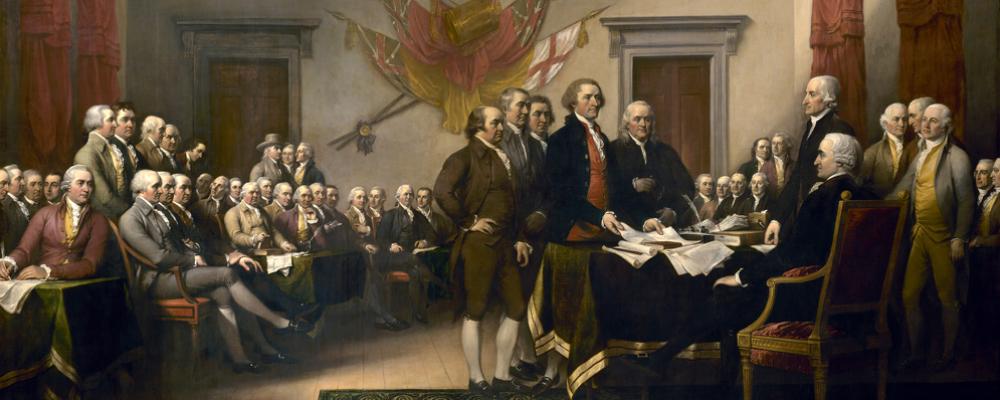
TOP: An 1818 painting by John Trumbull depicts the presentation of the Declaration of Independence to the Second Continental Congress on June 28, 1776, in Philadelphia. It has hung in the U.S. Capitol rotunda since 1826. An adaptation of the famous painting is also on the $2 bill.
SEE FOR YOURSELF IN WASHINGTON, D.C.
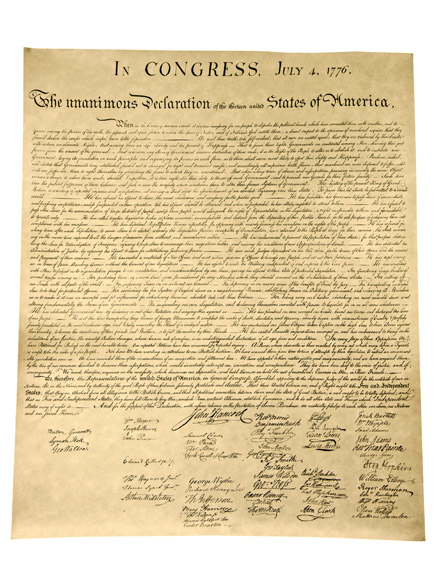
The Declaration of Independence is now on permanent display at the National Archives Museum in Washington, D.C.
In addition, the National Guard Memorial Museum, which is also in the nation’s capital, has several artifacts from the service of militiamen in the Revolutionary War.
You can see Cpl. James Briggs’ mobilization orders issued April 20, 1776, the day after the Battles of Lexington and Concord in Massachusetts. The orders instructed him to gather the enlisted men of Cranston, Rhode Island’s 3rd Company of Militia at Christopher Lippitt’s home the following day.
Pension records indicate Briggs went on to serve in Lippitt’s Regiment, which was raised by Rhode Island in January 1776 and joined the Continental Army that May. Briggs was with Gen. George Washington’s army during the pivotal battles of Trenton (Dec. 26, 1776) and Princeton (Jan. 3, 1777) before his regiment returned home to Rhode Island.
Also on display is the saber of Springfield, Massachusetts- native Abel Chapin, who, like many National Guardsmen today, began his military career by serving a contract with the regulars, then continuing to serve his community part time. His saber bears the inscription “Ticonderoga 1776” because in the summer of 1776, he enlisted for a term of six months, which he spent improving the defenses at Fort Ticonderoga in New York.
Chapin served in the Massachusetts militia from 1781 to 1794, rising to the rank of lieutenant colonel. He was originally commissioned by Massachusetts Gov. John Hancock, who earlier served as president of the Continental Congress.
The museum, which is maintained by the National Guard Educational Foundation, is in the National Guard Memorial, the NGAUS headquarters. More information about the museum can be found at www.ngef.org.
— By Will Roulett