then Add to Home Screen.

Shrinking World
The rapidly changing character of war has effectively eliminated the historic “sanctuary” of the American homeland, bringing it within much easier range of adversaries.
That was the consensus of a panel discussion “Asymmetric Warfare and the National Guard” at the 148th General Conference & Exhibition, Aug. 28–31 in Indianapolis.
Cheap, long-range, highly autonomous unmanned aerial systems — a hallmark of modern asymmetric warfare — along with cyber have greatly diminished the geographic protection that two vast oceans once offered against enemy attacks.
“The cost to generate significant even strategic effects has dropped dramatically,” said retired Air Force Lt. Gen. David Julazadeh, the current chief operating officer of Business Executives for National Security. “Inexpensive drones, commercially available technology, AI, satellite imagery, all those things can now create effects that once required very sophisticated state-level sponsorship or money to do that.”
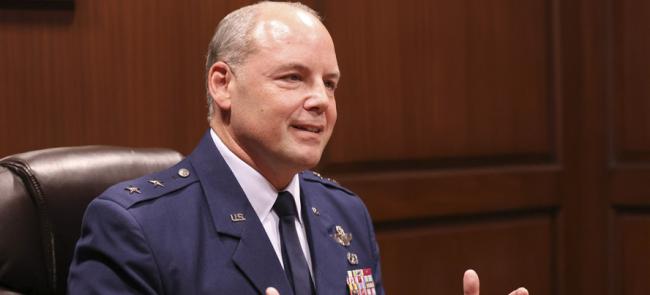
That means even adversaries with limited resources now have the means to inflict harm on the United States, said another panelist, Air Force Maj. Gen. Mark “Bones” Morrell, the adjutant general of South Dakota.
Likely targets include critical infrastructure such as power substations and water plants, he said. Damage could cascade, disrupting water, electricity, heat and communications while hampering the Guard’s ability to mobilize and respond.
Morrell said the discussion aimed to spur action, not fear. Guardsmen and their families must be prepared: The threat to the homeland is real, and the Guard will be the first line of defense and response.
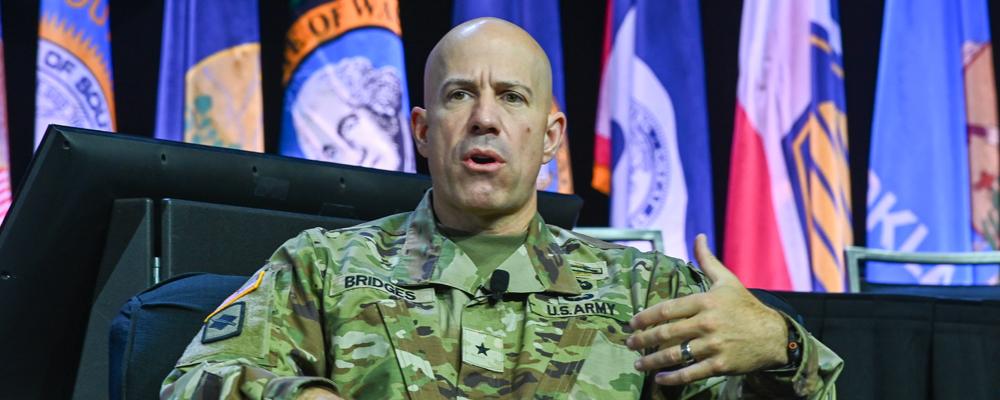
Fellow panelist Army Brig. Gen. Chad Bridges, Arkansas’s adjutant general, agreed.
Bridges described how the Guard connects civilian and military expertise. “The civilian skills that can be brought to bear to solve military problems is unique to the National Guard,” he said. “Conversely, they can take those things that they learn in the National Guard and solve civilian problems.”
Julazadeh said combat leaders also must recognize that widespread access to advanced technology has already minimized the U.S. military of a traditional battlefield advantage.
“The adversary can see everything you’re doing,” he said. “There’s no longer this thing of surprise. It’s very hard to conceal in the way that we used to think about concealment. They can see you. They can see what you’re doing.”
Speed is essential, he added, and “adaptation is becoming a combat capability.”
The conversation was one of three panel discussions during business/professional development sessions in Indianapolis. Another was a talk on post-traumatic growth. The third featured two retired officers who were at the forefront of the nation’s response to the Sept. 11 terrorist attacks.
Half my office is staffed by Guardsmen.
—Space Force Gen. Michael Guetlein, the director of Golden Dome
Pentagon leaders
Senior defense leaders were also on the agenda. They addressed the Guard’s current operations and growing importance. So was an overdue tribute (click here) to a past generation of Guardsmen.
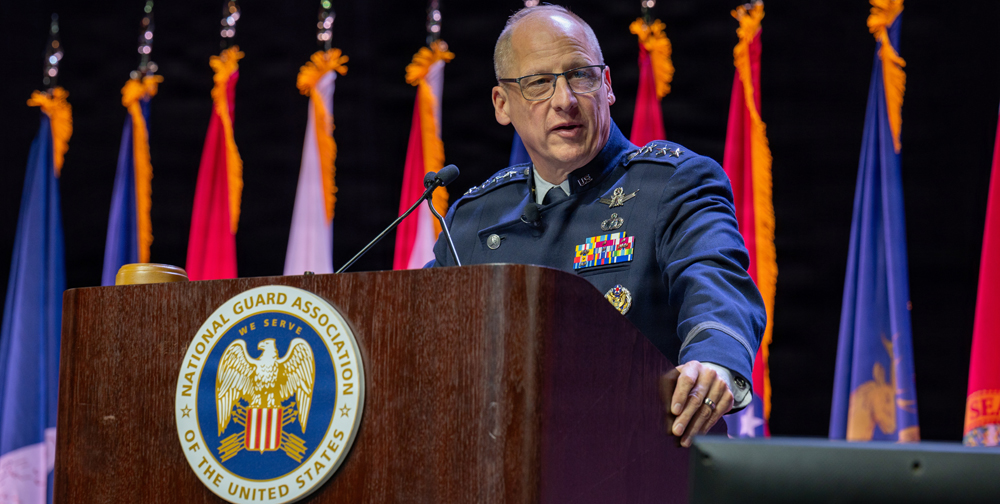
Space Force Gen. Michael Guetlein, who leads development of a nationwide missile shield, said the Guard would be vital to building Golden Dome.
Guetlein recalled a recent conversation with Air Force Gen. Steve Nordhaus, the chief of the National Guard Bureau. “I said, ‘Sir, I believe your Guardsmen are going to be the operators,’” he said. “‘I believe your Guardsmen have the skill set necessary to get after this, and I believe this fight is going to be in your backyard.’”
“And he has been a thinking partner from Day One,” Guetlein said. “Half my office is staffed by Guardsmen.”
Gen. Christopher LaNeve, the acting Army chief of staff, emphasized the Guard’s indispensable, multidomain contributions at home and abroad.
Operation Epic Fury demonstrated how the Army remains the foundation of the joint force, he said. While the operation may appear to center on air power and a blockade, the Army — including the Army Guard — has continued to provide critical warfighting functions in theater.
He cited the New York based 42nd Infantry Division, which led Task Force Spartan and provided tactical mission command for land forces from February to May, and the Kansas Guard’s 130th Field Artillery Brigade, which transitioned from supporting Combined Joint Task Force-Operation Inherent Resolve to serving as the field artillery headquarters for U.S. Central Command forces and executed one of the longest deep field-artillery strikes in Army history.
“You are a powerful part of our ability to project power on and from the land,” LaNeve said. “The National Guard generates combat-credible formations and helps strengthen the capacity of our allies and partners through the State Partnership Program.”
Nordhaus reminded the audience in his remarks that the faith Pentagon leaders have in the Guard comes with responsibilities. “Together, we need to lead boldly, and we can never be late to need,” he said.
He and Senior Enlisted Advisor John Raines, SEA to the NGB chief, reinforced four priorities: warfighters and families, readiness, partnerships and modernization. Together, these priorities form a strategy designed to keep the Guard ready for its dual role, while ensuring its Soldiers and Airmen have the resources and support necessary to succeed, they said.
The conference is also the association’s business meeting. Delegates passed resolutions that will shape next year’s legislative action plan and elected several new NGAUS board members, directors, including four new officers.
Air Force Maj. Gen. Gary Keefe, the adjutant general of Massachusetts and a board member for the last 10 years, is now the association’s chairman. He succeeded Army Maj. Gen. Paul Rogers, the adjutant general of Michigan, who was term limited.
Delegates also chose new officers for vice chair-Army, vice chair-Air and treasurer.
Army Maj. Gen. Thomas Friloux, the adjutant general of Louisiana, is now vice chair-Army. Friloux succeeded Army Maj. Gen. Hal Lamberton, the adjutant general of Kentucky, who did not seek reelection.
Air Force Brig. Gen. Shannon Smith, Idaho’s assistant adjutant general-Air, is now vice-chair-Air. He succeeded retired Air Force Maj. Gen. Ondra Berry, the former adjutant general of Nevada, who did not seek reelection.
Retired Army Maj. Gen. Jimmie Cole became treasurer. He is a one-time association vice-chair-Army and the former chairman of the NGAUS finance committee. He succeeded retired Air Force Brig. Gen. Ken Ross of Louisiana, who served as the treasurer for the last 26 years.
Delegates reelected retired Air Force Brig. Gen. Bobbi Doorenbos of Arkansas as board secretary.
The author is the NGAUS director of communications. He can be reached at [email protected].

Full-length videos of most conference presentations are available
on the NGAUS YouTube channel at www.youtube.com/user/NGAUS1878.
TOP PHOTO: Brig. Gen. Chad Bridges, the adjutant general of Arkansas, speaks during a panel on changes in asymmetric warfare. (ROBERT BANAYOTE)