then Add to Home Screen.

‘History has caught up’
The Indiana Rangers earned more combat decorations in one year
than any other Army infantry company in Vietnam.
Host states often welcome NGAUS conference attendees with local music. But at the opening ceremony Aug. 29 in Indianapolis, Indiana National Guard officials used their time to conduct a long-overdue tribute.
In doing so, they shared a fading piece of Guard history with the rest of the 54.
The event honored 40 members of a former Indiana Army Guard unit that deployed to Vietnam more than 57 years ago. “They didn’t just fight,” said the state’s senior enlisted leader. “They shattered every preconception of what a citizen-Soldier could achieve.”
Company D (Ranger), 151st Infantry spent 1969 earning more combat decorations in one year than any other Army infantry company in the war. Yet the Indiana Rangers, as unit members became known, never received the overall unit award they believed they deserved, despite repeated appeals.
Indiana Guard leaders saw the national platform of this year’s conference as an opportunity. The initial plan was to present the unit with the Sagamore of the Wabash, the highest honor Indiana’s governor can bestow. Less than three weeks before the conference, however, a second award emerged.
A determined congresswoman had nominated the unit for a U.S. military award and pressed the case directly with Defense Secretary Pete Hegseth. By Aug. 12, a review expected to take months had been completed in weeks. Rep. Victoria Spartz, R-Ind., announced that the Indiana Rangers would also receive the Presidential Unit Citation, the U.S. military’s highest unit award.
“Today, history has caught up,” said Command Sgt. Maj. Joshua Brown, the state’s senior enlisted leader, during the ceremony. “For those of us who have carried the colors of Company D, worn the patch and carried the standard, the stories of this historic unit are not just a history lesson. From Day One, you learn quickly that you are walking in the footsteps of giants.”
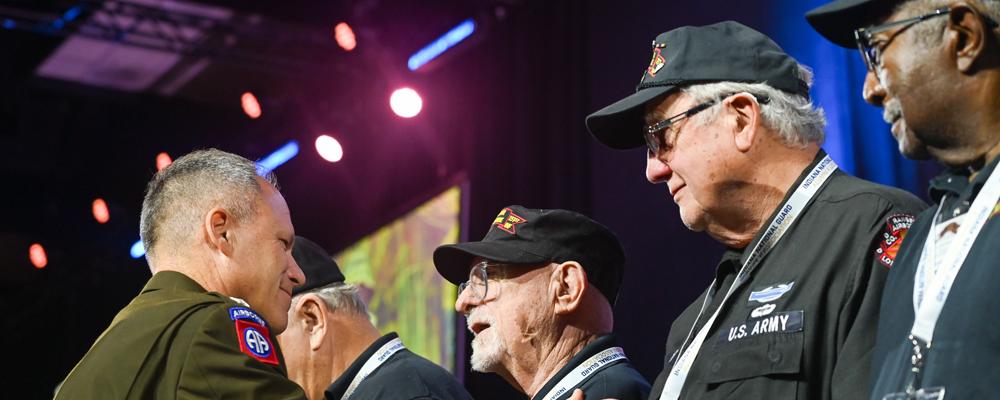
Each Indiana Ranger present — and 20 relatives of deceased members — received a NGEF PUC badge and an individual certificate. Gov. Mike Braun; Gen. Steve Nordhaus, chief of the National Guard Bureau; Gen. Christopher LaNeve, acting Army chief of staff; and Maj. Gen. Larry Muennich, adjutant general of Indiana, presented the items.
Oscar Bruno, 82, the medic unit members still call “Doc,” reached for a handkerchief after receiving his badge and certificate. “I wasn’t the only one,” he said in one of a series of phone interviews with unit members after the event. “I think it was pride, and how long it took. You know, we finally got it.”
The ceremony also included a video of the Company D’s year in Vietnam and the names of every unit member, including those no longer around.
Dennis Engi, 80, an infantryman who was part of many of the patrols behind enemy lines, and Gary Bussell, 82, who maintained and issued the unit’s radio equipment in Vietnam, said the event stirred lasting memories.
“I might forget the PIN number to get the money out of my ATM,” joked Bussell, “but there are names and faces and times that are permanent files.”
They shattered every preconception of what a citizen-Soldier could achieve.
—Command Sgt. Major Joshua Brown, Indiana National Guard Senior Enlisted Leader
In country
The award presentation underscored one of the most ironic chapters in Guard history: Many Indiana Rangers joined the unit to avoid the draft and Vietnam, yet their wartime service became the stuff of military lore and personally gratifying.
At the time, Guardsmen only went to Vietnam voluntarily. Although Pentagon leaders pressed President Lyndon Johnson to deploy the Guard and Reserve, he resisted, preferring to use an active-duty force reliant on conscripts. Johnson feared mobilizing the Guard would weaken rural support for the war. And a presidential election was approaching.
By early 1968, mounting crises forced Johnson’s hand. North Korea seized the Navy intelligence ship USS Pueblo and its crew. Days later, the Viet Cong launched the Tet Offensive, while Cold War tensions rose in Europe. The U.S. military needed more personnel available at the ready.
The Indiana Rangers were a natural choice. Company D was a highly trained long-range patrol unit. In March 1968, it spent two weeks at the Army’s Jungle Operations Center in Panama. Bussell recalled that his wife, Connie, saw what was coming. “When I got back home [from Panama], she said, ‘They’re spending too much money on you. Something’s going to happen.’”
She was right. Within days, the Indiana Rangers were one of 34 Army Guard units Johnson called. Mobilized in May 1968, they left Indiana for Fort Benning, Georgia, with eight officers, one warrant officer and 195 enlisted Soldiers.
Their 24 weeks of post-mobilization training included the Ranger and Pathfinder courses. Infantry School officials called Company D the best-trained unit in the school’s history, according to the Army History Foundation. The unit finally reached South Vietnam in late 1968.
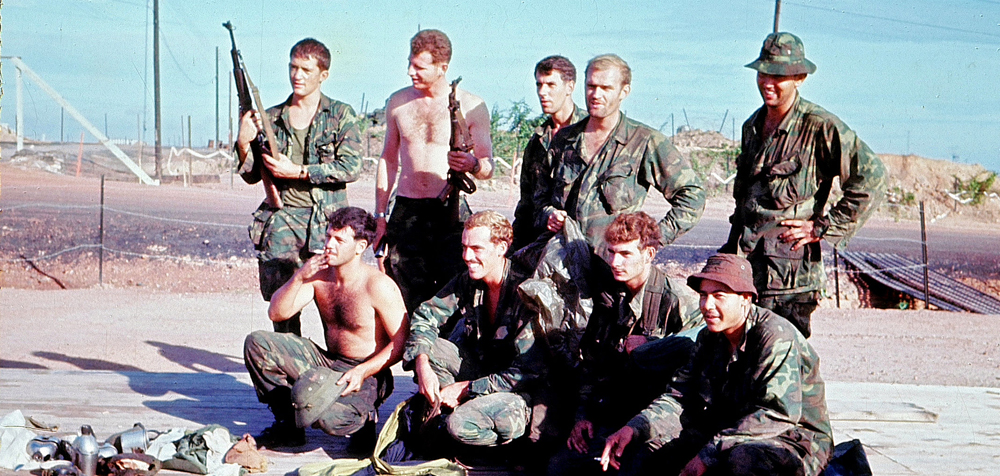
Company D stood out among Army units in country. In addition to all their recent training, the men were older (about 24 on average) and better educated (some had attended college). And they were extremely cohesive — many had known one another for years. After a period of acclimation, the Army formally designated the unit as a Ranger company.
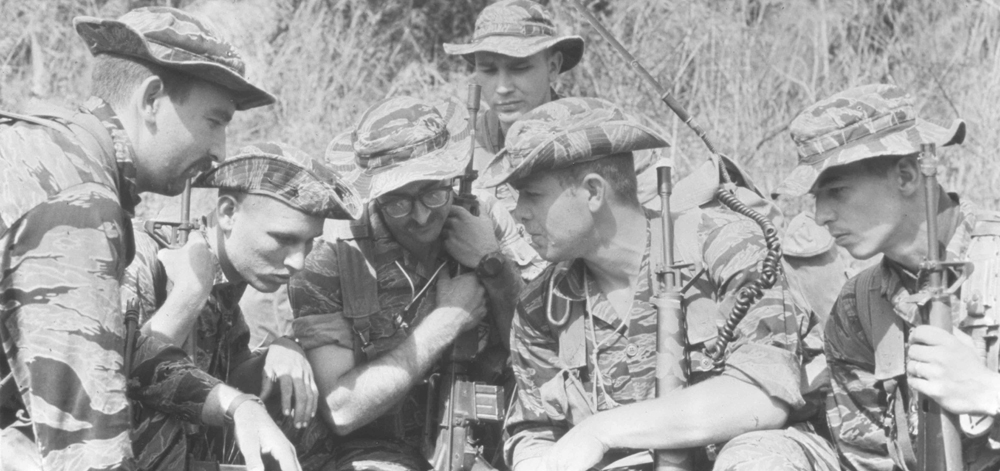
For the rest of 1969, the Indiana Rangers sent five- or six-man reconnaissance patrols behind enemy lines in War Zone D, northwest of Saigon. Operating from Camp Atterbury (East), they conducted 974 patrols, reported 134 enemy sightings and engaged the enemy 94 times. One team spotted 600 advancing North Vietnamese troops.
The unit killed more than 100 enemy troops by direct fire and many more through coordinated airstrikes and artillery. Eight of their own were killed — four in combat, three in a helicopter crash and one in training. Longstanding friendships made the losses especially painful.
“I knew their wives. I knew what kind of car they drove. I knew their kids’ names,” Bussell said. “That made it more expensive when somebody went down, but it did make you not want to let anybody down.”
The Indiana Rangers rarely did. Their individual decorations included 19 Silver Stars, 174 Bronze Stars, 111 Air Medals and 110 Purple Hearts. The PUC citation recognized the company’s “extraordinary heroism” during Operation Toan Thang, July 3–14, 1969, when members penetrated enemy bases, disrupted movement and supplies, and denied access to the Bien Hoa–Long Binh area.
Before Company D redeployed in November, Lt. Gen. Walter Kerwin, the command general of II Field Force, Vietnam, sent a letter to the unit praising the Indiana Rangers as his “eyes and ears” for providing vital intelligence. They were replaced by a Regular Army Ranger company.
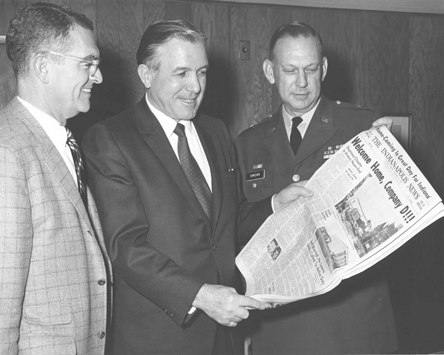
The Indiana Rangers received a hero’s welcome upon their return. Indiana Gov. Edgar G. Whitcomb marked the occasion by declaring Nov. 26, 1969, “Unity Day” and closing state and county offices. That evening, Indianapolis Mayor Richard Lugar presented Company D with a key to the city.
Company D was one of only eight intact Army Guard units (see below) — and the sole infantry unit — to serve in Vietnam, though other mobilized units supplied individual replacements. The decision to NGEF rely on conscripts despite the Guard’s availability spurred postwar reforms.
Kerwin helped shape those changes. As the Army’s deputy chief of staff for personnel, he helped develop the 1973 policy that ended the draft. Later, as Army vice chief of staff, he championed the Total Army concept that put the Guard and Reserve on more equal footing with the active Army.
Back home
Most Indiana Rangers left the Guard soon after returning home, but Vietnam stayed with them.
Bruno moved to Gary, Indiana, near the Illinois border where his wife lived. He rarely discussed Vietnam with neighbors, though he sometimes came across veterans eager to exchange stories.
At a Disabled American Veterans meeting, a man noticed his Guard hat and asked about his unit. When Bruno said he was with the Indiana Rangers, the man shook his hand and said, “Wait till I get back to the unit. I’m gonna tell the guys I met an original guy from the D Company, 151st. You guys are famous.’”
Bussell said Vietnam gave him perspective. He recalled having a “bad day” at work as a manager at a Westinghouse plant 20 years after coming home. He said he was feeling a little sorry for himself. Then, he thought, Shut up. Larkins, Smith, Fegatelli: Would they like to have your bad day? Just shut up and do your job. “And that’s what’s kept me in line and thinking in the right direction.”
Spc. Charles Larkins, Sgt. Robert Smith and Spc. Peter Fegatelli were the first three Indiana Rangers killed in Vietnam.
After Vietnam, Engi went back to Purdue University in West Lafayette, Indiana, where he. had been a sophomore physics major before he dropped out in 1966 and joined the Guard. He said he enlisted not to escape school or the draft, but to see life beyond mathematics before he earned his degree.
His inspiration was a quantum physics professor who once spent an entire class silently writing the “Schrödinger wave equation” on a blackboard. “His whole life was buried in math and equations,” Engi recalled. “I love that world, but I wanted to experience more, do something beyond the ordinary.”
The Guard, especially Vietnam, provided it. Although he has met many veterans who struggled in Southeast Asia, Engi said the experience helped him grow and learn.
After earning a doctorate in what he described as “a kind of applied mathematics and engineering,” Engi joined Sandia National Laboratories, a large nuclear weapons lab in Albuquerque, New Mexico. His first assignment was to build a mathematical model of how terrorists might steal nuclear material and how a SWAT team could stop them. He drew from time in Vietnam.
The work took him to Washington, D.C., to brief government officials. “I was often introduced as a former Army Ranger with experience in Vietnam,” he recalled. “That gave my mathematical models tremendous credibility. The audience would immediately perk up and listen.”
He eventually rose through Sandia to become its chief scientist.
While the Indiana Rangers went their separate ways, the bond they forged in Vietnam never waned. Bruno says they are a “family.” “Brothers” is Engi’s description. Bussell takes it further.
“Half of these people I’d never run with,” Bussell said. “But if one of these guys right now called me up from Arizona and said, ‘My truck’s broke and I can’t get home.’ Well, I’ll be gone for a while. I got to go gas up the truck and go to Arizona. It’s that kind of a brotherhood.”
The Indiana Rangers recently banded to help one of their own. Historic flooding on the Whitewater River in southeast Indiana destroyed much of the infrastructure of Robinson’s Whitewater River Campground owned by Dwain Robinson, 77.
Several unit members responded to help Robinson assess the damage and begin pick up the pieces at the 48-acre facility. They had all been there before. The Indiana Rangers hold their annual reunion at the facility every other year.
Robinson, who joined D Company right out of high school went on more than 50 patrols in Vietnam, was able to put work on hold and attend the award ceremony. “It was great to see all the guys,” he said.
His next mission is to rebuild the popular campground, which features a Vietnam War memorial that includes a UH-1H “Huey” helicopter. It’s like the ones that inserted the Indiana Rangers behind enemy lines so many times.
Robinson has set next August as his deadline to reopen. That’s when unit members plan to gather there for their annual reunion.
The Army reorganized Company D multiple times after Vietnam. Its lineage now continues within 1st Battalion, 151st Infantry Regiment, part of the 76th Mobile Brigade Combat Team.
JOHN GOHEEN is the NGAUS director of communications. He can be reached at [email protected].
TOP PHOTO: Gen. Christopher LaNeve, the acting Army chief of staff, presents some Indiana Rangers with the Presidential Unit Citation. (ROBERT BANAYOTE)
AT A GLANCE: Army Guard in Vietnam
Eight intact Army National Guard units served in Vietnam, all between 1968 and 1969:
● Company D (Ranger), 151st Infantry (Indiana)
● 2nd Battalion, 138th Field Artillery (Kentucky)
● 3rd Battalion, 197th Field Artillery (New Hampshire)
● 116th Engineer Battalion (Idaho)
● 131st Engineer Company (Light Equipment) (Vermont)
● 107th Signal Company (Rhode Island)
● 126th Supply and Service Company (Illinois)
● 650th Medical Detachments (Dental Service) (Alabama)
Roughly 4,000 additional Army Guard Soldiers — predominantly pulled from Hawaii’s 29th Infantry Brigade and Kansas’s 69th Infantry Brigade — were sent to the war zone as individual augmentees to fill active-duty vacancies.
More than 100 Army Guard Soldiers made the ultimate sacrifice.
Source: National Guard Bureau