then Add to Home Screen.

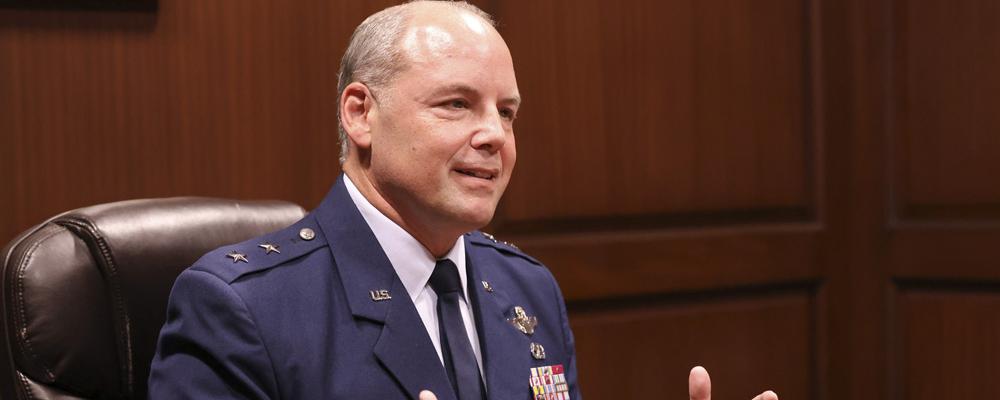
A Conversation with Maj. Gen. Duke Pirak
Nobody has been in a better position to know the trials and triumphs of the Air National Guard over the last two years than Maj. Gen. Duke Pirak, the acting director of the Air National Guard from June 2024 through July 2026.
During his tenure, the Air Guard grappled with recruiting challenges, the oldest planes in the Air Force inventory and sweeping leadership changes atop the service, yet it was able to make indispensable, little-notice contributions to major operations, including Operation Epic Fury.
The former Oregon Air Guard fighter pilot, known by the call sign “Juice,” stepped down at the end of July to spend more time with his family, according to a letter he posted on social media. He continues to serve as a senior advisor with his military retirement set for the end of the year.
Maj. Gen. Randal K. Efferson of Alabama is now the acting director while the Senate considers the president’s nomination nearly a year ago of Maj. Gen. Thomas Suelzer, the adjutant general of Texas, for a third star and the post in a permanent capacity.
Pirak sat down with NATIONAL GUARD to talk about the last two years and what they may portend for the force moving forward.
Before stepping down, you spent 26 months as the senior leader responsible for the overall management, readiness and strategic direction of the Air National Guard. It’s a three-star post. What kind of challenges does a two-star general have in the Pentagon performing the duties of a three-star?
The position is a three-star position. But really, the Air Force does a very nice job of giving deference to what is its largest MAJCOM [major command]. That is the Air National Guard. Also, unlike other MAJCOMs, you somewhat independently manage a $15 billion appropriation. More importantly, you have the backing of the adjutants general with their special connectivity, an influence the Air Force has learned to appreciate.
So, really, it’s a role with an outsized impact, regardless of the rank. And in the end, it’s not about the individual in the position, it’s what they represent across the 54. I was really appreciative of the way the Air Force treated the director’s position, not the deference they gave to me personally, but to the Air National Guard. I was not cut out of any meetings, any situations and I never ran into any conundrum where I wasn’t able to go directly to the secretary of the Air Force and have my day in court.
Were you able to really come up with a vision and implement it?
I did. We were lucky to do that. I remember my first conversation with the adjutants general in Minneapolis [in 2024] at an AGAUS [Adjutants General Association of the United States] conference. I had just transitioned out my predecessor [now retired Lt. Gen. Michael Loh]. As I was hearing a variety of different concerns about the Guard in the future, a couple of things dawned on me. First, in anticipation of potential great-power conflict, we really needed to focus on wartime readiness. That meant ensuring every dollar spent enhanced readiness in new and innovative ways. And then try as best we can to get the bureaucracy out of the way of the field, to empower unit commanders and adjutants general to do what they needed to do.
I could never have foreseen what had occurred with Epic Fury. I could never have imagined some of the engagements we’ve gotten into as of late. I would never claim to be a strategic savant and to have known that was going to happen in the near term. But it was interesting. All of that focus was about something that was distant in the future. I will admit to even talking about it in somewhat distant and esoteric terms, right? And people would say, “Yeah, yeah, yeah. We always got to be ready for the future.”
But when Epic Fury occurred, it became clear that we don’t get to choose the time and place. And I also think it became clear to the United States Air Force, and to the nation, that your Air National Guard is a fight-tonight force. There is no more surge force, there is no reserve in the traditional sense. When the nation goes to war, it has to go to war with the Air National Guard.
When the nation goes to war, it has to go to war with the Air National Guard.
But the story of the Air National Guard in Epic Fury has yet to be told in any detail. Will you share some of that?
It’s certainly a balance, right? I will try not to be braggadocious and whatnot about what we did. And there are, of course, concerns with operational security. I think when the door closes on that operation, the postmortem will really show what we were able to do. But I can tell you, just in a broad brush here, most of our tankers were mobilized for that fight. The balance was as mobilized in support of Operation Noble Eagle, and then certainly other commitments to strategic defense. Every single C-17 [airlift] unit in the Air National Guard was mobilized for that fight. As you know, a number of fighter squadrons and other enabling capabilities mobilized as well. So were a lot of our AOG [Air Operations Group] and C2 [command and control] personnel.
And so, without getting into classified terms, if you look at the number of forces mobilized overall, regardless of active, Guard or Reserve, mathematically you just simply couldn’t do it without us. You couldn’t, and I think you know there are ancillary benefits to this, proving to the world what we already know about ourselves — that we are that fight-tonight, ready and accessible force. And I know that the adjutants general have long advocated for favorable adjustments to AC/RC mix and an increased footprint of key capabilities in the Air National Guard. And key to that argument is that you have a host of authorities that when you need us, we are accessible and ready. We proved this with Epic Fury, it was the perfect case study.
But I’ll tell you there are other conclusions to be drawn from this that are part of my concerns going into the future. It’s a difficult irony that in a fight to become more relevant, to be recapitalized with new weapon systems, to be part of that front-line fight-tonight force, we are the beneficiaries of equipment that, in fact, are the fight-tonight capabilities the Air Force needs.
I think the way we have things now when we forecast demands for rotational presence we have a sustainable model. But the Air National Guard today is quite a bit busier than the Air National Guard that I joined 32 years ago. And if you look at the overall size and shape of the Air Force, I don’t see that changing anytime soon. I think in the past, when I was able to participate in what we called Air Expeditionary Force missions, we provided only a very small footprint because we truly were extra at the time.
But the size of the Total Air Force has contracted to the point where, as I said earlier, there’s no real surge capability. There’s no extra. Your Air National Guard is it. To make this work, we need to ensure it can be sustained without overtasking our members and exhausting the goodwill of our employers. Looking forward, I do worry about the kind of ops tempo we can maintain over time.
Now, I don’t know that anybody has the perfect crystal ball on that, but I can tell you this: It’s the responsibility of leaders like me to ensure sustainability by fighting for more resources, particularly full-time manpower and ensuring our forces are afforded the same access to flying hours and sustainment dollars as our active counterparts. If the Air Force needs us to be that fight-tonight force, then we need to be funded commensurate as such.
We also need to ensure that we’re maintaining good communication with the Hill, our employers and others to let everybody know what their National Guard is doing for the Air Force and for the nation, especially the biggest sacrifices of all, such as the three heroes of the Ohio National Guard that perished aboard Zeus 95 [the Air Force KC-135 Stratotanker that crashed after a mid-air collision with another aircraft March 12 in western Iraq] with three of their active-duty counterparts. They will forever be reflective of our effort and the profound impact the Air Guard had in providing mobility capabilities to the joint force.
There have been some concerns about the world post-Epic Fury, about the length of deployments and things of that nature and how sustainable this is. And again, I only think that we will be able to tell in the rearview mirror. While we do our best to provide Airmen and families with predictability, operational timelines are dictated by operational requirements and I’m proud of our Guard members for their resilience and flexibility in answering the nation’s call. But in the aggregate, I cannot imagine a world where the Air National Guard could simultaneously have new equipment, be part of that front-line force and be less busy. That’s the paradox, right? We’re going to have to wrestle with that in the future.
Do you think Pentagon leaders and the appropriators in Congress now understand?
I think so. I appreciated [Air Force Chief of Staff] General [Kenneth] Wilsbach’s statement at the opening of the last Air Force CORONA. He said to both my counterpart, Lt. Gen. [John] Healy from the Air Force Reserve, and I that “in terms of Epic Fury, I want to let you two gentlemen know that your performance has been epic.” It wasn’t just the deployment numbers, but actual results of missions: bombs on target, fuel delivered, equipment and cargo delivered to theater. He saw that in real terms.
I think we’ve overcome a lot of the negative sentiment and preconceived notions about the Air National Guard I experienced as a young officer in the Pentagon. But I would not spike the football yet. We still have a ways to go. I think it’s that constant education, and NGAUS is critical in that regard. At the end of the day, Air Force senior leaders appreciate and acknowledge how amazing the Air National Guard is, but that doesn’t always translate into the kind of funding we need to make this work. This is especially evident with equipping the Air National Guard. The rhetoric is often very positive about us and what we do, but there’s sometimes some difficulty in translating that into real terms, real dollars — particularly in terms of recapitalization.
What’s it going to take?
If I had that answer, I would have solved that problem for you by this time. But from working in the building for many years, I’ve settled on what I believe are two irrefutable facts. The Air National Guard, and the National Guard writ large, can secure its strategic future with the full synchronization, collaboration and advocacy of the adjutants general and organizations like NGAUS and AGAUS. But we also need bold, courageous and competent Title 10 senior leaders in the Pentagon. I don’t think that either can accomplish this on their own. It must be a balanced attack.
How are we doing with that?
(Laughs) I think we’re doing OK. I think we’ve made some great strides in developing our people. Sometimes I think we lose sight of the nature of the dynamic in the Pentagon, the kinds of competencies that you must have to be effective in that environment, the ability to speak the language which means you must be exposed to the kind of training, education, and experiences to be successful. Probably even more important is the shared experiences we must have with active-duty counterparts to be able to navigate their world.
But again, it’s not either/or, it’s both. And the times that we have had big wins going all the way back to the National Guard Empowerment Act I think you would find evidence of relative alignment of advocacy organizations and T-10 leadership. When we’re all on message, consistent, persistent and engaged in the right kind of I/O with the right people, that’s what gets us over the top.
When outside advocacy groups and our leaders are out of balance, that’s when we lose. That’s when we slide backwards, and the world takes advantage of us. We’re dealing with the services that have legions of O-6s with data analysts and a professional staff. Fortunately, I’ve found that we have brilliant folks from the field that come back and work for us on the Air National Guard staff, folks that bring in their outside civilian expertise and things of that nature. But they must be well led. They must be given the right direction and a bold vision.
I cannot imagine a world where the Air National Guard could simultaneously have new equipment and be part of that front-line force and be less busy.
In April, 22 adjutants general told Congress that the Air Force is “the oldest, the smallest and the least ready in its 78-year history.” What’s your take?
I think it’s a well-established fact. That was a big conversation from some of the speeches that I heard at the Air and Space Forces Association conference [in September] about where we’re at. We have projections for airplanes like KC-135s and B-52s nearing a century mark by the time we end up parking them. This is due to a variety of reasons: a procurement holiday for a long period of time after the Cold War coupled with a decades-long ops tempo that has overstressed our equipment. And, of course, with declining sustainment dollars and increased use. That’s a recipe for disaster.
The question then is how do we get out of this? And I do think that the Air Force and the Air National Guard are looking at wins when it comes to the current budget environment for procurement. But one of the things that I always took the opportunity to do is register my profound concerns about the fact that the Air National Guard bears most of the risk with its older fleet. One can point at bright spots where we’ve transitioned in the F-35s, certainly in Vermont, Wisconsin, Alabama, Florida and Massachusetts. And certainly with KC-46s, we’re seeing some new decisions for basing and things of that nature, but you know, that’s really a drop in the bucket. Even on the healthiest procurement schedules that I’ve seen with current basing projections 10 years from now, we’ll be left holding the bag with all that older equipment.
Now, I have every confidence in the ability of Air National Guard maintainers to keep our birds flying. But my biggest concern is this: If everything we established at the beginning of this interview is true — we are a fight-tonight force, that the Air Force can’t do it without us — it would be unconscionable for us to be engaged in combat without parity across the Total Force in lethality and survivability. It would be unconscionable to put our Guardsmen in a situation where they are not similarly or equally equipped as their active-duty counterparts.
So, again, securing our strategic future is a two-part thing: bold, courageous advocacy within the building from our Title 10 general officer leadership and aligned messaging and advocacy from the adjutants general and organizations like NGAUS. We do have a shared problem with the Air Force in terms of us being the oldest we’ve been in 78 years. But our problem is far more acute and we need to make that point. We need to register that point every opportunity we can.
You’ve been here in Washington, the Title 10 program for many, many years. What have you learned along the way?
(Laughs) It’s a good question, it certainly has been a journey. I cannot tell you how thankful I am to all the senior leaders who gave me all the experiences that I’ve had. I can tell you that when Lieutenant Pirak started, I never could have envisioned this. All I thought about at the time was becoming a competent fighter pilot. And after that, I wanted to become a flight leader, an instructor, a weapons officer and that was it.
I remember as a major there were a number of things. We were just coming out of the [2005] BRAC [Base Realignment and Closure] environment, which would have been disastrous — if fully implemented — for the Air National Guard. It would have eviscerated the Guard as we knew it. And then looking at a number of austerity measures, CAF [Combat Air Force] reductions, all of these things that occurred, that this wasn’t going to work unless we had people stepping up and going back to D.C. and joining the fight. I had a wing commander, Col. Steve Gregg, call sign “Bubbles,” that basically challenged me to do that. He said, “Hey, you’re doing a lot of complaining about these things, Juice. But what are you doing about it?” And he got me a job in 2008. And I walked in the building thinking I really knew a lot, and I was humbled on Day One, seeing how the sausage was made.
I was fortunate to be pulled up by General [Bud] Wyatt in his tour as the director of the Air National Guard, and I started a strategic studies group working directly for him for a period. I got to ride shotgun with him and that’s what really gave me the bug. I learned the nature of the struggle in D.C., it’s certainly not something you brag about in a bar, but it is a noble cause and it is absolutely necessary for some of us to step up and engage in the struggle.
But we really need to encourage future leaders to find the next young guns, you know, the big brains, as it were, and develop them and give them those experiences that we talked about. To be a very competent Title 10 general officer, there’s a series of things that need to occur in one’s career, and you can’t cram for finals. They need to start when you’re a major. And so, I really learned that we weren’t going to win unless people were stepping up. And in my mind is, if not me, then who?
Let me flip this around. You’ve worked with active Air Force officers who’ve had little contact with the Air National Guard across the 54. What do they know about the Title 32 Air National Guard?
Unfortunately, not a lot. I will tell you though that it has changed significantly. Early in my career, I was exposed to Regular Air Force officers who would make comments about the Air National Guard and competency and accessibility and things of that nature that probably matched with their very narrow experiences. What I’ve noticed over the years is an increasing number of officers who have served in Total Force Integration units. I’ve been on staff with them. Went to school with them. And so, I think over time, iteratively, slowly, it’s changed the perception of many of our active-duty general officers. But what really is going to seal the deal is if we’re looking for these integration opportunities even deeper than what we have now. “ I cannot imagine a world where the Air National Guard could simultaneously have new equipment and be part of that front-line force and be less busy.”
I think more Air National Guard officers serving, perhaps in Regular Air Force billets, maybe some Regular Air Force officers serving in Guard billets. I always point out to people that one of the greatest advocates I’ve ever seen for the Air National Guard was Maj. Gabby White, who was a Regular Air Force officer coming off of school and was assigned to the Air National Guard Readiness Center. And once he lived and worked with us, he just marveled at our business model and came to appreciate the indispensability of our force. Gabby became one of our most staunch advocates in his active duty career.
We need more of that level of integration. But I would never say to you that it’s all great. It’s tribal in a way, right? For us to grow up within a certain tribe and think, We’re the best, and there is only one way to do business. But until we expose that tribe to ours in a more fundamental way, they’re always going to be insular in their thinking.
AT A GLANCE: Maj. Gen. Duke Pirak
BORN: Duke A. Pirak (Portland, Oregon)
FAMILY: Wife (Juliana), three children
EDUCATION: University of Washington, Seattle, Wash., B.A. Business (Accounting), 1994; National War College, Fort Leslie J. McNair, Washington, D.C., M.S., National Security Strategy, 2012
COMMISSIONING SOURCE: Academy of Military Science, McGhee Tyson Air National Guard Base, Knoxville, Tenn., 1996
MILITARY SERVICE: Oregon Air National Guard, 19962013; Hawaii Air National Guard, 2013-2016; Oregon Air National Guard, 2016-present
PREVIOUS ASSIGNMENTS: Acting Director Air National Guard, The Pentagon, Arlington, Va., 2024-2026; Deputy Director, Air National Guard, The Pentagon, Arlington, Va., 2022-2024; Deputy Director, Politico-Military Affairs (Africa), Strategy, Plans and Policy Directorate (J5), the Joint Staff, the Pentagon, Arlington, Va., 2021–2022; Deputy Director, Strategy, Plans and Policy Directorate (J5), U.S. Central Command, MacDill Air Force Base, Fla., 2019–July 2021
OVERSEAS OPERATIONS: Operations Coronet Nighthawk, Southern Watch, NATO Air Policing, Atlantic Resolve, Inherent Resolve
ALSO NOTABLE: A command pilot with 2,800 flight hours in multiple aircraft, but mostly in F-15 Eagle and F-22 Raptor fighters. Commanded the Oregon Air Guard’s 142nd Fighter Wing from 2016 to 2018. Has said his passion for aviation began when his father started taking him to air shows as a child.
Source: Air Force