then Add to Home Screen.

The Fight to Rebuild the Fighter Fleet
Earlier this year, NGAUS, the National Guard Bureau and nearly two dozen adjutants general launched a messaging campaign to tell Congress that replacing the Air Guard’s aging fighter fleet should be a top defense priority.
Pete Boone, the NGAUS government affairs manager for Air Guard programs, says the organizations are working together to build support for higher fighter procurement as lawmakers consider annual defense authorization and spending bills.
“When we are all on the same page, it’s a much stronger message to Congress,” he says. “When states start straying off and looking at their own parochial interests, it dismantles and disrupts that consistent messaging for the Air National Guard.”
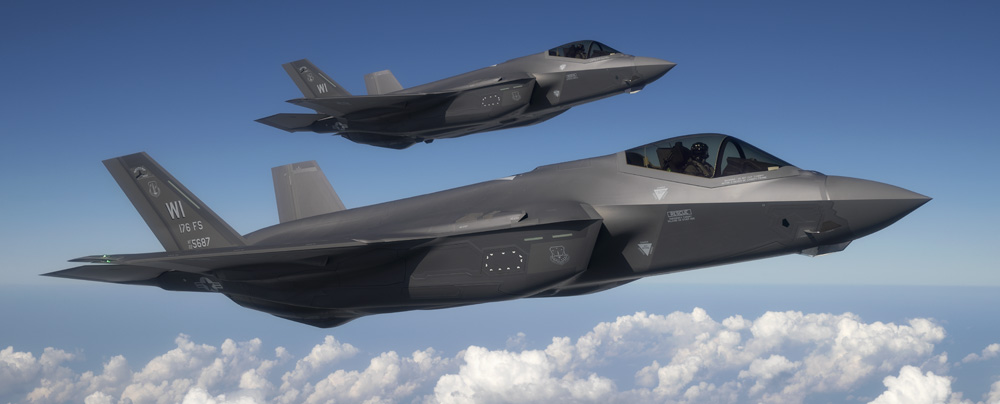
Guard leaders argue that without a significant increase in fighter procurement, many Air Guard squadrons will have to fly aircraft well beyond their intended service lives and no clear path to modern replacements. To avoid those capability gaps, they are urging Congress to fund a long-term recapitalization effort that would procure at least 72 fighters annually — 48 F-35A Lightning IIs and 24 F-15EX Eagle IIs.
While Boone says lawmakers from both parties have been receptive to the campaign, he acknowledges that fighter recapitalization is up against Capitol Hill’s growing defense priorities and limited funding.
“There’s only so much money to go around, so it’s a tough problem to solve,” he explains. Still, he says the three organizations remain united in pressing Congress to recapitalize the fighter force at what he calls a “rate of relevance.”
The Air Guard fighter fleet’s contribution to overall Air Force lethality speaks to its relevance. Guard fighter units provide 30% of service’s combat power, yet 13 of the 24 Guard fighter squadrons lack a recapitalization plan commensurate with combat capability needs identified in the 2026 National Defense Strategy.
The United States Air Force is the OLDEST, the SMALLEST, and the LEAST READY in its 78-year history.
—22 Adjutants General in a letter to Congress
Why now & not then
The messaging effort began in earnest in April, when 22 adjutants general took the unusual step of signing an open letter to Congress warning that “the United States Air Force is the OLDEST, the SMALLEST and the LEAST READY in its 78-year history.”
“We must build a fighting force that WILL WIN,” they wrote, emphasizing several words in all capital letters. They argued that reversing that trend would require replacing aging fighters at a pace not seen in decades.
But the seemingly sudden and unprecedented step raised the question: Why weren’t these issues dealt with before?
Calls to replace the Guard’s aging fighters are not new. Congress has considered multiple recapitalization proposals over the past six years, but those efforts generally funded too few aircraft to modernize the force at the pace Guard leaders say is necessary to retain combat readiness.
Brig. Gen. Shannon Smith, the Idaho assistant adjutant general-Air, says “continuous modernization of our weapons and weapons systems has always been a priority.”
What’s changed, he says, is the strategic environment.
“Our shift in National Defense Strategy in 2018 and forward however has put a heightened level of importance to it, specifically transitioning from a focus on asymmetric warfare and global terrorism to peer competition,” he says.
“The rapidly changing nature of warfare and the unrelenting efforts of the People’s Republic of China to become the strongest, most prolific military force in the world requires all of our attention to defend the homeland, compete, deter conflict and win if deterrence fails,” he says.
China’s military modernization has accelerated in recent years as the People’s Liberation Army has replaced older fighters with more advanced 4.5- and fifth-generation aircraft.
At the same time, the Pentagon’s 2026 National Defense Strategy identifies China as the nation’s primary long-term security challenge and emphasizes deterring conflict by maintaining a force capable of defeating a peer adversary.
Boone says the Air Guard’s requested procurement levels are based on the Air Force’s 2025 Fighter Force Structure Report, which outlines how the Guard’s 24 fighter squadrons would transition to newer aircraft over roughly the next 15 years.
Previous recapitalization efforts, Boone says, often fell short because they modernized only portions of individual fleets. He compares that approach to “hitting a single” in baseball versus “hitting a home run.”
“Recapitalizing into a ‘newer’ fighter platform such as going from a Block 30 F-16 to a Block 50 F-16 is like hitting a single,” he explains. “It’s OK but not great. Having a recapitalization plan for all 24 fighter squadrons, placing them into 4.5- and fifth-generation fighter platforms would be hitting the home run.”
While replacing a handful of aircraft helps, he said, it leaves most squadrons operating legacy fighters that will continue aging out of relevance.
Recapitalize, not modernize
The Guard’s proposal raises another question: Why replace so many aircraft instead of simply upgrading existing ones?
To retain combat readiness and bolster survivability, Guard leaders say, the Air Guard must transition its aging fleet of F-15 Eagles, F-16 Fighting Falcons, F-22 Raptors and A-10 Thunderbolt IIs to advanced aircraft. This includes the Lockheed Martin F-35A, the Boeing F-15EX and possibly the latest U.S. version of the F-16, the F-16 Block 70/72 Viper, another Lockheed Martin product, which the Air Force does not currently procure.
The F-15EX and the F-16 Block 70/72 are 4.5-generation fighters. They lack stealth but have advanced avionics and radar. They also boast more speed, greater range and a larger payload capacity than the F-35A. The Air Force envisions teaming 4.5-gen fighters with F-35As on operations.
Smith says commanders routinely weigh whether it makes more sense to upgrade existing aircraft or buy new ones, but he argued that many legacy fighters have reached the point where further investment results in little to no benefit.
“Without a doubt, legacy fighters procured in the Reagan Era must be recapitalized into advanced fighter capability,” he says, adding that the cost of sustaining some aircraft is resulting in “diminished returns on aircraft availability and mission-capable rates.”
Smith, a pilot with more than 4,600 flying hours including 500 in combat, says the F-35A, F-15EX and the latest U.S. variant of the F-16 provide dramatically greater survivability and combat capability while also offering decades of additional service life.
“We as an Air Force are literally ‘throwing good money after bad’ to sustain these weapons systems when advanced-fighter production lines exist, capable of producing fighters at a rate of relevance to recapitalize the fleet in capability and capacity that can meet the objectives of our National Defense Strategy,” he says.
It’s partly a money equation, but it’s also how quickly can industry respond to our demand signal.
—Gen. John Lamontagne, the vice chief of staff of the Air Force
Industrial base needs time
Winning congressional support is only part of the challenge. Even if lawmakers authorize and appropriate funding for more fighters, the defense industry must still be able to build them.
“It’s partly a money equation, but it’s also how quickly can industry respond to our demand signal,” said Gen. John Lamontagne, the Air Force’s vice chief of staff, during a June event hosted by the Mitchell Institute for Aerospace Studies in Arlington, Virginia.
“Right now, I’d say our demand signal is outstripping their ability to produce quality airplanes on schedule [and] on time,” he says.
Lamontagne attributed part of the problem to inconsistent procurement. He described the military’s investment strategy as a “sawtooth” approach in which annual purchases rise and fall, making it difficult for manufacturers to plan production or expand capacity. He said the solution is stable, predictable funding through multiyear procurement contracts.
Smith agrees, calling multiyear contracts the key to creating stability throughout the defense industrial base, from major manufacturers to smaller subcontractors.
“This sustained demand signal not only allows for investment in long-lead materials and components but also investments in production line optimization and expansion,” he says.
Lawmakers want to know more
After the adjutants general released their letter, the campaign quickly gained traction on Capitol Hill.
During a House Appropriations Committee hearing in April, lawmakers noted that the administration’s budget request funded only 38 new fighters and did not specifically allocate any to the Air Guard or Air Force Reserve.
Asked about the impact on the reserve components, Gen. Steve Nordhaus, the NGB chief, said the issue extends beyond replacing aging aircraft. He noted that the Air Guard operates 94% of the sites supporting the Aerospace Control Alert mission, which maintains armed fighters ready to respond to threats in U.S. airspace.
“Many of those are flying older F-16 aircraft and so they need to be modernized as we get into the future,” Nordhaus, a former fighter pilot, said. “They have strong capabilities now, but as we get into the future and new threats, we have to make sure that we recapitalize our fighters.”
Lt. Gen. John P. Healy, the chief of the Air Force Reserve, added at the same hearing that the shortage of modern aircraft also affects pilot retention. “The challenge is there’s not enough production … we need those production levels to increase, so that we’re available to retain that talent,” he said.
“If we’re in the proper aircraft, if we’ve got the proper production, that’s a return on investment for a highly trained, well-trained active-duty force but for much cheaper in the reserve and Guard going forward,” Healy added.
Congress begins to respond
Since launching the messaging campaign, lawmakers in both the Senate and House have taken action.
In April, Sens. Ted Budd, R-N.C., and Jeanne Shaheen, D-N.H., introduced the bipartisan Airpower Acceleration Act of 2026, a package of proposals intended to expand combat aircraft production, strengthen the defense industrial base and retain experienced aviators.
Boone calls the legislation “good for the Air Force” and “good for the Air National Guard,” but said it falls short of the Guard’s recapitalization goals because one provision in the legislation specifically replaces F-15E aircraft with excess F-15EXs. Since the Air Guard does not operate F-15Es, he said the measure would provide little benefit to most Guard fighter squadrons.
That prompted NGAUS to work with House lawmakers on revisions.
Rep. Sheri Biggs, R-S.C., who is also an Air Guard lieutenant colonel, has emerged as one of the biggest champions of the issue.
In June, she led a letter signed by 13 other lawmakers urging members in the House and Senate Armed Services committees and Defense Appropriations committees to support language that helps the Air National Guard procure what it needs. She argued that the Air Guard must “have a clear path to modern aircraft, stable procurement, and the force structure needed to meet growing threats around the world.”
After the House approved its version of the fiscal 2027 National Defense Authorization Act in July, Biggs said in an op-ed that she was “proud” the legislation included language intended to strengthen the nation’s fighter fleet over the long term.
She added that Congress must “continue working to ensure the Air National Guard is fully included in all recapitalization efforts, including those involving legacy fighters.”
Yet, Boone cautioned that authorizing fighter procurement is only one step.
The NDAA establishes defense policy, but appropriations bills determine how much money is available. The Senate must also pass its version before negotiators can reconcile the two bills.
Boone described the legislation as “conversation starters” and says that “there’s been a lot of great conversations happening.” Still, he acknowledges that significant hurdles remain before those conversations translate into new aircraft.
If Congress does not provide additional procurement funding, Boone says, Air Guard units will have to continue finding “creative ways” to keep aging aircraft operational while meeting the demands of the National Defense Strategy.
“Due to not being equipped with the latest and greatest generation of fighter aircraft, future missions against our adversaries will become seemingly more challenging,” Boone said.
DANIEL TERRILL, a former U.S. Marine and police officer, is a Chicago-based freelance writer who specializes in firearm and military subjects. He can be reached via [email protected].
TOP PHOTO: Many Air Guard F-16s, like this one with Ohio’s 180th Fighter Wing, are more than 30 years old. (JIM “HAZY” HASELTINE)
AT A GLANCE: ANG Fighter Force
The Air National Guard has 24 fighter squadrons across 23 flying wings in 21 states and the District of Columbia:
Alabama 187th Fighter Wing* (F-35A)
Arizona 162nd Fight Wing** (F-16)
California 144th Fighter Wing (F-15C/D→F-15EX)
Colorado 140th Wing* (F-16)
District of Columbia 113th Wing* (F-16)
Florida 125th Fighter Wing (F-35A)
Hawaii 154th Wing (F-22)
Idaho 124th Fighter Wing* (A-10→F-16)
Indiana 122nd Fighter Wing* (F-16)
Louisiana 159th Fighter Wing (F-15C/D→F-15EX)
Massachusetts 104th Fighter Wing (F-15C/D→F-35A)
Michigan 127th Wing (A-10→F-35A)
Minnesota 148th Fighter Wing* (F-16)
New Jersey 177th Fighter Wing* (F-16)
Ohio 180th Fighter Wing* (F-16)
Oklahoma 138th Fighter Wing* (F-16)
Oregon 142nd Fighter Wing (F-15EX)
Oregon 173rd Fighter Wing (F-15C/D→F-35A)
South Carolina 169th Fighter Wing* (F-16)
South Dakota 114th Fighter Wing* (F-16)
Texas 149th Fighter Wing* (F-16A)
Vermont 158th Fighter Wing (F-35A)
Wisconsin 115th Fighter Wing (F-35A)
* Denotes units lack a recapitalization plan commensurate with combat capability needs identified in the 2026 National Defense Strategy.
**Denotes wing with two squadrons.