then Add to Home Screen.
Always There
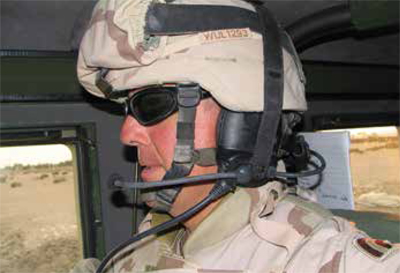
Then-Sgt. Howard Wulforst was driving a Humvee west of the Hudson River toward the Lincoln Tunnel, a major entrance to New York City, on Sept. 12, 2001, when the previous day’s events became shockingly real.
The Twin Towers of the World Trade Center were gone. Billowing smoke was all that remained of the Lower Manhattan landmark and workplace of thousands.
“All I could think was … those are souls going to heaven,” says the now-retired New York Army National Guard Soldier.
The Global War on Terror began with the response to the Sept. 11 attacks in New York City and Washington, D.C., and the Guard played a vital role. Some Guardsmen were mobilized; others watched events unfold on TV, put on their uniforms and reported for duty.
Twenty years later, Guardsmen were also present for the final withdrawal from Afghanistan, which closed a critical phase of the overall effort. The global battle against terrorism continues, but in a more decentralized, intelligence-driven form. And Guardsmen remain part of it.
President George W. Bush had warned the nation from the outset that the fight would not look like a traditional military campaign with a swift completion date.
“Americans should not expect one battle, but a lengthy campaign, unlike any other we have ever seen,” Bush told a Joint Session of Congress nine days after 9/11.
Since 9/11, approximately 800,000 Guardsmen have deployed overseas, according to the National Guard Bureau — many more than once. Tens of thousands more have completed vital security missions at home.
This is the story of two Guardsmen who were there on some of the hardest days: one at Ground Zero on September 12, the other at the end in Afghanistan.
The Guard on September 10
On the eve of the attacks, the Guard was emerging from a decade of change. It had weathered the manning and budget cuts of the 1990s while remaining relevant through international partnerships, peacekeeping missions and disaster response.
A terrorist strike inside the United States — including one involving a weapon of mass destruction — was an emerging threat. In response, the Pentagon created 22-member, full-time Guard Civil Support Teams to help civilian first responders identify potential chemical, biological or radiological contaminants.
NGAUS, meanwhile, argued that the Guard should remain the Army and Air Force’s primary combat reserve for overseas operations under the Total Force Policy. As the War on Terror approached, the Guard was adapting to a changing world.
In the days before Sept. 11, Wulforst felt confident. He had served about a decade in the Guard, loved it and was part of a tank crew that operated seamlessly.
“That’s one of the proud things of the National Guard,” he recalls. “Our crews stay together longer, so we know each other better.”
They had just returned from training in Vermont, where C Company, 1st Battalion, 101st Cavalry, had performed exceptionally well.
That feeling was cut short not long after he arrived at his civilian job on Tuesday, Sept. 11. The television was on, and the message was clear to him: America had been attacked.
Embodying the “Always Ready, Always There” motto, Guardsmen around New York City sprang into action. First Sgt. Joseph Ranauro, also of the 101st Cavalry, was working as a senior court officer and protector in the Judicial Protection Program a dozen blocks from the towers. He organized fellow court officers to move toward the danger. They arrived as the second plane struck the World Trade Center.
Meanwhile, Wulforst began calling his teammates with a warning: “Hey. Get ready … We’re probably going to be activated for this.”
He and many other traditional members of his unit were already at their armory outside Albany, New York, when orders arrived that afternoon.
Mobilizing New York
New York Gov. George Pataki mobilized the entire New York National Guard. By day’s end, about 6,265 Guardsmen were on duty statewide, including roughly 1,500 citizen-soldiers in New York City.
Within hours, the New York Police contacted the New York National Guard with an urgent request: Troops were needed to seal off Ground Zero. During the first 24 hours, the Guard focused on restoring order and a measure of calm.
Elements of Wulforst’s battalion were the first to reach Ground Zero from their Staten Island armory. Wulforst’s company, meanwhile, assembled in Albany and drove to New York City early the next morning.
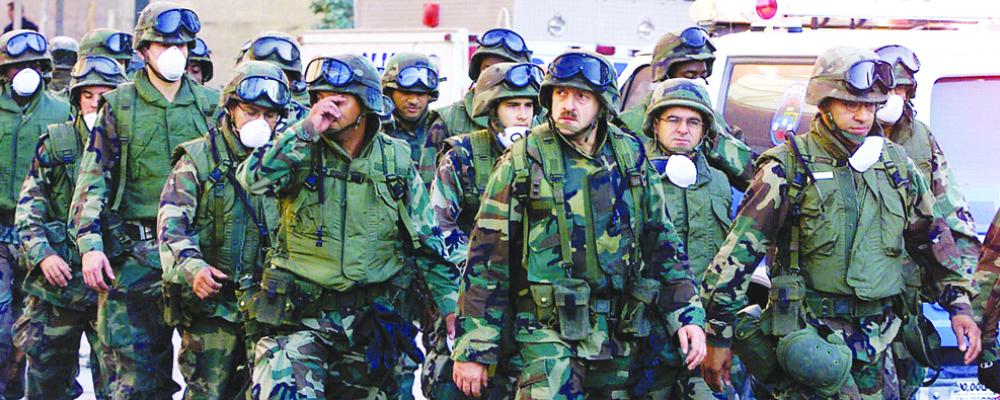
As Guard units arrived, a new plan took shape on Sept. 12 to secure Lower Manhattan. They established a perimeter across the island, with New York’s “Fighting 69th” covering the western half and the 1-101st Cavalry the eastern half.
Wulforst says the devastation defied description: “It’s easy to say words like catastrophe or bomb site, but it doesn’t really do it justice.”
A thick layer of dust covered everything, hanging in the air wherever he walked or drove. “The thoughts that go through your head,” he recalls, “I’m breathing this dust. I’m breathing people.”
It’s easy to say words like catastrophe or bomb site, but it doesn’t really do it justice.
—Staff Sgt. Howard Wulforst (Ret.) of the New York Army National Guard on the scene at Ground Zero
A second mission
While stopping civilians from entering the restricted area was Wulforst’s official mission, his mother charged him with another. “Find my brother,” she told him. Wulforst’s uncle, Eamon McEneany, worked for Cantor Fitzgerald on the 105th floor of the World Trade Center.
“I had a purpose through that period of time,” he says. And that helped me overcome some of the emotional challenges that I had to deal with.”
Finding any identifiable remains seemed like an impossible task.
“We went up to the morgue to look for my uncle,” Wulforst recalls. “The chaplain was coming out of the morgue. And he stopped me from going in. He said, ‘No, you can’t go in there. You’re not going to find him. There’s only pieces of people in that location.’”
A community comes together
Wulforst phoned his mother with a difficult update. “I was able to call my mom and tell her, ‘I’m OK. Still looking for Eamon.’ She repeated her message. When I hung up, I was pretty emotional. A nurse simply grabbed me and hugged me. She said nothing, handed me a tissue and moved on.”
A few weeks after the initial World Trade Center response, Wulforst joined the Bridges and Tunnels mission, providing security across New York City. During a therapy session, an Air Force therapist asked him, “What was one thing someone did for you while you were at the World Trade Center?”
Remembering the nurse’s kindness helped him see the experience differently. “It really helped me, not just then, but later in life, even through my Iraq experiences,” he says.
Eventually, his uncle’s remains were identified — an effort Wulforst remembers as extraordinary.
“What made it even better was that not long afterward, they found his wedding ring,” Wulforst recalls. “The effort that went into recovering not just people, but their belongings, was incredible.”
“The funeral service was very large, and many people had great things to say about my uncle. At that point, my World Trade Center experience was over,” he says.
When Wulforst looks back on responding after Sept. 11, he remembers both the pain and the moments of grace. “There were nightmares,” he says. “But I think the balance there is thanks to that Air Force therapist who reminded me of the good things.”
Many Guardsmen showed similar resilience over the next two decades.
The Guard adapts
The mobilizations extended beyond the New York National Guard. Bush declared a national emergency on the day of the attacks, and by Sept. 14, nearly 35,000 Guardsmen and Reservists were on orders.
Across the 54 states and territories, Air Guardsmen flew Combat Air Patrols over major U.S. cities. NORAD and the 1st Air Force lacked enough armed aircraft to defend against additional suicide attacks, but Air Guard aircraft from several states were armed and airborne within an hour.
The Guard met these new demands and evolved into an operational reserve.
Operation Noble Eagle covered military operations for homeland defense and support to federal, state and local authorities. Guard and Reserve personnel secured airports, bridges, power plants, ports and other potential terrorist targets.
At the same time, Guardsmen, including Wulforst, deployed to Afghanistan and Iraq and became essential to the war effort. In 2005, Army Guard brigades made up more than half of the Army’s combat brigades in Iraq.
One of the uniforms Wulforst wore at Ground Zero is among 9/11 artifacts on display at the National Guard Memorial Museum in the NGAUS headquarters building in Washington, D.C. So is a plastic bottle of dust he collected from the site. It was to represent his uncle before his remains were found.
The beginning of the end
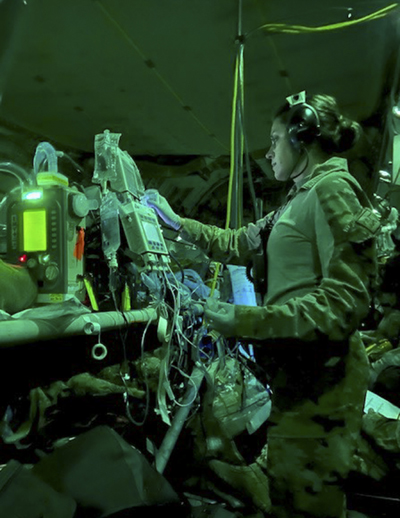
“I answered it [the phone], and it was my doc,” Maj. Katie Lunning recalls. “He said, ‘There’s been an explosion at HKIA [Hamid Karzai International Airport]. Get your stuff. We’re going back right now.’ No notice — just get back to the airplane this second.”
Then a captain, she had just returned to her room at Al Udeid Air Base in Qatar on Aug. 26, 2021. A critical care nurse on a Critical Care Air Transport Team, she had completed a round trip to HKIA in Kabul, Afghanistan, to evacuate patients and had been awake for about 30 hours.
“CCATT members don’t have guaranteed crew rest after a mission — time set aside to rest and recover,” she explains.
A suicide bomber had struck HKIA’s Abbey Gate, killing 13 American service members and more than 150 Afghans and wounding many others. Lunning’s team was sent back to evacuate the most critical patients.
“We had no idea what we were flying into,” she says. “We didn’t know how many casualties there would be, what types of patients we would see or how many people needed help. We knew absolutely nothing.”
No security team — just me, my doctor, my respiratory therapist and our M-9s.
—Maj. Katie Lunning of the Minnesota Air National Guard’s Critical Care Air Transport Team during the Afghanistan withdrawal
‘I love nursing’
After about 10 years as an enlisted Airman, Lunning commissioned in the Minnesota Air Guard.
“I was a nurse on the outside, and to be a nurse in the National Guard you have to be an officer,” she says. “So, I decided, ‘I love nursing,’ and I wanted nursing to be part of my military career, too.”
Like all Guardsmen, she served both her community and country. Her civilian work as a Department of Veterans Affairs nurse strengthened the skills she brought to her military role.
“I started working at the VA in Minneapolis in the intensive care unit,” Lunning says. “That gave me a lot of critical-care experience. I worked in the medical ICU and later moved to the surgical ICU.”
That experience proved invaluable when she moved from the 133rd Airlift Wing’s Domestic Operations Medical Response Team to CCATT in 2018 and became fully validated in 2020.
“CCATT is a three-person team made up of a critical care physician, critical care nurse and critical care respiratory therapist,” she says. “The team provides ICU-level care in flight for the most critically injured or ill patients while moving them to a higher level of care.”
The year 2020 was especially difficult for nurses and the Guard, and Lunning spent long stretches away from her daughter.
“My daughter had already experienced me being gone for a couple of months during the worst of COVID that winter, so she understood what it meant to have Mom away,” she says. “She doesn’t like it, but I want to set a good example for her. I want her to understand why we work hard and serve people beyond ourselves.”
Short notice
In 2021, she learned about a short-notice deployment opportunity with the 379th Aeromedical Evacuation Squadron.
“So, I found out in May; I accepted it,” Lunning says. “And by July 5, I was flying to Travis Air Force Base [California] to start my COVID quarantine. … I left for Al Udeid on July 17, 2021.”
With the support of her husband, who serves in the Army Guard full time, she was able to get her affairs in order quickly and prepare for the deployment.
Upon arriving in Qatar, there were two full CCATT teams and Lunning expected a routine deployment. However, an injury and a family hardship took away almost a full team.
“So, when all the chaos in Afghanistan started, we were down to two doctors, one nurse and one respiratory therapist,” which left her with no backup. From there, the situation deteriorated even further.
‘Scary stuff we can’t control’
As the Taliban swept across Afghanistan, President Ashraf Ghani fled on Aug. 15, 2021, and desperate civilians overran HKIA in search of a way out.
“People flooded onto the flightline,” Lunning recalls. “There were three C-17s parked there, each with a U.S. flag on its tail. And what does that flag represent to most of us? Freedom. So, they ran for those airplanes.”
Her flights began Aug. 18, after U.S. forces regained control of the airfield. Like Wulforst nearly 20 years earlier, she focused on the positive, looking for ways to cope with danger and uncertainty.
“We got these intel briefs before we would fly,” she says. “They would tell us rockets were being fired at the airplanes. My respiratory therapist looked at me and said, ‘Scary stuff we can’t control.’ That became what we told each other. We couldn’t control the environment, so we focused on the work: getting to our patients and getting them out.”
Under normal circumstances, a CCATT flight carried three or four patients, each retrieved and brought back to the aircraft one at a time.
“We have to go to them to put them on our own equipment, because most are on ventilators and life-supporting medications,” Lunning explains. “The Coalition hospital where we picked up patients was run by Norwegian and U.S. Air Force staff about two and a half blocks inside Kabul. We were landing in an unsecured city under Taliban control, with no security team — just me, my doctor, my respiratory therapist and our M-9s.”
Lunning had just returned from her sixth flight when the suicide bomber struck.
Abbey Gate
When Lunning arrived at HKIA this time, conditions had deteriorated. What had already been chaotic “had become much more intense. The crowds had scattered, but it had been replaced with fighting.”
Running on adrenaline, she repeated her mantra: “Scary stuff we can’t control.” Then she headed down a familiar route through newly hostile territory. Lunning frequently walked beside the Taliban as she retrieved and treated critically wounded patients.
She triaged and received 22 patients — far more than the usual three — before they boarded an eight-hour aeromedical evacuation flight to Landstuhl, Germany.
The mission also brought a different mix of patients. Earlier flights had carried only Afghans; this one, Lunning says, included “a mixture of Marine casualties and Afghan casualties.”
The patients were far less stable than usual. “The biggest challenge that we had were these patients were not flight worthy,” she adds. “Normally, CCATT would not fly unstable people who were fresh out of surgery, but there was no time. We had to take them out because there were so many other patients.”
“One of the Marines was an ‘open chest,’ meaning he arrived at the little Norwegian hospital without a pulse,” Lunning explains. “They opened his chest, found the source of the bleeding and stopped it. He had chest tubes coming out of everywhere.”
She and her team kept all 22 patients alive during the flight to Landstuhl — an evacuation later recognized as the largest single aeromedical airlift in the Kabul Coalition Hospital’s history.
The end of the end
Lunning saw the same kind of community that Wulforst had witnessed. “I think it was just an amazing display of teamwork, between branches, between service members who had never met, everybody coming together for a common goal,” she says.
That sense of community helped carry her through an extraordinarily difficult time — one that placed her at the end of the U.S. presence in Afghanistan.
“I was on the final flights to Afghanistan for the final withdrawal out of Kabul. There was no more medical support on the ground,” the Minnesota Air Guard nurse says. “So, we were there to provide any sort of medical support. And then we were the last airplane out of Afghanistan.”
In early 2023, Lunning, then newly promoted to major, and her CCATT teammates received the Distinguished Flying Cross for their actions, making her the first Air Guard nurse to earn the award.
“I was humbled and overwhelmed,” she says. “It’s a very rare and prestigious award. I was very happy that the medical community, specifically nursing, is being recognized. I’m glad to bring awareness for what the National Guard can do, and what nursing is involved with as well.”
Wulforst and Lunning reflect some of the distinctive strengths the Guard brings to the fight.
“My civilian training was invaluable to this experience,” Lunning says. “I got my skills on the outside. That is one of the strengths of being that citizen-Soldier, citizen-Airman. Being a nurse is my dayto-day job; I work all the time in critical care.”
For Wulforst, Guard service also fulfilled a personal desire to serve. “I think in my particular circumstance, the Guard filled a personal need, not necessarily a financial need.”
But service also brings sacrifice, including time away from family, he says.
In 2004, Wulforst deployed to Iraq with D Company of New York’s “Fighting 69th,” the same unit he had worked alongside after Sept. 11.
When he came home, he returned to a family that had endured his deployments, the World Trade Center response and the missed birthdays and weddings that can come with Guard service.
Lunning says she serves for her daughter: “I hope for her, looking back someday, she’ll realize that women can do amazing things, nurses can do amazing things. And I hope she’s proud of her mom.”
The uniform she wore and some of the tools she carried in Afghanistan are on exhibit in the National Guard Memorial Museum.
WILL ROULETT serves as deputy director of the National Guard Educational Foundation and curator of the National Guard Memorial Museum in Washington, D.C. He holds a master’s degree in history from Rutgers University. He can be reached at [email protected].
TOP PHOTO: Guardsmen march toward Ground Zero to aid rescue efforts September 12. (AP PHOTO/BETH KEISER)