then Add to Home Screen.
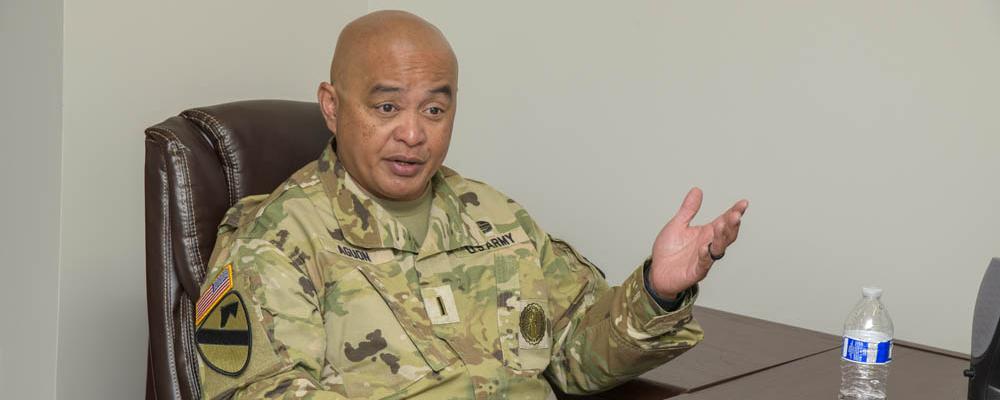
A Conversation with CW5 Bernard Aguon, Command Chief Warrant Officer of the Army National Guard
What does a warrant officer do? It’s a question Chief Warrant Officer 5 Bernard Aguon has heard repeatedly in his nearly 37 years in uniform.
The answer comes easy to the Army National Guard’s new command chief warrant officer. More importantly, one of his initiatives is demystifying his cohort to the rest of the force.
“Warrant officers play a critical role in maintaining readiness,” he recently told NATIONAL GUARD. “When you look at what we do, all things readiness, you’ve got a warrant officer behind it. So, knowing what I know about warrant officer involvement, I think the missing piece now is just awareness.”
Aguon, a longtime Guam Army Guardsman, sat down with the magazine July 1 at the National Guard Memorial, the NGAUS headquarters in Washington, D.C.
The wide-ranging interview covered his responsibilities, which began with serving as the primary advocate for the Army Guard’s 9,100 warrant officers nationwide, and his priorities for mentoring his cohort. He also discussed how Army Guard warrant officers are helping the Air Guard develop its small but growing number of new warrant officers.
One of your principal responsibilities is to advise the director of the Army National Guard on matters relating to Army National Guard Warrant Officers. How do you stay current with developments within the Army Guard warrant officer cohort across the 50 states, three territories and the District of Columbia?
There are several different opportunities I use. We meet virtually every month with the Warrant Officer Senior Advisory Council, which includes the command chief warrant officers across the 54. We also meet in person at least twice a year. In addition, we have regional warrant officer senior advisory council meetings. I also go to warrant officer candidate school graduations and meet with the Soldiers there as well as those attending some of the more senior warrant officer professional military education sessions.
I use the opportunities to engage with our up-and-coming warrants and our seasoned warrants, and I take what I learn back to the director to keep him informed on what’s going on. We also have warrant officers inside the Army National Guard Temple Army Readiness Center [in Arlington, Virginia]. We have senior warrant officers working at every directorate there.
And then one of the real key things that I use, and you’ll hear this quite often from me, is I meet with the staff and our liaison officers at the Army Centers of Excellence, getting some of the information back from what Army proponents are doing as it relates to warrant officer development. I also take that back and keep the boss informed.
What experiences do you draw from that motivate you to want to have a positive impact on the Army National Guard and Army National Guard warrant officer cohort?
I look at my experiences, most recently as a command chief warrant officer in the District of Columbia, and I remember in my time there that we helped build our warrant officer structure to optimal levels. But what I like to see is our enlisted folks, our NCOs, come in and ask for letters of recommendation to become a warrant officer. It brings me a lot of joy to see the development of that Soldier ultimately becoming a warrant officer.
So, in my experience, what we’ve done is we’ve had a lot of mentorship sessions with the enlisted force. I knew early on as the command chief that one of the most important figures that we must develop a relationship within any command is the senior enlisted of that organization. Almost immediately, wherever I go, I seek out the sergeant major because I think it’s important to develop that relationship with the enlisted force, with the noncommissioned officers, knowing that’s our talent pool, our primary pool of accession, because warrant officers come up from the enlisted corps.
You’re still new in the position. What are your priorities?
My leadership philosophy is “warrant officer excellence,” and embedded in that warrant officer excellence is a three-point call to action.
The first thing is that warrant officers should remain technical experts, and that’s exactly what the Army expects the warrant officer to become. Warrant officers are technical experts. We’re the system integrators, the masters of the craft. We are subject matter experts who understand, operate and manage Army systems — you name it, from HR to logistics to cyber to aviation.
And take that technical expertise and use it to mentor, to coach, to educate both our junior warrant officers coming up and others, including our leaders and our communities. That’s the first thing: Remain a technical expert.
The second thing is to be what I like to call not just a problem solver, but a problem preventer. When you are a problem solver, what are you doing? Solving an existing problem. You get a problem preventer out there, and now you’re getting after issues before they become problems.
Chief is out there, the chief is in the motor pool, chief is in the hangar, the chief is in the MI center, the chief is in the HR department, the chief is in the supply room. The chief is in what I call daily operations. So, my charge to Army National Guard warrant officers is to stay involved, stay connected, stay exposed to daily operations. You must have your ear on the ground.
When you’re in that environment, you’re more adept at being a problem preventer because when you’re not, you’re removed from that. Now, you’re probably problem solving, right? And it’s why the warrant officer is so embedded in daily operations. We have that opportunity to connect, to help prevent problems. So be problem preventers. Our leaders are asking for it. Leadership comes to the warrant officer, and they say, “Hey, chief, here’s what’s going on.” We need to say, “Hey, sir, ma’am, we can avoid doing this by executing such and such.”
The third thing is that we, as warrant officers, need to be relevant lifelong learners. Our knowledge today has an “as-of” date. Things are changing so fast. You’ve got emerging technologies. You’ve got multi-domain platforms. You’ve got digital systems. And all these things have warrant officer fingerprints all over them. But we are only good at what we do if we stay relevant, and so we must be lifelong learners.
Those are the three calls to action. And then what I ask warrant officers to do is bowtie them with a unified voice and the right attitude. So, a unified voice, meaning not just a warrant officer unified voice, but a unified voice with your command leadership team, a unified voice with our organization, with the unified voice with the entire enterprise, and not working in a silo, right? That’s where my priorities are right now.
Warrant officers need to be relevant lifelong learners. Our knowledge today has an ‘as-of’ date. Things are changing so fast.
The Army National Guard warrant officer cohort has long been less than 100% of its authorized end strength. What is being done to increase recruiting and retention?
We see a lot of challenges. Our warrant officer talent pool, as I stated earlier, comes primarily from the enlisted force. For aviation, we also have programs such as “Street to Seat,” which can bring someone in and move them toward flight school. But our technical warrant officers are predominantly pulled from the enlisted force.
As the Army continues to transform and modernize, we have to keep building that talent pool. One of the programs I’ve been promoting is the Warrant Officer Candidate Accession Program, or WOCAP. It’s a pilot program that several states are using to bring interested enlisted Soldiers in during drill weekends and prepare them for that next level of warrant officer training.
WOCAP targets the areas the schoolhouses have told us challenge many candidates, including land navigation, fitness and leadership skills. The goal is to improve our success rates. We don’t want to simply send candidates to Warrant Officer Candidate School and then see them return without completing the course. We want to prepare them before they get there.
We are also working closely with the Army Centers of Excellence to advocate for Army National Guard candidates and help proponents better understand the unique experience our Citizen-Soldiers bring. Many of them work every day in fields such as human resources, cyber, logistics and aviation, and they bring that civilian experience and expertise back to the Guard.
So, through WOCAP, stronger advocacy and better recognition of the talent already in our formations, I believe we can improve our warrant officer accessions and continue building the cohort.
Warrant officers comprise only about 3% of the Army National Guard. Many personnel and officers don’t have much contact with them. What do you want the rest of the force to understand about Army Guard warrant officers and the role they play in training and readiness?
That’s a good one, and I say that because over the course of my career, some 37 years, what I’ve seen is that we are kind of mysterious. What does the warrant officer do? Hey, what is chief doing? And what I’m trying to do with our Warrant Officer Senior Advisory Councils and inside the TARC with Temple Army Readiness Center senior warrants is to bring greater awareness to what warrant officers do.
I’ll tell you, warrant officers play a critical role in maintaining readiness. When you look at what we do, all things readiness, you’ve got a warrant officer behind it. So, knowing what I know about warrant officer involvement, I think the link now, the missing piece, is just awareness.
You take me as an example, the Army National Guard command chief warrant officer, and then my colleagues, the CCWOs who are arrayed across the 54. We’re not just advising the adjutants general or the commanding generals or the director of Army National Guard. We’re also mentoring. We’re also training. We’re also advising others. We’re partnering with our other leaders inside of the command. We do policy building. What we are is the trusted counselors, those resident mentors that are in our formations.
Awareness is something I am targeting during my tenure as the command chief to highlight and show that the warrant officer is truly doing so much more.
You say warrant officers are technical experts. Are warrant officers also leaders?
Absolutely. When you look at where the warrant officer fits in the structure of a unit, we’re nested between the enlisted and the commissioned officers. We are leaders. We are the lead system integrators, system managers in every modality that we operate in.
Some warrant officers are also “green tabbers.” Every Army Guard band is commanded by a warrant officer. There’s a leader right there. When you look at aviation, a lot of our detachments in the fixed-wing area are commanded by a warrant officer. There’s another formal leader. Even in our rotary units, you have pilots in command. You also see warrant officer leadership in our Special Forces units.
And let’s not forget the obvious: the command chief warrant officer. A command chief warrant officer sits at the table with the general, be it the adjutant general of a state, a commanding general or, in my case, the director of the Army National Guard, and the sergeant major, that senior enlisted leader. “Command” is embedded in the title.
Now look at our chief warrant officer of the Army. For many, many years, the chief warrant officer of the Army was a senior warrant officer advisor working in the chief of staff’s office. A few years back, in July of 2024, the chief of staff of the Army chartered the newest position to that staff. So, everybody knows about sergeant major of the Army, the SMA. Everybody knows about the CSA, the chief of staff of the Army. Well, now we have the CWA, the chief warrant officer of the Army. So, there’s a leader in himself right there, and we’re so happy that he has evolved into somebody who’s now, and I like to use this phrase, at the table and not on the menu.
We’re not just technical experts. And what’s unique and what’s beautiful about that is we’re leaders, but it doesn’t take away that we’re still technical experts. So, you’ve got both, the best of both worlds.
Warrant officers play a critical role in maintaining readiness.
How do you see the professional military education changing for warrant officers in the years ahead? Specifically, Army National Guard warrant officers?
Professional military education, we’ve already modernized it. A few years back, the U.S. Army warrant officer leadership formed working groups to modernize our PME. What’s happening is we now embed in our curriculum more of that leadership quality, while still reinforcing our technical value.
So, the warrant officer professional military education standards are elevated, if you will, to reflect some of the commonality that you see in a War College or a sergeants major academy. We’ve taken that because it’s the same institutions that are teaching those courses that have provided guidance and the framework for what we’re doing in our warrant officer education system.
Looking at the models and speaking with our Army National Guard warrant officers, I’m encouraging them to get out there and learn more about leadership while still being that technical tactical expert.
Warrant officers returned to the Air Force in 2024. The Air National Guard now has about 100 warrant officers, all of them in cyber or IT fields. Is your office playing a role in advising the Air National Guard as it develops its WO cohort?
We are, and what we’ve done is taken on a big-brother approach. We Army National Guard command chief warrant officers, we see the growing number of Air Guard warrant officers, and I feel like for the National Guard at large, we have an advantage because we are working closely. I mean that’s how we’re designed. Go to a state joint force headquarters and it’s joint — you’ve got Army and Air.
So, what we’ve done as the Army National Guard Warrant Officer Senior Advisory Council, our senior warrants across the Guard, is we’ve taken the approach of, “Hey, Air National Guard warrant officers, while the structure continues to be developed for you , we’re going to take you on. We’re going to help mentor you.” It’s what we’ve done. We’ve mentored, we’ve coached, we’ve trained, we’ve encouraged, we’ve provided information, we’ve provided directional guidance.
And the reason why we’re able to do that is because our Air Guard members are part of our organization. We have a great opportunity to be influential and to really care for them, which, at the bottom of all of this, is what it’s about. It’s caring for our own because Air Guard, Army Guard doesn’t matter, we’re a National Guard.
Anything else you’d like to add?
I would like to share something about my command coin. It has a very simple design. On one side is a rising eagle, the symbol of our warrant officer ranks. The other side shows we are combat ready, THIS WE'LL DEFEND. But surrounding the coin are chain links. Someone once asked me, “Chief, what do the chain links symbolize?” The chain links represent the link between intent and execution.
Warrant officers across the Army National Guard operate in a unique space. We talked about emerging technologies, multi-domain platforms, we’re working in continual transformation, large-scale combat operations, you name it. We are value propositioned across the world. We’re working Title 10 missions, all things Epic Fury, Spartan Shield, down to the homeland defense of our nation.
Warrant officers are there, and we are the absolute link, the unbreakable link between intent and execution. That’s what we have to offer. That’s what we’re delivering to our formations and to our leadership.
PHOTO CREDIT: PAUL GILLIS
AT A GLANCE: Chief Warrant Officer 5 Bernard Aguon
BORN: 1971 in Tamuning, Guam
FAMILY: Wife (Jennifer), four children
CIVILIAN EDUCATION: Liberty University, Lynchburg, Va., B.S. Business Administration
MILITARY SERVICE: Army Reserve, 1990-2003; Regular Army, 2003-2008; Guam Army National Guard, 2008-present
COMMISSIONING SOURCE: Army Warrant Officer Candidate School, Fort Rucker, Ala., 2008
MILITARY EDUCATION: General Construction Equipment Operators Course, Fort Leonard Wood, Mo.; Administrative Specialist Course, Fort Jackson, S.C.; Human Resources Warrant Officer Basic Course, Fort Jackson, S.C.; Human Resources Warrant Officer Advanced Course, Fort Jackson, S.C.; Warrant Officer Intermediate Level Education Course, Fort Rucker, Ala.; Warrant Officer Senior Service Education Course, Fort Rucker, Ala.
PREVIOUS ASSIGNMENTS: Command Chief Warrant Officer, District of Columbia Army National Guard, 2024-2025; Senior Personnel Advisor, Human Resource Information Systems Division, National Guard Bureau G1, 2021-2024; Senior HR Technician, Personnel Services Division, NGB G1, 2017-2021; Chief, Officer Personnel Management Branch, Joint Forces Headquarters G1, Guam National Guard, 2012-2017
OVERSEAS OPERATIONS: Operation Iraqi Freedom
ALSO NOTABLE: Inducted into the U.S. Army Adjutant General Corps of Distinguished Members in 2023 and has a permanent display in the AG Corps Hall of Fame in Fort Jackson, S.C., for his leadership in helping to develop the Integrated Personnel and Pay System. He is also a member and past president of the U.S. Army Warrant Officer Arlington Hall Minute Silver Chapter and a life member of both the U.S. Army Warrant Association and NGAUS. Played baseball growing up on several village and all-star teams and in the Guam Major League.
Source: National Guard Bureau