then Add to Home Screen.

Why the Guard Needs Counter-UAS Capabilities
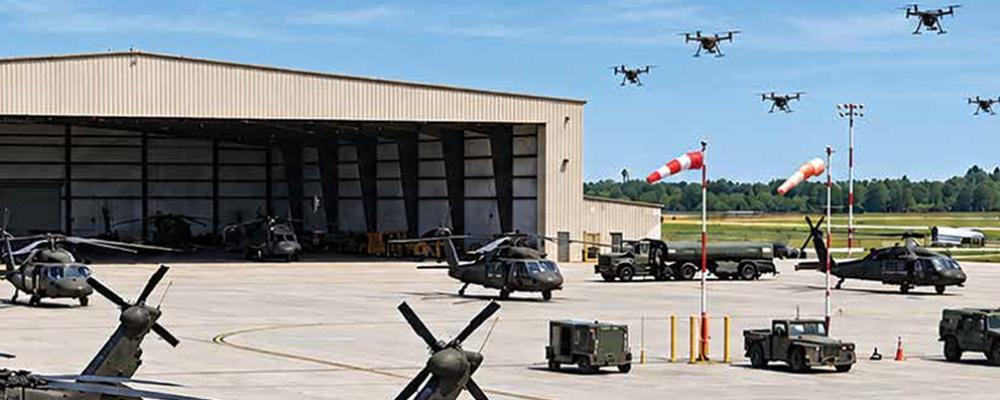
It is a sunny Saturday afternoon, six hours into a drill weekend. Twenty-two aircraft occupy the flightline. Some are returning from training flights while others undergo maintenance. Fuel trucks move between aircraft as crews prepare for the coming night missions. Dozens of other National Guardsmen spread across the flightline carrying out their assigned duties.
Without warning, the high-pitched, buzzing whine of several drones fills the air.
Seconds later, the flightline erupts into chaos. Drones release explosive payloads or deliberately crash into vulnerable aircraft and their crews. Other personnel scramble for cover, unable to defend themselves or their equipment.
Fences, barriers, access-control systems and guarded gates designed to stop traditional threats provide no defense against an attack from above.
In the days that follow, graphic footage dominates the news. Pentagon officials struggle to explain why such a foreseeable threat was never adequately prioritized. Dozens are dead or wounded, hundreds of millions of dollars in aircraft and equipment have been destroyed, and the attack occurred not on a distant battlefield but within the sanctuary of the American homeland.
While hypothetical, this scenario is not unrealistic.
The rapid proliferation of UAS technology has fundamentally changed the security environment, creating vulnerabilities that current physical security measures fail to address. The general lack of protection combined with the low barrier to entry for anyone with ill-intent offers ample opportunity to do great harm and hold facilities, equipment and personnel at risk— both overseas and at home.
Counter-UAS should therefore be viewed as a necessary layer of physical security to ensure infrastructure and critical asset defense as well as force protection and assured response for homeland defense and public safety.
Fixed-site defense
Installation commanders and managers have a duty to protect their tenant units and employees from foreseeable threats. This is why we install fences, vehicle barriers, access control points, closed-circuit TV, etc. UAS represents the newest threat to physical security and organizations have a responsibility to ensure that they understand the threat, establish security requirements and resource those requirements with effective measures just as they have in the cyber domain and through current physical and operational security imperatives.
Incorporating c-UAS into installation security plans is essential to protecting personnel, aircraft, equipment and infrastructure critical to both power projection and domestic emergency response.
Force protection
Drones have fundamentally changed the character of risk to force and risk to mission. Commercially available UAS now use autonomous navigation, extended range, precision flight and payload-delivery capabilities. They can conduct surveillance, interfere with emergency operations, collect intelligence, damage critical infrastructure, or directly threaten personnel and equipment with little warning.
For the Guard, these risks are real. The Guard routinely supports operations at disaster response sites, planned high-profile, public events and during episodes of civil-unrest and riots — the very environments where malicious or unauthorized drones can create significant operational challenges and pose real threats to personnel.
Furthermore, during wildfire suppression or hurricane recovery, airspace itself becomes a critical operational resource. Helicopters, fixed-wing aircraft and unmanned systems all work together to save lives and deliver aid. An unauthorized drone is far more than a nuisance and poses significant hazards to flight operations, putting the lives of aircrews at risk.
Emergency response
Public safety has always been at the heart of the Guard. Whether responding to natural disasters, protecting critical infrastructure or supporting major public events, the Guard provides reassurance that trained professionals stand ready to respond when communities need them most.
As threats evolve, that reassurance must also extend to the airspace above the event or incident. Ensuring the Guard has effective c-UAS capabilities is therefore not about expanding its responsibilities. It is about enabling the force to continue fulfilling the responsibilities it has always carried in an increasingly complex security environment, and with the tools and authorities to effectively respond to the UAS threat.
Effectively addressing the UAS threat requires a chain that looks something like this:
■ Detection: this provides both situational awareness and data collection and generally does not require special authorities
■ Analysis: Determination and classification of the UAS as a threat
■ Mitigation: Kinetic or nonkinetic measures to defeat the threat, generally requiring specific authorities
Detection and analysis
For most routine c-UAS activities, detection allows the force to understand the airspace in real time, and when combined with a Common Operating Picture, to rapidly share that understanding with partner agencies, and to support informed operational decisions. Further aggregation of this data over time builds a broader understanding of UAS activity, identifies emerging trends, informs threat assessments and supports future decisions on requirements, prioritization and resourcing. This shared picture benefits not only the Guard but the broader interagency community responsible for protecting the homeland.
From an operational perspective, the Guard’s most immediate requirement is persistent situational awareness. A force that cannot see the threat cannot effectively coordinate a response, contribute to a shared intelligence picture or make informed decisions on force protection. Situational awareness starts at the installation perimeter but must extend across the span of the operational time and space.
Addressing the UAS threat will require thoughtful investment in manpower, equipment, training and doctrine to ensure the Guard remains prepared to defend the homeland.
Mitigation
This involves acting to directly or indirectly eliminate the threat. Depending on the circumstances, this may include nonkinetic capabilities, effects in the electromagnetic spectrum or kinetic defeat systems. Mitigation also manifests as action to identify the controller’s location and deny his ability to operate (through arrest, seizure, etc.). Those actions generally require specific statutory authorities and clearly defined rules governing their employment.
Not all mitigation relies on advanced technology. Passive protective measures — including overhead netting, hardened shelters, protective structures and other physical barriers — can provide an additional layer of defense for high-value assets. Like traditional security measures, these systems complement rather than replace detection and active mitigation capabilities.
Constraints/restraints on mitigation
These capabilities must also develop within the legal framework governing domestic military operations. The Guard has repeatedly adapted policy as new technologies emerged while maintaining accountability and protecting civil liberties.
A recent example is the employment of the Guard’s own unmanned aircraft. To avoid airspace conflicts and ensure proper intelligence oversight, units had to submit Proper Use Memorandums identifying where, how and why UAS would be employed before operations began. Policy evolved alongside technology, allowing new capabilities to be used responsibly while maintaining public trust.
Counter-UAS capabilities should evolve in the same way. Early detection supports lawful, measured decision-making by reducing uncertainty and allowing commanders to coordinate with agencies possessing the appropriate authorities before situations escalate. Detection also provides operators with system familiarity that will be very necessary when they do have the authority for mitigation and tactical decisions that will need to be made in a matter of seconds.
In extreme circumstances, such as the scenario in the outset, having the right systems in place and being familiar with their employment will provide commanders with that In Extremis option for immediate defense of life and property.
The Congressional Research Service has noted that the rapid growth of drone technology has outpaced the development of comprehensive domestic countermeasures. That gap is more than a technological concern — it is an operational vulnerability that directly affects the Guard’s ability to protect personnel, accomplish its mission and support civil authorities.
Legal authority is a good starting point. Guardsmen face significant challenges accessing legal authorities to support federal or State law enforcement and while Title 10 (full federal status) provides authority to protect critical military assets from drone threats, it does not extend to Guardsmen in a Title 32 (state) status.
Beyond authorities alone, however, the Guard must also receive the resources necessary to posture the force for persistent fixed-site defense, planned security operations, and emergency response. Addressing the UAS threat will require thoughtful investment in manpower, equipment, training and doctrine to ensure the Guard remains prepared to defend the homeland.
Fixed-site defense provides perhaps the clearest justification for expanding the Guard’s c-UAS capabilities and authorities because installation commanders have a duty to protect tenant units, Soldiers, Airmen, civilian employees, and the high-value assets entrusted to them.
The Guard needs c-UAS capabilities and authorities to defend the homeland. Few institutions carry the public trust and operational responsibility of the Army and Air Guard. Living within the communities they serve, Guardsmen respond during hurricanes, wildfires, civil disturbances, and major public events where public safety cannot be left to chance. Unlike forces operating primarily overseas, the Guard routinely serves in neighborhoods, cities and around critical infrastructure where national security and daily life intersect.
That close connection to the public makes the Guard indispensable, but it also makes drone threats uniquely urgent. Throughout its history, the Guard has adapted and evolved to meet the intensifying demands of domestic security. Today, that evolution must include preparing for an airspace that can no longer be assumed to be secure.
The same challenges exist during large public events where the Guard works alongside local, state, and federal agencies. A drone operating overhead introduces uncertainty into an already complex environment, particularly when responders lack the ability to identify the aircraft, determine its intent, or rapidly share that information with partner organizations. Counter-UAS capabilities are therefore not an expansion of the Guard’s traditional mission, but a necessary evolution of its longstanding homeland defense and public safety responsibilities.
The Guard has repeatedly demonstrated its ability to adapt to emerging challenges while preserving its core identity. Whether integrating advanced communications, modern logistics, cyber capabilities, or its own unmanned aircraft, the Guard has consistently evolved to meet changing operational demands.
Counter-UAS represents the next challenge in that evolution. What makes today’s challenge different is the pace at which it is advancing. Drones are becoming more capable while simultaneously becoming more accessible. Capabilities once limited to sophisticated military systems are increasingly available on commercially produced platforms. As this technology continues to mature, unmanned aircraft will become a permanent feature of the homeland operational environment rather than an occasional anomaly.
The Guard has never been defined by the challenges it faces, but by its ability to adapt to them. Meeting the UAS threat will require the same qualities that have characterized the Guard for generations: foresight, coordination, disciplined execution, and an unwavering commitment to homeland defense and public service.
Returning to the opening scenario, the question should not be whether such an attack is imaginable, but whether we have taken the necessary steps to ensure it never succeeds. The threat is real, the technology exists and the operational requirement is increasingly evident. What remains is the commitment to provide the Guard with the authorities, resources, training and capabilities necessary to meet it.
“Always Ready, Always There” is more than a motto. In an era where threats increasingly arrive from above, it must also mean that the Guard is properly postured, equipped and prepared to defend the homeland against them.
RETIRED BRIG. GEN. DAVID DORAN is a former Assistant Director of the Army National Guard for Aviation, Intelligence and Information. Originally, an Oregon Army Guard aviator, he flew CH-47D Chinook helicopters in Afghanistan and C-23 Sherpa fixed-wing aircraft in Iraq. He holds a law degree from the University of Seattle Law School and is currently a strategic advisor to DroneShield.
TOP PHOTO: An image produced by an artificial-intelligence program depicts attack drones descending on an Army Guard aviation support facility. (CHAT GPT/ BONOTOM STUDIO, INC.)
OUR TAKE

Enhancing unmanned aerial system/counter-UAS capabilities and authorities is a top NGAUS legislative priority. The association is working with Congress to expand authorities and increase dedicated funding to support future acquisition, fielding and manning of c-UAS equipment.